
Inverse operations
Inverse operations undo each other: + undoes −, and × undoes ÷. They are how you solve equations. A quiz for kids, parent help below.
🧒 Kids: undo it!
Adding 7 then taking away 7 gets you back where you started. That is an inverse! Use inverses to get x on its own. Then try the quiz.
💡 Trick: 3x + 7 = 22: take away the 7 first, then divide by 3. x = 5!
More equations: What is an equation · Variables · Algebraic expressions · Evaluating expressions · Writing expressions · Inverse operations
This part is for grown-ups: the key idea, pictures to draw, what to say, common mistakes, questions with answers and a free worksheet.
The trick: undo the last step first
Every operation has an inverse that undoes it. To get x on its own, undo what was done to x, starting with the last operation. Do each inverse to both sides of the equation.
- + 9: undo with − 9
- × 4: undo with ÷ 4
- ÷ 2: undo with × 2
- x + 5 = 12: subtract 5: x = 7
Patterns to spot
- Adding and subtracting the same number gets you back to the start.
- Multiplying and dividing by the same number gets you back to the start.
- Undoing happens in reverse order, like rewinding a video.
- Whatever you undo on one side, you undo on the other.
- Fact families show inverses: 3 × 4 = 12, so 12 ÷ 4 = 3.
- Squaring and square roots are inverses too (grade 8).
Key words
- Inverse operation: the operation that undoes another: + and − are inverses, × and ÷ are inverses.
- Undo: get back to the starting number.
- Isolate: get the variable on its own on one side.
- Both sides: every move in an equation is done to the left and right sides.
- Reverse order: undo the last step first.
Why it matters: Inverse operations are the engine of solving equations. Every equation, from x + 4 = 9 to 3(x − 2) = 4x + 1, is solved by undoing operations in reverse order on both sides.
See it: pictures to draw with your child
Draw these on paper or a whiteboard. A quick sketch makes the idea concrete before any rules.
What your child already knows
Children already know fact families: 4 + 5 = 9 means 9 − 5 = 4, and 3 × 6 = 18 means 18 ÷ 6 = 3. Inverse operations are fact families used on purpose to find an unknown.
In real life: Working backwards is everyday thinking. If you spent $7 and have $15 left, you started with 15 + 7 = $22. If 3 friends split a bill and each paid $8, the bill was 3 × 8 = $24.
Undo in reverse order
If you put on socks and then shoes, you take off the shoes first. Equations work the same way: undo the last operation first.
In 3x + 7 = 22, x was multiplied by 3 and then 7 was added. So undo the + 7 first (subtract 7) and the × 3 last (divide by 3).
A function machine shows this clearly: run it forwards to build the equation, then backwards with the inverse operations to solve it.
Brackets change the order. In 3(x + 2) = 21, the + 2 happens first inside the brackets, so it is undone last: divide by 3 to get x + 2 = 7, then subtract 2.
Worked examples
Example 1: One step
- Solve x − 6 = 10.
- The 6 was subtracted, so add 6 to both sides: x = 16.
Example 2: Multiply
- Solve 5x = 35. x was multiplied by 5, so divide both sides by 5: x = 7.
Example 3: Two steps
- Solve 4x + 3 = 23.
- Undo + 3 first: 4x = 20.
- Then undo × 4: x = 5.
Example 4: Divide then subtract
- Solve x ÷ 2 − 4 = 6.
- Undo − 4 first: x ÷ 2 = 10.
- Then undo ÷ 2: x = 20.
- Check: 20 ÷ 2 − 4 = 6.
Common mistakes
What to say to your child
A short script for your first session. Pause after each line and let your child answer.
- “What undoes + 7?” (− 7.)
- “What undoes × 3?” (÷ 3.)
- “In 3x + 7 = 22, what was done to x first?” (× 3.)
- “So what do we undo first?” (The + 7.)
- “What is x?” (5.)
Questions to try (answers below)
Ask these out loud or write them down. The last one is a stretch.
- What undoes − 8?
- What undoes ÷ 5?
- x + 11 = 20
- x − 4 = 13
- 6x = 42
- x ÷ 3 = 9
- First step for 2x + 5 = 17?
- 2x + 5 = 17
- Stretch: (x − 3) ÷ 2 = 5
Show the answers
- + 8
- × 5
- 9
- 17
- 7
- 27
- Subtract 5
- 6
- 13
Games to play at home
Number machine
Your child secretly picks a number, does “× 2 + 3” and tells you the result. You undo it to find their number.
Rewind the day
Describe getting dressed, then list the undressing steps in reverse order.
Fact family triangles
Draw triangles with 3 numbers and say all four facts.
A 5-day plan for inverse operations
Ten minutes a day is enough. Short, regular practice works far better than one long session.
- Day 1: Learn it with real things: a kitchen scale, cups and counters, or the pictures above.
- Day 2: Read the script together, then ask the first four questions.
- Day 3: Do the quiz at the top of the page and read the hints for anything missed.
- Day 4: Play one of the games at home for ten minutes.
- Day 5: Ask the rest of the questions, then do a round of the matching equation practice skill.
By grade
Grade 6 (Common Core 6.EE.B.7) solves one-step equations with inverse operations. Grade 7 (7.EE.B.4a) uses them in two steps, and grade 8 adds square roots. In India, this is the heart of the class 7 chapter “Finding the Unknown”.
More for each grade: Grade 6 math and the CBSE class 6 maths guide.
What comes next
Next, put inverses to work in one-step equations, then check steps with the equation solver.
Worksheet and more practice
Print a free worksheet with an answer key, or keep practicing online with equation practice.
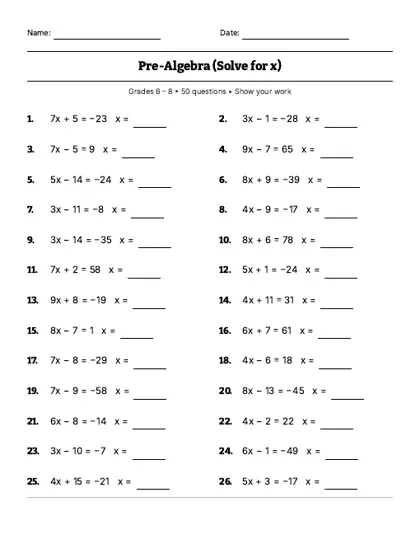 Solving equations
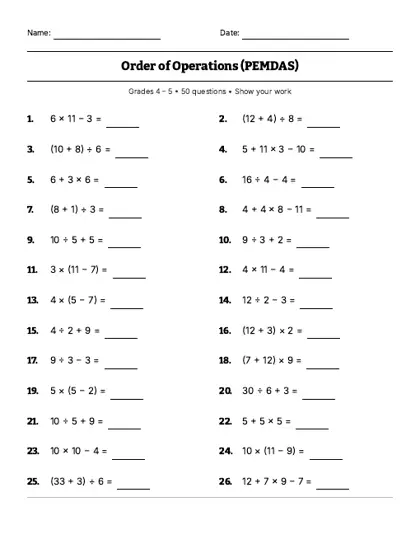 Order of operations
Printable worksheets: evaluating expressions · combining like terms · one-step equations · make a fresh equations test · make an expressions test
More: solving equations for kids · equation solver · balance scale · equation practice · order of operations · integers
Last reviewed
Questions parents ask
What are inverse operations?
Operations that undo each other. Addition and subtraction are inverses, and so are multiplication and division.
What is the inverse of multiplying by 4?
Dividing by 4.
How do inverse operations help solve equations?
They undo what was done to x, one step at a time, until x is on its own.
Which step do you undo first?
The last one that was done. In 3x + 7 = 22, undo the + 7 before the × 3.
What grade learns inverse operations?
Grade 6 under Common Core 6.EE.B.7, building on fact families from grades 1 to 3. In India, class 7.