
What is an equation?
An equation says two amounts are equal, like a balanced scale: 2x + 3 = 11. Pictures and a quiz for kids, parent help below.
🧒 Kids: keep it balanced!
An equation is like a seesaw that is perfectly level. Both sides weigh the same. Find the number that keeps it balanced! Then try the quiz.
💡 Trick: ? + 3 = 8 means “something plus 3 is the same as 8”. The box must be 5!
More equations: What is an equation · Variables · Algebraic expressions · Evaluating expressions · Writing expressions · Inverse operations
This part is for grown-ups: the key idea, pictures to draw, what to say, common mistakes, questions with answers and a free worksheet.
The trick: read = as “is the same as”
An equation has two sides joined by an equals sign, and both sides have the same value. Read the equals sign as “is the same as”. To find an unknown, ask which number makes both sides match.
- 4 + 5 = 9: true: both sides are 9
- 10 = 6 + 3: false: 9 is not 10
- x + 2 = 7: true when x = 5
- 3 + 4 = 5 + 2: true: both sides are 7
Patterns to spot
- An equation always has exactly one equals sign.
- The two sides can be swapped: 8 = x + 3 is the same as x + 3 = 8.
- Doing the same thing to both sides keeps an equation true.
- An expression like 2x + 3 has no equals sign, so it is not an equation.
- Some equations are true for one number, some for none and some for every number.
- Putting the solution back in makes both sides equal.
Key words
- Equation: a number sentence with an equals sign, saying two amounts are the same.
- Equals sign (=): means “is the same as”, not “the answer is”.
- Unknown: a number we don’t know yet, often shown by a letter or a box.
- Solution: the value that makes the equation true.
- True or false: an equation is true when both sides really are equal.
Why it matters: Equations are the language of algebra. Every later topic, from two-step equations to graphs and formulas, starts with the idea that an equation is a balance. Children who see the equals sign as “the same as” make far fewer mistakes later.
See it: pictures to draw with your child
Draw these on paper or a whiteboard. A quick sketch makes the idea concrete before any rules.
What your child already knows
Children already write number sentences like 3 + 4 = 7. They also know fact families, so they can work out the missing number in 3 + ? = 7. An equation with a letter is the same idea, with x in place of the box.
In real life: Sharing sweets fairly, balancing a seesaw and splitting a bill all use equations. If 3 friends pay the same and the bill is $24, then 3x = 24 tells you each person pays $8.
What the equals sign really means
Many children think = means “now write the answer”. So they fill in 8 + 4 = ? + 5 with 12, because 8 + 4 is 12.
The equals sign actually means “is the same as”. Both sides must have the same value, so the missing number is 7: 8 + 4 = 7 + 5.
Try questions with the blank on either side, like 9 = ? + 4 or 3 + ? = 2 + 6. They build the balance idea before any letters appear.
Worked examples
Example 1: Is it true?
- Is 12 − 4 = 2 × 4 true?
- The left side is 8 and the right side is 8.
- Both sides match, so it is true.
Example 2: Find the missing number
- Solve ? + 6 = 15.
- Ask: what plus 6 makes 15?
- The answer is 9, because 9 + 6 = 15.
Example 3: Check a solution
- Is x = 4 a solution of 3x − 2 = 10?
- Put 4 in place of x: 3 × 4 − 2 = 10.
- Both sides are 10, so yes.
Common mistakes
What to say to your child
A short script for your first session. Pause after each line and let your child answer.
- “What does the equals sign mean?” (Is the same as.)
- “Is 5 + 2 = 4 + 3 true?” (Yes, both are 7.)
- “What number goes in the box: ? + 3 = 8?” (5.)
- “How can you check?” (Put 5 in: 5 + 3 = 8.)
- “So an equation is like a balance: both sides weigh the same.”
Questions to try (answers below)
Ask these out loud or write them down. The last one is a stretch.
- Is 6 + 3 = 10 − 1 true?
- Is 4 × 3 = 15 true?
- ? + 7 = 12
- 15 = ? + 9
- 4 × ? = 28
- Is x = 3 a solution of 2x + 1 = 7?
- Is 2x + 5 an equation?
- 9 + 6 = ? + 10
- Stretch: find two different numbers a and b with a + b = 2 × 5
Show the answers
- Yes, both are 9
- No, 12 is not 15
- 5
- 6
- 7
- Yes
- No, it is an expression
- 5
- e.g. 4 and 6
Games to play at home
Balance with a hanger
Hang two cups from a coat hanger. Put coins in each and keep it level.
True or false cards
Write number sentences on cards and sort them into true and false piles.
Mystery bag
Hide counters in a bag. Say “the bag and 3 more make 8” and let your child find how many are inside.
A 5-day plan for what is an equation
Ten minutes a day is enough. Short, regular practice works far better than one long session.
- Day 1: Learn it with real things: a kitchen scale, cups and counters, or the pictures above.
- Day 2: Read the script together, then ask the first four questions.
- Day 3: Do the quiz at the top of the page and read the hints for anything missed.
- Day 4: Play one of the games at home for ten minutes.
- Day 5: Ask the rest of the questions, then do a round of the matching equation practice skill.
By grade
Grade 6 (Common Core 6.EE.B.5 and 6.EE.B.6) learns that solving an equation means finding the value that makes it true, and uses letters for unknowns. Earlier grades meet the equals sign as “the same as”. In India, equations start in class 7 (“Finding the Unknown”).
More for each grade: Grade 6 math and the CBSE class 6 maths guide.
What comes next
Next, learn about variables and algebraic expressions. Try the balance scale to solve your first equations.
Worksheet and more practice
Print a free worksheet with an answer key, or keep practicing online with equation practice.
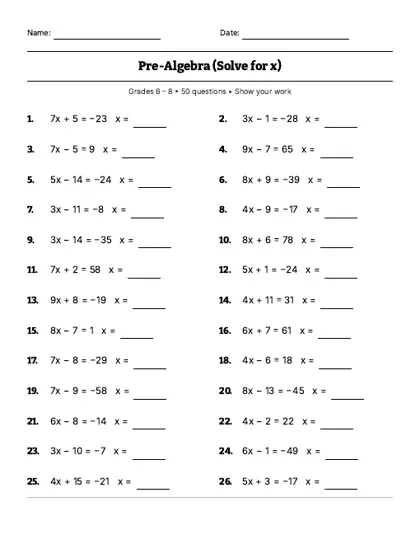 Solving equations
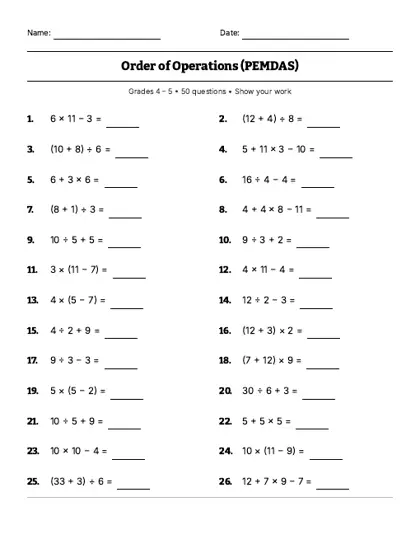 Order of operations
Printable worksheets: evaluating expressions · combining like terms · one-step equations · make a fresh equations test · make an expressions test
More: solving equations for kids · equation solver · balance scale · equation practice · order of operations · integers
Last reviewed
Questions parents ask
What is an equation?
A number sentence with an equals sign that says two amounts are the same, like 2x + 3 = 11.
What is the difference between an equation and an expression?
An equation has an equals sign joining two sides. An expression, like 2x + 3, has no equals sign.
What does solving an equation mean?
Finding the value of the unknown that makes the equation true. In x + 4 = 9, the solution is x = 5.
Why is an equation like a balance?
Both sides have the same value, like two pans that weigh the same. Doing the same to both sides keeps it level.
What grade learns equations?
Grade 6 under Common Core 6.EE.B.5. In India, class 7.