
Scientific notation
Scientific notation writes very big or very small numbers as a number between 1 and 10 times a power of 10, like 4.5 × 10⁴.
The idea: a short way to write long numbers
150,000,000 km, the distance to the Sun, has a lot of zeros to count. In scientific notation it is 1.5 × 10⁸ km.
Every number in scientific notation has two parts: a number from 1 up to (but not including) 10, and a power of 10. The power says how far the decimal point moved.
See it: pictures to draw with your child
Copy these onto paper or a whiteboard. A quick sketch makes the idea concrete before any written method.
Writing a big number
Put the decimal point after the first digit: 45,000 becomes 4.5. Then count how many places the point moved to get there: 4 places.
So 45,000 = 4.5 × 10⁴. For a big number, the power of 10 is positive.
Writing a small number
For 0.0045, move the point to just after the first non-zero digit: 4.5. It moved 3 places to the right.
So 0.0045 = 4.5 × 10⁻³. For a number smaller than 1, the power is negative. The negative exponents lesson explains why.
Converting back to an ordinary number
Move the point the other way. 3.2 × 10⁵ means move the point 5 places to the right: 320,000.
2.1 × 10⁻³ means move it 3 places to the left: 0.0021. Fill any gaps with zeros.
Big powers of 10
Try base 10 with a big or negative exponent. Then try 9 with exponent 20 to see a big answer in scientific notation.
Comparing numbers in scientific notation
Compare the powers of 10 first. 3 × 10⁵ is bigger than 9 × 10⁴, because 10⁵ is ten times 10⁴.
Only when the powers are the same do you compare the first numbers. 7.2 × 10⁶ is bigger than 6.9 × 10⁶.
Scientific notation on a calculator
Calculators show very big answers with an E: 1.5E8 means 1.5 × 10⁸. Some show “×10” with small digits instead.
Children sometimes copy 1.5E8 as 1.58, which is a very different number. Teach them to read the E as “times ten to the”.
Key words
- Scientific notation: a × 10ⁿ, where 1 ≤ a < 10.
- Standard form: the ordinary way of writing a number, like 45,000. (In the UK, “standard form” means scientific notation.)
- Coefficient: the first number, between 1 and 10.
- Power of 10: the 10ⁿ part, which shows how far the point moved.
Teaching tip: hop the point
Write the number on squared paper with one digit per box. Draw the decimal point, then draw a small hop for every place it moves, as in the pictures.
The number of hops is the power of 10. Hops to the left make a positive power, and hops to the right make a negative power.
Real data makes it stick. Look up the population of India (about 1.4 × 10⁹) or the size of a red blood cell (about 8 × 10⁻⁶ m).
A week of practice
Ten minutes a day is plenty. Short, regular practice beats one long session at the weekend.
- Day 1: powers of 10 from 10⁻³ to 10⁶.
- Day 2: big numbers into scientific notation.
- Day 3: small numbers into scientific notation.
- Day 4: converting back and comparing.
- Day 5: the quiz on this page, then a round of scientific notation practice.
If one day goes badly, repeat it rather than moving on. Each day builds on the one before.
Quiz: scientific notation
Type the number and the power of 10.
Where this fits: exponents step by step
What to say to your child
A short script for teaching it the first time. Pause after each line and let your child do the next step.
- “What does 10⁴ equal?” (10,000.)
- “So what is 4.5 × 10⁴?” (45,000.)
- “How do we write 600 in scientific notation?” (6 × 10².)
- “Is 12 × 10³ in scientific notation?” (No, 12 is bigger than 10. It is 1.2 × 10⁴.)
- “What about 0.07?” (7 × 10⁻².)
More worked examples
Example 1: big number
3,500,000 = 3.5 × 10⁶.
Example 2: small number
0.00072 = 7.2 × 10⁻⁴.
Example 3: back to standard form
6 × 10⁵ = 600,000.
Example 4: fixing the form
12 × 10⁵ = 1.2 × 10⁶, because 12 = 1.2 × 10.
Practice questions (answers below)
Ask these out loud or write them down. Check each answer, and ask “how did you get that?” for one or two.
- 45,000
- 7,000,000
- 0.003
- 0.000052
- 2.4 × 10³ as a number
- 9.1 × 10⁻² as a number
- Which is bigger, 3 × 10⁴ or 8 × 10³?
- Write 12 × 10⁵ correctly.
- Write 0.5 × 10³ correctly.
- Stretch: how many digits does 6.02 × 10²³ have when written out?
Show the answers
- 4.5 × 10⁴
- 7 × 10⁶
- 3 × 10⁻³
- 5.2 × 10⁻⁵
- 2,400
- 0.091
- 3 × 10⁴
- 1.2 × 10⁶
- 5 × 10²
- 24
Common mistakes
How to teach it at home
Big number hunt
Find big numbers in the news or on food labels and write them in scientific notation together.
Space facts
The Moon is about 384,000 km away. Ask your child to write it as 3.84 × 10⁵.
Tiny things
A human hair is about 0.00008 m wide. Write it as 8 × 10⁻⁵ m.
By grade
- Grade 5: powers of 10 (5.NBT.A.2).
- Grade 8 (8.EE.A.3): write and compare very large and very small numbers using a single digit times a power of 10.
- In India, writing large numbers in standard form is in the class 8 chapter Power Play.
- Next: operations with scientific notation.
More for each grade: Grade 8 math and the CBSE class 8 maths guide.
Worksheets and practice
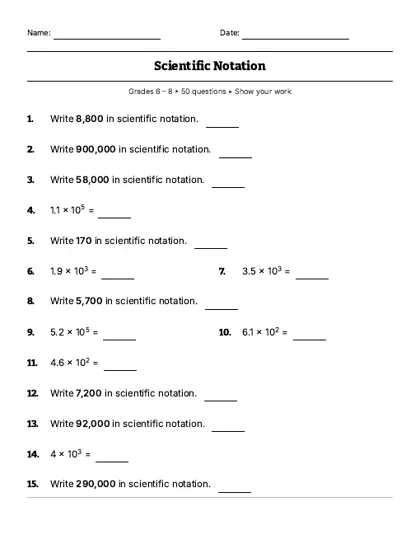
Scientific notation worksheet: printable PDF with an answer key. · Make a fresh test
Exponents practice · exponent calculator · exponents for kids · exponent rules worksheet · scientific notation worksheet · order of operations with exponents
Last reviewed
Questions parents ask
What is scientific notation?
A way to write a number as a number from 1 up to 10, times a power of 10. 45,000 = 4.5 × 10⁴.
How do you write a small number in scientific notation?
Move the point to just after the first non-zero digit and count the places. 0.0045 = 4.5 × 10⁻³.
Why must the first number be less than 10?
So every number has only one way to be written, which makes comparing easy.
What does E mean on a calculator?
Times ten to the power of. 2.5E6 means 2.5 × 10⁶ = 2,500,000.
What grade learns scientific notation?
Grade 8 under Common Core 8.EE.A.3 and 8.EE.A.4.