
Operations with scientific notation
To multiply or divide in scientific notation, work out the numbers and the powers of 10 separately, then tidy the answer.
The idea: two easy jobs instead of one hard one
(3 × 10⁴) × (2 × 10⁵) looks hard, but it is two small jobs. Multiply the numbers: 3 × 2 = 6. Multiply the powers of 10: 10⁴ × 10⁵ = 10⁹.
The answer is 6 × 10⁹. The exponent rules from the exponent rules lesson do the work on the powers.
See it: pictures to draw with your child
Copy these onto paper or a whiteboard. A quick sketch makes the idea concrete before any written method.
Multiplying: add the exponents
Multiply the first numbers, and add the exponents of 10. (1.5 × 10³) × (4 × 10²) = 6 × 10⁵.
If the first number comes out at 10 or more, tidy it. (5 × 10⁴) × (6 × 10³) = 30 × 10⁷ = 3 × 10⁸, because 30 = 3 × 10.
Dividing: subtract the exponents
Divide the first numbers, and subtract the exponents of 10. (9 × 10⁸) ÷ (3 × 10²) = 3 × 10⁶.
If the first number comes out below 1, tidy it the other way. (2 × 10⁵) ÷ (8 × 10¹) = 0.25 × 10⁴ = 2.5 × 10³.
Check the power of 10
10⁴ × 10⁵ = 10⁹. Type base 10 and exponent 9 to see the one billion it stands for.
Adding and subtracting: match the powers first
To add, the powers of 10 must match. 3 × 10⁴ + 5 × 10³ becomes 3 × 10⁴ + 0.5 × 10⁴ = 3.5 × 10⁴.
A quick check is to write both as ordinary numbers: 30,000 + 5,000 = 35,000. Subtracting works the same way: 6 × 10⁵ − 4 × 10⁴ = 5.6 × 10⁵.
Real-life comparisons
Scientific notation makes huge comparisons easy. Earth’s mass is about 6 × 10²⁴ kg and the Moon’s is about 7.3 × 10²² kg.
Dividing gives about 0.82 × 10² = 82. So Earth is about 82 times heavier than the Moon. Questions like this are typical in grade 8 tests.
Key words
- Coefficient: the number in front, between 1 and 10.
- Add the exponents: what happens to the powers of 10 when you multiply.
- Subtract the exponents: what happens to the powers of 10 when you divide.
- Tidy the answer: rewrite it so the first number is between 1 and 10.
Teaching tip: two columns
Ask your child to draw two columns on paper: “numbers” and “powers of 10”. Each question is worked in both columns, then the answers are joined.
Finish with the tidy-up check: is the first number between 1 and 10? If not, move the point and change the power by 1.
Estimating catches slips. (3.1 × 10⁴) × (2.9 × 10³) should be about 9 × 10⁷.
Finally, a calculator check builds confidence. Type both numbers using the E key, multiply, and compare the display with the written answer.
A week of practice
Ten minutes a day is plenty. Short, regular practice beats one long session at the weekend.
- Day 1: review the product and quotient rules with powers of 10.
- Day 2: multiplying, with answers that need no tidying.
- Day 3: multiplying with tidying, like 30 × 10⁷.
- Day 4: dividing, then adding and subtracting with matched powers.
- Day 5: the quiz on this page, then a round of scientific notation operations practice.
If one day goes badly, repeat it rather than moving on. Each day builds on the one before.
Quiz: multiply and divide in scientific notation
Type the number and the power of 10.
Where this fits: exponents step by step
- What are exponents
- Square numbers
- Square roots
- Estimating square roots
- Cube numbers and cube roots
- Powers of 10
- Exponent rules
- Zero and negative exponents
- Scientific notation
- Operations with scientific notation (this page)
What to say to your child
A short script for teaching it the first time. Pause after each line and let your child do the next step.
- “What is 10³ × 10⁴?” (10⁷.)
- “So what is (2 × 10³) × (4 × 10⁴)?” (8 × 10⁷.)
- “What about (5 × 10²) × (4 × 10³)?” (20 × 10⁵, tidied to 2 × 10⁶.)
- “What happens to the exponents when you divide?” (Subtract them.)
- “Is 0.4 × 10⁵ tidy?” (No: 4 × 10⁴.)
More worked examples
Example 1: multiply
(2 × 10³) × (4 × 10⁵) = 8 × 10⁸.
Example 2: multiply and tidy
(5 × 10⁴) × (6 × 10³) = 3 × 10⁸.
Example 3: divide
(8.4 × 10⁷) ÷ (2 × 10³) = 4.2 × 10⁴.
Example 4: add
3 × 10⁴ + 5 × 10³ = 3.5 × 10⁴.
Practice questions (answers below)
Ask these out loud or write them down. Check each answer, and ask “how did you get that?” for one or two.
- (3 × 10²) × (2 × 10⁴)
- (4 × 10⁶) × (5 × 10²)
- (8 × 10⁹) ÷ (2 × 10³)
- (1.5 × 10⁴) × (3 × 10⁵)
- (6 × 10⁷) ÷ (1.2 × 10³)
- 2 × 10⁵ + 3 × 10⁵
- 7 × 10⁶ − 2 × 10⁵
- (2 × 10⁻³) × (4 × 10⁵)
- (9 × 10⁴) ÷ (3 × 10⁶)
- Stretch: Earth (6 × 10²⁴ kg) is how many times heavier than the Moon (7.3 × 10²² kg)?
Show the answers
- 6 × 10⁶
- 2 × 10⁹
- 4 × 10⁶
- 4.5 × 10⁹
- 5 × 10⁴
- 5 × 10⁵
- 6.8 × 10⁶
- 8 × 10²
- 3 × 10⁻²
- About 82 times
Common mistakes
How to teach it at home
Two columns
Work a few questions with a “numbers” column and a “powers of 10” column.
Space maths
Light travels about 3 × 10⁵ km a second. How far in 1,000 (10³) seconds? (3 × 10⁸ km.)
Estimate first
Before each question, say roughly what the answer should be.
By grade
- Grade 8 (8.EE.A.3): write numbers in scientific notation.
- Grade 8 (8.EE.A.4): add, subtract, multiply and divide numbers in scientific notation, and read calculator output.
- In India, this follows the class 8 chapter Power Play and is used in science.
- Back to: exponents for kids.
More for each grade: Grade 8 math and the CBSE class 8 maths guide.
Worksheets and practice
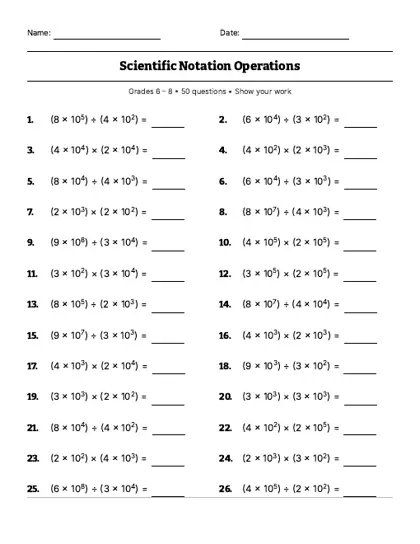
Operations with scientific notation worksheet: printable PDF with an answer key. · Make a fresh test
Exponents practice · exponent calculator · exponents for kids · exponent rules worksheet · scientific notation worksheet · order of operations with exponents · Multiplication practice trainer · 1-minute speed test
Last reviewed
Questions parents ask
How do you multiply numbers in scientific notation?
Multiply the first numbers and add the exponents of 10. Then make sure the first number is between 1 and 10.
How do you divide numbers in scientific notation?
Divide the first numbers and subtract the exponents of 10, then tidy the answer.
How do you add numbers in scientific notation?
Make the powers of 10 the same first, then add the first numbers. 3 × 10⁴ + 5 × 10³ = 3.5 × 10⁴.
What if the first number is bigger than 10?
Move the decimal point one place left and add 1 to the exponent. 30 × 10⁷ = 3 × 10⁸.
What grade learns operations with scientific notation?
Grade 8 under Common Core 8.EE.A.4.