
Negative exponents and the zero exponent
A negative exponent means divide instead of multiply: 2⁻³ = 1/8. Any number except 0 to the power of 0 is 1.
The idea: keep the pattern going
Write the powers of 2 going down: 2³ = 8, 2² = 4, 2¹ = 2. Each time the exponent drops by 1, the answer is divided by 2.
Keep going and the pattern decides the answers. 2⁰ = 2 ÷ 2 = 1, then 2⁻¹ = 1/2, and 2⁻² = 1/4. Nobody made these up: they are the only answers that keep the pattern.
See it: pictures to draw with your child
Copy these onto paper or a whiteboard. A quick sketch makes the idea concrete before any written method.
The zero exponent: always 1
Any number except 0 to the power of 0 is 1. So 5⁰ = 1, 100⁰ = 1 and (−7)⁰ = 1.
The quotient rule agrees. 5³ ÷ 5³ = 1, and the rule says 5³⁻³ = 5⁰. 0⁰ is left undefined in school maths.
Negative exponents: 1 over the power
A negative exponent means 1 divided by the same power with a positive exponent. 3⁻² = 1/3² = 1/9.
The answer is a small positive number, not a negative number. The minus sign in the exponent means “divide”, not “below zero”.
See the pattern table
The table under the answer shows each step dividing by the base. Try base 10 with exponent −4.
Negative powers of 10 are decimals
10⁻¹ = 1/10 = 0.1, 10⁻² = 1/100 = 0.01 and 10⁻³ = 0.001. The exponent tells you which decimal place the 1 is in.
This is how scientists write tiny numbers. A grain of sand about 0.0005 m wide is 5 × 10⁻⁴ m. See scientific notation.
Negative exponents with fractions
A negative exponent flips a fraction. (1/2)⁻¹ = 2, and (2/3)⁻² = (3/2)² = 9/4.
The rule is the same: 1 divided by the power. Dividing by a fraction is the same as multiplying by its flip, so the fraction turns over.
Key words
- Zero exponent: a power like 5⁰, which equals 1.
- Negative exponent: an exponent below zero, meaning 1 over the power.
- Reciprocal: 1 divided by a number; 1/8 is the reciprocal of 8.
- Pattern table: a list of powers where each row is the one above divided by the base.
Teaching tip: build the table together
Start with a power your child knows, like 2⁴ = 16. Write the powers going down, dividing by 2 each time, all the way to 2⁻³.
Ask them to say the rule they see. Then ask what 3⁰ and 3⁻¹ must be, using a new table. Seeing the pattern twice is usually enough.
If your child later writes 2⁻³ = −8, ask them to rebuild the table. The mistake fixes itself.
A week of practice
Ten minutes a day is plenty. Short, regular practice beats one long session at the weekend.
- Day 1: build the pattern table for powers of 2 from 2⁴ down to 2⁻³.
- Day 2: the zero exponent with different bases, including negatives.
- Day 3: negative exponents as fractions, like 3⁻² = 1/9.
- Day 4: negative powers of 10 as decimals.
- Day 5: the quiz on this page, then a round of zero and negative exponents practice.
If one day goes badly, repeat it rather than moving on. Each day builds on the one before.
By the end of the week your child should be able to explain, not just state, why 7⁰ = 1. Explaining it is the best sign the idea has stuck.
Where negative exponents are used
Scientists measure tiny things with negative powers of 10. A millimetre is 10⁻³ m and a micrometre is 10⁻⁶ m, about the size of a bacterium.
Computer storage uses powers of 2. Half a kilobyte is 2⁻¹ of a kilobyte, and the same pattern table explains why.
So the pattern on this page is not just a classroom rule. It is how very small amounts are written everywhere in science and technology.
Quiz: zero and negative exponents
Write it as a fraction or a decimal.
Where this fits: exponents step by step
What to say to your child
A short script for teaching it the first time. Pause after each line and let your child do the next step.
- “What is 2³?” (8.) “And 2²?” (4.)
- “What do we do each time we go down?” (Divide by 2.)
- “So what is 2⁰?” (1.)
- “And 2⁻¹?” (A half.)
- “Is 2⁻³ negative?” (No, it is 1/8, a small positive number.)
More worked examples
Example 1: zero exponent
9⁰ = 1.
Example 2: negative exponent
5⁻² = 1/5² = 1/25.
Example 3: power of 10
10⁻³ = 1/1,000 = 0.001.
Example 4: with the rules
2⁵ × 2⁻² = 2³ = 8.
Practice questions (answers below)
Ask these out loud or write them down. Check each answer, and ask “how did you get that?” for one or two.
- 2⁻¹
- 5⁻²
- 10⁻³
- 4⁰
- (−7)⁰
- 3⁻³
- 2⁻⁴
- Write 1/8 as a power of 2.
- Write 0.01 as a power of 10.
- Stretch: (1/2)⁻²
Show the answers
- 1/2
- 1/25
- 0.001
- 1
- 1
- 1/27
- 1/16
- 2⁻³
- 10⁻²
- 4
Common mistakes
How to teach it at home
Halving chain
Start at 16 and keep halving: 8, 4, 2, 1, ½, ¼. Write each as a power of 2.
Decimal places
Say a power of 10 like 10⁻². Your child writes it as a decimal: 0.01.
Spot the trap
Write 5⁰ = 0 and 2⁻¹ = −2. Your child explains what is wrong.
By grade
- Grade 6: whole-number exponents (6.EE.A.1).
- Grade 8 (8.EE.A.1): zero and negative exponents, such as 3² × 3⁻⁵ = 3⁻³ = 1/27.
- In India, negative exponents are in the class 8 chapter Power Play.
- Next: scientific notation.
More for each grade: Grade 8 math and the CBSE class 8 maths guide.
Worksheets and practice
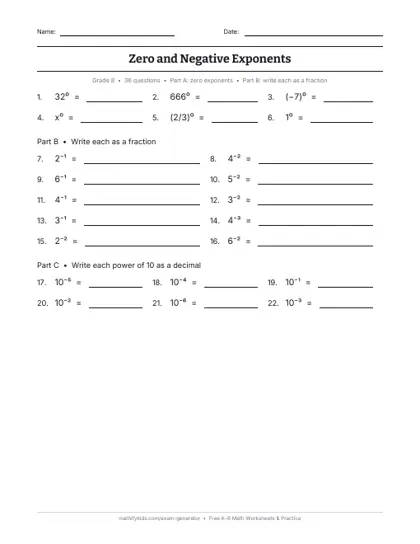
Negative exponents worksheet: printable PDF with an answer key. · Make a fresh test
Exponents practice · exponent calculator · exponents for kids · exponent rules worksheet · scientific notation worksheet · order of operations with exponents
Last reviewed
Questions parents ask
What does a negative exponent mean?
1 divided by the power with a positive exponent. 2⁻³ = 1/2³ = 1/8.
Why is any number to the power of 0 equal to 1?
Each step down in the exponent divides by the base. 2¹ = 2, so 2⁰ = 2 ÷ 2 = 1.
Is a negative exponent a negative number?
No. 2⁻³ is 1/8, a small positive number.
What is 10 to the power of −2?
1/100, which is 0.01.
What grade learns negative exponents?
Grade 8 under Common Core 8.EE.A.1.