
Numerator and denominator
The denominator (bottom) is how many equal parts make a whole. The numerator (top) is how many of those parts we have.
The two numbers in a fraction
In 3/4:
- 4 is the denominator. It names the size of the parts: the whole is cut into 4 equal parts, called quarters.
- 3 is the numerator. It counts how many of those parts we have: 3 of them.
So 3/4 means “3 parts, each one quarter”. The line between them can be read as “out of”, “of” or “divided by”, depending on the problem.
See it: pictures to draw with your child
Copy these onto paper or a whiteboard. A quick sketch makes the idea concrete before any written method.
Ways to remember which is which
- Denominator = Down. Both start with D, and the denominator is down at the bottom.
- Numerator = Number we have. It counts, so it numbers the parts.
- The denominator names the fraction: 3/4 is “three fourths”. The denominator gives the name, the numerator gives the count.
Say it while pointing: “Three, out of four equal parts.” Children who say the meaning out loud make fewer mix-ups than those who learn only the words.
What happens when each number changes
Change the numerator and the number of pieces changes: 2/8, 3/8, 4/8 get bigger, because there are more eighths.
Change the denominator and the size of the pieces changes: 1/2, 1/3, 1/4 get smaller, because the whole is cut into more, smaller pieces. This is the idea most children find surprising, and it is the heart of comparing fractions.
Change both by the same factor and the size stays the same: 1/2 = 2/4 = 3/6. That is the idea behind equivalent fractions.
Special cases to know
- Numerator 0: 0/5 = 0. None of the parts.
- Numerator equals denominator: 5/5 = 1. All of the parts make one whole.
- Numerator bigger than denominator: 7/5 is more than 1, an improper fraction. See mixed numbers.
- Denominator 1: 6/1 = 6. Wholes not cut at all.
- Denominator 0: not allowed. You can’t cut a whole into 0 parts, just as you can’t divide by 0.
The fraction line also means divide
From grade 5, children learn that a fraction is a division: 3/4 = 3 ÷ 4. The numerator is the number being shared and the denominator is the number of shares. Share 3 pizzas among 4 children and each gets 3/4 of a pizza. See fractions as division.
Quiz: top and bottom numbers
Name each fraction. The bottom number is the number of equal parts.
Where this fits: fractions step by step
- Halves and quarters
- What are fractions
- Unit fractions
- Numerator and denominator (this page)
- Fractions on a number line
- Fractions of a set
- Equivalent fractions
- Simplifying fractions
- Comparing fractions
- Ordering fractions
- Improper fractions and mixed numbers
- Adding fractions
- Subtracting fractions
- Finding a common denominator
- Adding mixed numbers
- Subtracting mixed numbers
- Fraction of a number
- Fractions × whole numbers
- Multiplying fractions
- Fractions as division
- Dividing fractions by whole numbers
- Dividing fractions
- Fractions to decimals
- Fraction word problems
What to say to your child
A short script for teaching it the first time. Pause after each line and let your child do the next step.
- “Look at 3/4. What is the bottom number?” (4.) “That tells us the cake is cut into 4 equal pieces.”
- “What is the top number?” (3.) “We have 3 of those pieces.”
- “The bottom one is called the denominator. D for down.”
- “The top one is the numerator. It numbers the pieces we have.”
- “What would 4/4 be?” (The whole cake!)
More worked examples
Example 1: reading 5/8
The denominator 8 says the whole has 8 equal parts (eighths). The numerator 5 says we have 5 of them: five eighths.
Example 2: writing a fraction
A pie has 6 equal slices and 4 are left. Denominator 6, numerator 4: 4/6 of the pie is left.
Example 3: comparing denominators
1/3 or 1/5? The denominator 5 cuts the whole into more pieces, so each fifth is smaller. 1/3 is bigger.
Example 4: a whole
7/7: the numerator equals the denominator, so it is all the parts: 1 whole.
Practice questions (answers below)
Ask these out loud or write them down. Check each answer, and ask “how did you get that?” for one or two.
- In 5/9, which number is the denominator?
- In 2/7, which number is the numerator?
- A pizza in 8 slices, 3 eaten. Write the fraction eaten.
- What does the denominator in 3/10 tell you?
- What is 6/6?
- What is 0/4?
- Which is bigger: 1/6 or 1/9?
- Which is bigger: 4/9 or 7/9?
- Is 9/4 more or less than 1?
- Stretch: what is 12/1?
Show the answers
- 9
- 2
- 3/8
- The whole has 10 equal parts
- 1
- 0
- 1/6
- 7/9
- More
- 12
Common mistakes
How to teach it at home
Point and say
Point to each number of a fraction and say its job.
Pizza orders
Order “3 out of 8 slices” and write the fraction.
D for down
Make a sign with the memory aid for the fridge.
By grade
- Grade 3 (3.NF.A.1): understand 1/b as one of b equal parts and a/b as a parts of size 1/b.
- Grade 4: use the numerator and denominator to compare and find equivalent fractions.
- Grade 5 (5.NF.B.3): see the fraction line as division.
- Next: fractions on a number line.
More for each grade: Grade 3 math and the CBSE class 3 maths guide.
Worksheets and practice
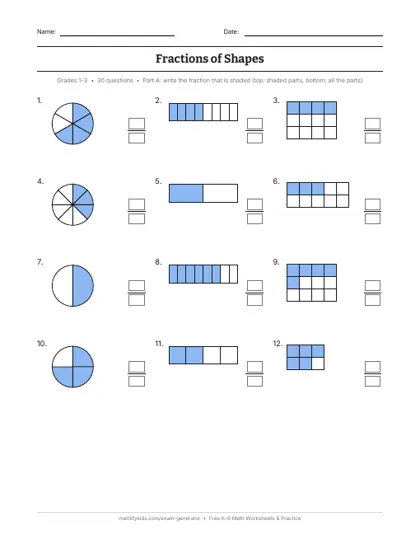
Fractions of shapes worksheet: printable PDF with an answer key. · Make a fresh test
Fraction practice · fraction calculator · fraction wall · fractions quiz · fraction levels · fraction games · fractions for kids
Last reviewed
Questions parents ask
What is the numerator?
The top number of a fraction. It counts how many equal parts we have. In 3/4, the numerator is 3.
What is the denominator?
The bottom number of a fraction. It says how many equal parts make one whole. In 3/4, the denominator is 4.
How do I remember numerator and denominator?
Denominator starts with D, like down, and is at the bottom. The numerator numbers the parts we have.
Can the denominator be 0?
No. A whole can’t be cut into 0 parts, just as you can’t divide by 0.
What happens if the numerator is bigger than the denominator?
The fraction is more than 1 whole, an improper fraction, like 7/4 = 1 3/4.