
Unit fractions
A unit fraction is one equal part of a whole, like 1/2, 1/3 or 1/4. Its top number is 1. Quiz for kids, parent help below.
🧒 Kids: meet the unit fractions!
Each picture shows one equal part. Then try the quiz!
💡 Trick: 1/3 or 1/8? Cutting into 8 makes tiny pieces. So 1/3 is bigger!
More fractions: Halves and quarters · Unit fractions · Number line · Fractions of a set · Fraction of a number · Fractions as division
This part is for grown-ups: the key idea, pictures to draw, what to say, common mistakes, questions with answers and a free worksheet.
The trick: more pieces, smaller pieces
A unit fraction has 1 on top. The bottom number (the denominator) says how many equal parts the whole is cut into. This leads to the idea that surprises most children: the bigger the bottom number, the smaller the piece. Sharing a pizza among 8 people gives smaller slices than sharing it among 3. So 1/8 is less than 1/3, even though 8 is more than 3. Every other fraction is built from unit fractions: 3/4 is three pieces of 1/4.
- 1/2 or 1/4: 1/2, because halves are bigger than quarters
- 1/10 or 1/5: 1/5, because 5 people share more than 10 people get
- 3/4: three unit fractions of 1/4: 1/4 + 1/4 + 1/4
- one whole: all the pieces: 5/5, 8/8 or 12/12
Patterns to spot
- The top number of a unit fraction is always 1.
- The bigger the bottom number, the smaller the unit fraction: 1/2 > 1/3 > 1/4 > 1/5.
- d copies of 1/d make one whole: 6 sixths make 1.
- 1/2 is the biggest unit fraction smaller than 1 whole.
- Doubling the bottom number halves the piece: 1/8 is half of 1/4.
- Every fraction is a number of unit fractions: 5/6 is five sixths.
See it: pictures to draw with your child
Draw these on paper or a whiteboard. A quick sketch makes the idea concrete before any rules.
What your child already knows
Children who know halves and quarters already know two unit fractions. The new step in grade 3 is to see the pattern: thirds, fifths, sixths and eighths work the same way, and the name of each piece comes from how many equal pieces there are. They also learn to write any fraction as a number of unit fractions, which is the key to adding fractions later.
In real life: Share a pizza or a bar of chocolate among different numbers of people and compare the pieces. Fold paper strips into 2, 3, 4 and 8 equal parts and lay them side by side.
Worked examples
Example 1: Naming a piece
- A pizza is cut into 6 equal slices.
- One slice is 1/6 of the pizza, read “one sixth”.
Example 2: Comparing
- Which is bigger, 1/5 or 1/9?
- Cutting into 9 pieces makes smaller pieces than cutting into 5.
- So 1/5 is bigger.
Example 3: Building a fraction
- Shade 1/8 of a bar, then another 1/8, then another.
- Three eighths are shaded: 3/8 is three unit fractions of 1/8.
Common mistakes
What to say to your child
A short script for your first session. Pause after each line and let your child answer.
- “Let’s share this paper strip between 3 people. Fold it into 3 equal parts.”
- “Each part is one third. We write 1/3.”
- “Now fold another strip for 6 people. Is each part bigger or smaller?” (Smaller.)
- “So 1/6 is smaller than 1/3, even though 6 is bigger than 3.”
- “How many sixths make the whole strip?” (6.)
Questions to try (answers below)
Ask these out loud or write them down. The last one is a stretch.
- Which is bigger: 1/2 or 1/3?
- Which is bigger: 1/10 or 1/4?
- How many quarters make 1 whole?
- How many fifths make 1 whole?
- A cake is cut into 8 equal pieces. What fraction is one piece?
- Write 1/6 + 1/6 + 1/6 as one fraction
- Order from smallest: 1/3, 1/12, 1/6
- Which unit fraction is half of 1/4?
- Stretch: how many 1/3s make 2 wholes?
Show the answers
- 1/2
- 1/4
- 4
- 5
- 1/8
- 3/6
- 1/12, 1/6, 1/3
- 1/8
- 6
Games to play at home
Paper strip wall
Fold strips into 2, 3, 4, 6 and 8 parts and line them up.
Pizza night
Ask what fraction of the pizza each slice is.
Biggest piece wins
Roll a dice; the player with the smaller number gets the bigger unit fraction.
A 5-day plan for unit fractions
Ten minutes a day is enough. Short, regular practice works far better than one long session.
- Day 1: Learn it with real things: paper, snacks, counters or a ruler, like the pictures above.
- Day 2: Read the script together, then ask the first four questions.
- Day 3: Do the quiz at the top of the page and read the hints for anything missed.
- Day 4: Play one of the games above for ten minutes.
- Day 5: Ask the rest of the questions, then do a round of the matching fraction practice skill.
By grade
Grade 3 (Common Core 3.NF.A.1) understands a unit fraction 1/b as one part when a whole is split into b equal parts, and a/b as a parts of size 1/b. Grade 3 also splits shapes into equal areas (3.G.A.2). In India, unit fractions appear in class 3 and class 4 maths.
More for each grade: Grade 3 math and the CBSE class 3 maths guide.
What comes next
Next, place unit fractions on a number line, then compare and order them on the fraction wall. The comparing fractions lesson takes the same idea further, and numerator and denominator explains both numbers.
Worksheet and more practice
Print a free worksheet with an answer key, or keep practicing online with fraction practice.
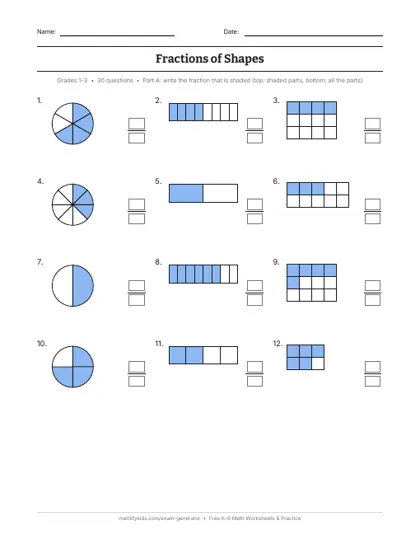 Fractions of shapes
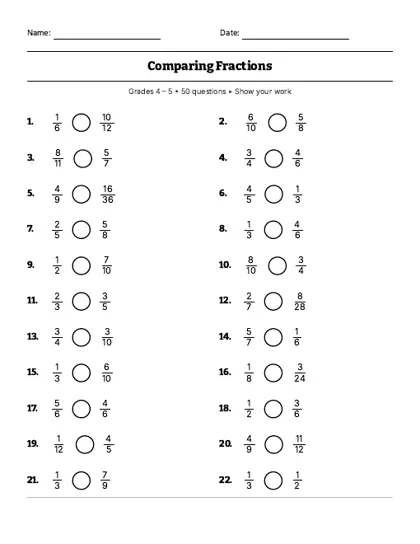 Comparing fractions
More: fractions for kids · fraction wall · fraction calculator · fractions quiz · fraction levels · fraction games · fractions chart
Last reviewed
Questions parents ask
What is a unit fraction?
A fraction with 1 on top, such as 1/2, 1/3 or 1/10. It is one equal part of a whole.
Which unit fraction is bigger?
The one with the smaller bottom number. 1/3 is bigger than 1/5, because cutting into 3 pieces makes bigger pieces than cutting into 5.
How are unit fractions used to make other fractions?
Any fraction is a number of unit fractions. 3/4 is three pieces of 1/4: 1/4 + 1/4 + 1/4.
How many unit fractions make a whole?
As many as the bottom number: 4 quarters, 6 sixths or 10 tenths make one whole.
What grade learns unit fractions?
Grade 3 (class 3 or 4 in India), under Common Core 3.NF.A.1.