
What are fractions?
A fraction is a number for part of something: equal parts of a whole, part of a group, or a point between whole numbers.
Fractions mean equal parts
When a pizza is cut into 4 equal slices and you eat 1, you have eaten one quarter of the pizza, written 1/4. A fraction tells you how many equal parts the whole was cut into, and how many of those parts you are talking about.
The word that matters most is equal. If one slice is bigger than the others, the slices are not quarters. Children who understand equal parts find every later fraction idea easier, from comparing to adding.
Fractions are also numbers. 1/2 sits half-way between 0 and 1, just as 5 sits between 4 and 6. Seeing fractions as numbers is a big step in grade 3.
See it: pictures to draw with your child
Copy these onto paper or a whiteboard. A quick sketch makes the idea concrete before any written method.
Three ways to see a fraction
- Part of a whole: a shape or object cut into equal parts. 3/4 of a pizza is 3 of 4 equal slices.
- Part of a set: some of a group of things. If 3 of 8 balloons are red, 3/8 of the balloons are red. See fractions of a set.
- A point on a number line: a distance from 0. 3/4 is three quarter-jumps from 0. See fractions on a number line.
All three describe the same number. Moving between them helps children see that a fraction is one idea, not three different tricks.
How to read and write fractions
A fraction has two numbers separated by a line. The bottom number, the denominator, is how many equal parts make one whole. The top number, the numerator, is how many of those parts we have. More in numerator and denominator.
- 1/2 is read “one half”, 1/3 “one third” and 1/4 “one quarter” or “one fourth”.
- From 5 on, add “th”: 1/5 is “one fifth”, 3/8 “three eighths”, 7/10 “seven tenths”.
- When the top number is more than 1, the name is plural: “two thirds”, “five sixths”.
Explore fractions on the fraction wall
Tap pieces to shade them. Each row is one whole, cut into equal parts.
One whole, and fractions bigger than 1
When every part is shaded, the fraction equals 1: 4/4, 6/6 and 10/10 are all one whole. Children enjoy spotting this: the top and bottom numbers are the same.
Fractions can also be bigger than 1. Five quarters is one whole pizza and one more slice: 5/4. That can be written as the mixed number 1 1/4, which grade 4 and 5 explore in improper fractions and mixed numbers.
Where children meet fractions
Fractions are everywhere once you look: half past three, a quarter of a cake, three quarters full, half price, a 1/2 cup of flour, 3/4 of the way to school. Talking about these at home gives children a feel for fraction sizes long before they meet the rules.
A good habit is to ask “is that more or less than half?” Children who can judge sizes against 1/2 make far fewer mistakes when comparing and adding fractions later.
Quiz: name the fraction
Look at each picture or number line. Type the top number, then the bottom number.
Where this fits: fractions step by step
- Halves and quarters
- What are fractions (this page)
- Unit fractions
- Numerator and denominator
- Fractions on a number line
- Fractions of a set
- Equivalent fractions
- Simplifying fractions
- Comparing fractions
- Ordering fractions
- Improper fractions and mixed numbers
- Adding fractions
- Subtracting fractions
- Finding a common denominator
- Adding mixed numbers
- Subtracting mixed numbers
- Fraction of a number
- Fractions × whole numbers
- Multiplying fractions
- Fractions as division
- Dividing fractions by whole numbers
- Dividing fractions
- Fractions to decimals
- Fraction word problems
What to say to your child
A short script for teaching it the first time. Pause after each line and let your child do the next step.
- “Here is one sandwich. Let’s cut it so 4 people get the same.” (Cuts into 4 equal parts.)
- “Each piece is one quarter. We write 1/4.”
- “If you eat 3 pieces, how much have you eaten?” (3/4.)
- “How much is left?” (1/4.)
- “Can you find something at home cut into equal parts?”
More worked examples
Example 1: naming a shape
A chocolate bar has 6 equal pieces and 5 are eaten. 5/6 of the bar is eaten and 1/6 is left.
Example 2: naming a set
There are 10 children and 7 wear glasses. 7/10 of the children wear glasses.
Example 3: on a number line
0 to 1 is split into 5 equal parts. A point 2 parts from 0 is at 2/5.
Example 4: one whole
A pie is cut into 8 slices and all 8 are eaten: 8/8 = 1 whole pie.
Practice questions (answers below)
Ask these out loud or write them down. Check each answer, and ask “how did you get that?” for one or two.
- A pizza has 4 equal slices; 1 is eaten. What fraction is eaten?
- 6 equal parts, 5 shaded. What fraction is shaded?
- What is 3/3 equal to?
- 3 of 7 cars are red. What fraction are red?
- How do you say 5/8?
- Is 1/2 more or less than 1/3?
- What fraction is not shaded if 2/5 is shaded?
- How many sixths make a whole?
- Where is 1/2 on a number line from 0 to 1?
- Stretch: what is 5 quarters as a mixed number?
Show the answers
- 1/4
- 5/6
- 1
- 3/7
- five eighths
- More
- 3/5
- 6
- Half-way
- 1 1/4
Common mistakes
How to teach it at home
Sandwich fractions
Cut food into equal parts and name the fraction eaten.
Clock fractions
Talk about half past and quarter past.
Fraction spotting
Find fractions in recipes, signs and measuring jugs.
By grade
- Grade 2 (2.G.A.3): split shapes into halves, thirds and fourths.
- Grade 3 (3.NF.A.1, 3.NF.A.2): fractions as equal parts and as numbers on a number line.
- Grade 4: equivalent fractions, comparing and adding.
- Next: unit fractions.
More for each grade: Grade 2 math and the CBSE class 2 maths guide; Grade 3 math and the CBSE class 3 maths guide.
Worksheets and practice
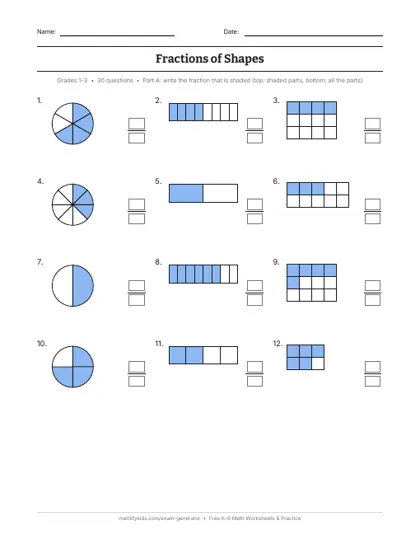
Fractions of shapes worksheet: printable PDF with an answer key. · Make a fresh test
Fraction practice · fraction calculator · fraction wall · fractions quiz · fraction levels · fraction games · fractions for kids
Last reviewed
Questions parents ask
What is a fraction in simple words?
A number for part of something. It tells how many equal parts the whole is cut into (bottom number) and how many of those parts you have (top number).
Why must fraction parts be equal?
Because a fraction names one size of piece. If the pieces are different sizes, a name like “one quarter” doesn’t mean anything.
Can a fraction be bigger than 1?
Yes. 5/4 is one whole and one more quarter. It can also be written as the mixed number 1 1/4.
How do you read fractions?
Say the top number, then the bottom number as a part name: 3/4 is “three quarters” or “three fourths”, 5/8 is “five eighths”.
What grade learns fractions?
Grade 1 and 2 meet halves and quarters, and grade 3 learns fractions as numbers in depth. Fractions continue up to grade 6.