
Dividing fractions
To divide by a fraction, multiply by its reciprocal: keep the first fraction, change ÷ to ×, and flip the second fraction.
What dividing by a fraction means
6 ÷ 2 asks “how many 2s fit in 6?” In the same way, 3 ÷ 1/2 asks “how many halves fit in 3?” Each whole has 2 halves, so 3 wholes have 6: 3 ÷ 1/2 = 6.
This surprises children because the answer is bigger than the number we started with. That happens whenever we divide by a number less than 1: small pieces fit many times.
See it: pictures to draw with your child
Copy these onto paper or a whiteboard. A quick sketch makes the idea concrete before any written method.
The method: keep, change, flip
- 2/3 ÷ 1/4.
- Keep the first fraction: 2/3.
- Change ÷ to ×.
- Flip the second fraction: 1/4 becomes 4/1.
- Multiply: 2/3 × 4/1 = 8/3 = 2 2/3.
The flipped fraction is called the reciprocal. A number times its reciprocal is always 1: 1/4 × 4 = 1.
Why keep, change, flip works
Dividing by 1/4 asks how many quarters fit. Each whole holds 4 quarters, so dividing by 1/4 is the same as multiplying by 4. Dividing by 3/4 asks how many three-quarters fit: 4 quarters per whole, but you need 3 at a time, so multiply by 4 and divide by 3, which is multiplying by 4/3.
Another way: with a common denominator, divide the numerators. 2/3 ÷ 1/4 = 8/12 ÷ 3/12 = 8 ÷ 3 = 8/3. Same answer, and it shows that dividing fractions is just asking how many pieces fit.
Divide any two fractions, step by step
The calculator shows the flip and the multiplication.
Dividing mixed numbers
Change mixed numbers to improper fractions first, then keep, change, flip. 2 1/2 ÷ 1 1/4 = 5/2 ÷ 5/4 = 5/2 × 4/5 = 20/10 = 2. Check: two lots of 1 1/4 make 2 1/2. See improper fractions and mixed numbers.
Dividing with whole numbers
Keep, change, flip works with whole numbers too: write the whole number over 1. 4 ÷ 2/3 = 4/1 × 3/2 = 12/2 = 6. Check the meaning: how many two-thirds fit in 4? Each 2 wholes hold three lots of 2/3, so 4 wholes hold 6.
And a fraction divided by a whole number shares it: 3/5 ÷ 3 = 3/5 × 1/3 = 3/15 = 1/5. Grade 5 meets these simpler cases first, in dividing fractions by whole numbers.
In word problems
Look for “how many … in”, “how many … fit” and “how many servings”. “A 3/4 kg bag of rice is split into 1/8 kg portions. How many portions?” 3/4 ÷ 1/8 = 3/4 × 8 = 6 portions.
Check by multiplying back
Division and multiplication undo each other. If 2/3 ÷ 1/4 = 8/3, then 8/3 × 1/4 should give 2/3. 8/12 = 2/3, so it does. A size check helps too: dividing by a fraction less than 1 should make the answer bigger.
Quiz: dividing fractions
Keep, change, flip, then simplify. Any equivalent answer is fine.
Where this fits: fractions step by step
- Halves and quarters
- What are fractions
- Unit fractions
- Numerator and denominator
- Fractions on a number line
- Fractions of a set
- Equivalent fractions
- Simplifying fractions
- Comparing fractions
- Ordering fractions
- Improper fractions and mixed numbers
- Adding fractions
- Subtracting fractions
- Finding a common denominator
- Adding mixed numbers
- Subtracting mixed numbers
- Fraction of a number
- Fractions × whole numbers
- Multiplying fractions
- Fractions as division
- Dividing fractions by whole numbers
- Dividing fractions (this page)
- Fractions to decimals
- Fraction word problems
What to say to your child
A short script for teaching it the first time. Pause after each line and let your child do the next step.
- “We have 3 pizzas. Each person eats half a pizza. How many people can eat?”
- “How many halves in one pizza?” (2.) “In 3 pizzas?” (6.)
- “So 3 ÷ 1/2 = 6. Dividing by a half doubles!”
- “The shortcut: keep 3, change to ×, flip 1/2 to 2/1. 3 × 2 = 6.”
- “Keep, change, flip.”
More worked examples
Example 1: whole ÷ unit fraction
4 ÷ 1/3 = 4 × 3 = 12.
Example 2: fraction ÷ fraction
3/4 ÷ 3/8 = 3/4 × 8/3 = 24/12 = 2.
Example 3: with a remainder
5/6 ÷ 1/4 = 5/6 × 4 = 20/6 = 3 1/3.
Example 4: mixed numbers
1 1/2 ÷ 3/4 = 3/2 × 4/3 = 2.
Practice questions (answers below)
Ask these out loud or write them down. Check each answer, and ask “how did you get that?” for one or two.
- 2 ÷ 1/2
- 3 ÷ 1/4
- 1/2 ÷ 1/4
- 3/4 ÷ 1/2
- 2/3 ÷ 2/9
- 5/8 ÷ 1/4
- 4/5 ÷ 2/3
- How many 3/4-cup servings in 6 cups?
- What is the reciprocal of 5/7?
- Stretch: 2 1/4 ÷ 1 1/2
Show the answers
- 4
- 12
- 2
- 1 1/2
- 3
- 2 1/2
- 1 1/5
- 8
- 7/5
- 1 1/2
Common mistakes
How to teach it at home
Serving sizes
How many 1/2-cup servings in a 3-cup bag?
Ribbon pieces
How many 1/4 m pieces from 2 m of ribbon?
Say the question
Read each division as “how many … fit in …?”
By grade
- Grade 5 (5.NF.B.7): divide unit fractions by whole numbers and whole numbers by unit fractions.
- Grade 6 (6.NS.A.1): divide fractions by fractions and solve word problems.
- Next: fractions to decimals.
More for each grade: Grade 6 math and the CBSE class 6 maths guide.
Worksheets and practice
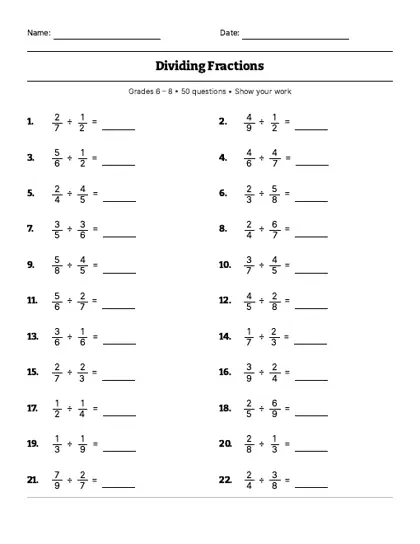
Dividing fractions worksheet: printable PDF with an answer key. · Make a fresh test
Fraction practice · fraction calculator · fraction wall · fractions quiz · fraction levels · fraction games · fractions for kids
Last reviewed
Questions parents ask
How do you divide fractions?
Keep the first fraction, change ÷ to ×, and flip the second fraction, then multiply: 2/3 ÷ 1/4 = 2/3 × 4 = 8/3.
Why do you flip the second fraction?
Dividing by a fraction asks how many of it fit. Dividing by 1/4 is the same as multiplying by 4, its reciprocal.
Why is the answer bigger than the number I started with?
When you divide by a number less than 1, lots of small pieces fit, so the answer grows.
How do you divide mixed numbers?
Change them to improper fractions first, then keep, change, flip.
What grade learns dividing fractions?
Grade 5 meets unit fractions and whole numbers, and grade 6 divides any fractions (6.NS.A.1).