
Addition within 10
All the addition facts within 10, with ten-frame pictures, three easy strategies and practice. Parent help is below.
🧒 Kids: add up to 10!
Learn the ways to make 10. Then tap Practice!
▶ Practice ⏱️ 1-minute challenge 🫧 Make 10 Pop game
Ways to make 10
- 0 + 10 = 10
- 1 + 9 = 10
- 2 + 8 = 10
- 3 + 7 = 10
- 4 + 6 = 10
- 5 + 5 = 10
- 6 + 4 = 10
- 7 + 3 = 10
- 8 + 2 = 10
- 9 + 1 = 10
- 10 + 0 = 10
💡 Trick: 4 + 4 = 8, so 4 + 5 is one more: 9!
More facts: Within 5 · Counting on · Within 10 · Make 10 · Doubles · Within 20
This part is for grown-ups: the trick that makes these facts easy, pictures to draw, what to say, common mistakes, questions with answers and a free worksheet.
The trick: use what you know
There are 66 facts within 10, but children only need a few strategies to work them all out: count on for + 1, + 2 and + 3; doubles like 4 + 4; and the pairs that make 10. Each fact your child knows becomes a stepping stone to the next.
- 7 + 2: count on: 8, 9
- 4 + 4: a double: 8
- 4 + 5: near double: 4 + 4 = 8, plus 1 = 9
- 6 + 4: a pair that makes 10
Patterns to spot
- Adding 0 changes nothing, and adding 1 gives the next number.
- Order does not matter: 3 + 6 = 6 + 3 = 9.
- Doubles to 10: 1 + 1, 2 + 2, 3 + 3, 4 + 4, 5 + 5.
- Pairs that make 10: 1 + 9, 2 + 8, 3 + 7, 4 + 6, 5 + 5.
- When one number goes up by 1 and the other goes down by 1, the total stays the same: 3 + 5 = 4 + 4.
See it: pictures to draw with your child
Draw these on paper or a whiteboard. Seeing the counters makes the fact stick.
Facts you already know
Within 10 there are 66 facts, but most are easy wins. Facts with 0 and 1 follow simple rules. Turn-arounds halve the rest. The doubles and the pairs that make 10 are worth learning by heart, and the few left over are one away from a double: 3 + 4, 4 + 5, 2 + 3.
In real life: Ten fingers are a ready-made ten frame. Egg boxes with 10 spaces, ten-pin bowling and counting coins all build the feeling for 10.
Worked examples
Example 1: 5 + 3 on a ten frame
- Put 5 counters in the top row, then 3 in the bottom row.
- The top row is full (5), and 3 more makes 8.
- Your child can see the answer without counting from 1: 5 + 3 = 8.
Example 2: 3 + 4, a near double
- 3 + 3 = 6 is a double your child knows.
- 4 is one more than 3, so the answer is one more than 6: 3 + 4 = 7.
Example 3: a story problem
- “Ali has 6 stickers.
- He gets 4 more.
- How many stickers now?”
- Write 6 + 4.
- 6 and 4 are a pair that makes 10, so Ali has 10 stickers.
Common mistakes
What to say to your child
A short script for your first session. Pause after each line and let your child answer.
- “Let’s fill a ten frame. Put in 6 counters.” (Places 6.)
- “How many more to fill it?” (4.)
- “So 6 + 4 makes…?” (10!)
- “Now take one away. What is 6 + 3?” (9, one less than 10.)
- “Every ten frame fact is a picture you can see in your head.”
Questions to try (answers below)
Ask these out loud or write them down. The last one is a stretch.
- 5 + 3
- 2 + 7
- 4 + 4
- 6 + 4
- 3 + 4
- 0 + 9
- 8 + ? = 10
- There are 6 birds on a tree. 3 more land. How many birds now?
- Stretch: find two different pairs that make 7
Show the answers
- 8
- 9
- 8
- 10
- 7
- 9
- 2
- 9
- Any two of 0 + 7, 1 + 6, 2 + 5, 3 + 4 (or turn-arounds)
Games to play at home
Ten frame snack
Draw a 2 × 5 grid. Fill it with cereal: 4 on one colour, then how many more to make 10?
Ten-pin bowling
Use 10 plastic bottles. Count how many fell and how many are still standing.
Card pairs
Use cards 1 to 9. Find two cards that add to 10, or to any number you choose.
A 5-day plan for addition within 10
Ten minutes a day is enough. Short, regular practice helps facts stick far better than one long session.
- Day 1: Learn it with objects. Use the pictures above with real counters, fingers or toys.
- Day 2: Read the script together, then ask the first four questions.
- Day 3: Play one round in the practice tool at the top of the page, with no timer.
- Day 4: Play one of the games above for ten minutes.
- Day 5: Ask the rest of the questions, then try the 1-minute challenge and write down the score.
Next week, repeat the round in the practice tool and compare the fact map. When most facts are green, move on to the next page.
By grade
Kindergarten (K.OA.A.2) solves addition word problems within 10 with objects and drawings. Grade 1 (1.OA.C.6) adds within 20 and is fluent within 10. In India, addition within 10 is part of class 1 maths.
More for each grade: Kindergarten math; Grade 1 math and the CBSE class 1 maths guide.
What comes next
When most facts within 10 come from memory, the next step is the make 10 strategy, then doubles and addition within 20. Practice the subtraction facts alongside: if 6 + 4 = 10, then 10 − 4 = 6 and 10 − 6 = 4.
Worksheet and more practice
Print a free worksheet with an answer key, or keep practicing online with the addition practice trainer.
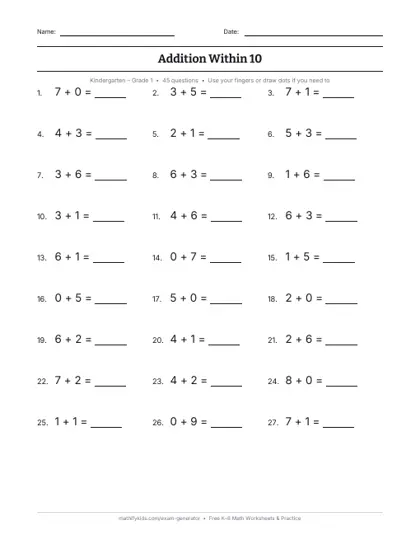 Addition within 10
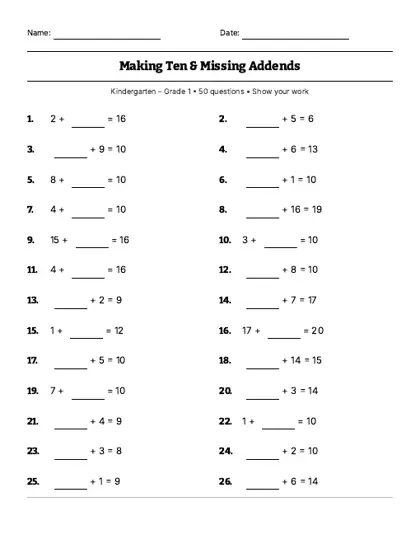 Number bonds
More: addition for kids · addition facts strategies · addition chart · number bonds
Last reviewed
Questions parents ask
What is addition within 10?
Adding two numbers with a total of 10 or less, such as 6 + 3. These facts are the base for everything else in addition.
How many addition facts are there within 10?
66, including facts with 0 and turn-arounds like 3 + 6 and 6 + 3. With strategies, children only need to memorise a few.
What strategies help with addition within 10?
Counting on for + 1, + 2 and + 3, doubles like 4 + 4, near doubles like 4 + 5, and the pairs that make 10.
When should kids know addition within 10?
Kindergarten works within 10 with objects; by the end of grade 1 children should be fluent within 10 (Common Core 1.OA.C.6).
How can I practice addition within 10 at home?
Use a ten frame, fingers, card games and the online practice on this page. Five minutes a day is enough.