
Subtraction with regrouping
When the top digit is too small to take from, trade 1 from the next place for 10. That trade is called regrouping or borrowing.
What regrouping means
In 52 − 18, the ones column asks for 2 − 8. There are not enough ones. So we trade 1 ten for 10 ones. The 5 tens become 4 tens, and the 2 ones become 12 ones.
Now the ones column is 12 − 8 = 4, and the tens column is 4 − 1 = 3. The answer is 34.
This trade is called regrouping. Many families call it borrowing, and both words mean the same thing. Nothing is really borrowed and given back: 52 is simply rewritten as 4 tens and 12 ones, which is still 52.
See it: pictures to draw with your child
Copy these onto paper or a whiteboard. A quick sketch makes the idea concrete before any written method.
How to subtract with regrouping, step by step
- Line up the places. Ones under ones, tens under tens, hundreds under hundreds.
- Start with the ones. If the top digit is smaller than the bottom digit, regroup: cross out the tens digit, write one less, and add 10 to the ones.
- Subtract the ones.
- Move to the tens and do the same: regroup from the hundreds if you need to.
- Check by adding: the answer plus the bottom number should give the top number.
Watch each column, step by step
Type a subtraction and press Next step. Every regroup is shown in red.
Every kind of regrouping
| Case | Example | What happens |
|---|---|---|
| No regrouping | 58 − 23 = 35 | 8 − 3 and 5 − 2. Every top digit is big enough. |
| Regroup the ones | 52 − 18 = 34 | 2 − 8 is not possible: 1 ten becomes 10 ones, 12 − 8 = 4. |
| Regroup the tens | 427 − 153 = 274 | 2 − 5 in the tens: 1 hundred becomes 10 tens, 12 − 5 = 7. |
| Regroup twice | 634 − 278 = 356 | The ones and the tens both need a trade. |
| Top digit is 0 | 60 − 24 = 36 | 0 − 4: 1 ten becomes 10 ones, 10 − 4 = 6. |
| Across a zero | 403 − 158 = 245 | No tens to trade, so a hundred is traded first. See subtracting across zeros. |
Why regrouping works
Our numbers use base ten: 1 ten is the same as 10 ones, and 1 hundred is the same as 10 tens. Regrouping does not change the number, only the way it is split.
52 can be 5 tens and 2 ones, or 4 tens and 12 ones. Both are 52. We choose the second way because it lets us take 8 ones away.
Base-ten blocks make this easy to see. Build 52, then try to take away 18. There are not enough loose cubes, so swap one rod for 10 cubes. Now take away 8 cubes and 1 rod. The blocks left are 3 rods and 4 cubes: 34.
A quick check
Every subtraction can be checked with addition. 52 − 18 = 34, so 34 + 18 should be 52. It is. The addition with regrouping lesson shows the same trade in reverse.
Quiz: subtract with regrouping
Every question needs at least one regroup.
Where this fits: subtraction step by step
- What is subtraction
- Subtraction within 10
- Counting back
- Subtraction on a number line
- Counting up
- Fact families
- Make 10 subtraction strategy
- Subtraction within 20
- Subtracting tens and hundreds
- 2-digit subtraction
- Subtraction with regrouping (this page)
- 3-digit subtraction
- Subtracting across zeros
- Mental subtraction strategies
- Checking subtraction with addition
- Missing number subtraction
- Estimating differences
- Multi-digit subtraction
- Subtraction word problems
What to say to your child
A short script for teaching it the first time. Pause after each line and let your child do the next step.
- “Let’s do 52 − 18. Ones first: 2 − 8. Can we do that?” (No, not enough.)
- “Let’s trade 1 ten for 10 ones. How many tens now?” (4.) “How many ones?” (12.)
- “Now 12 − 8?” (4.)
- “Tens: 4 − 1?” (3.) “So the answer is 34.”
- “Let’s check: 34 + 18 = ?” (52! It works.)
More worked examples
Example 1: one regroup: 73 − 46
Ones: 3 − 6 is not possible. Trade 1 ten: 6 tens and 13 ones. 13 − 6 = 7. Tens: 6 − 4 = 2. Answer: 27.
Example 2: regroup the tens: 538 − 164
Ones: 8 − 4 = 4. Tens: 3 − 6 is not possible, so trade 1 hundred: 4 hundreds and 13 tens. 13 − 6 = 7. Hundreds: 4 − 1 = 3. Answer: 374.
Example 3: two regroups: 621 − 287
Ones: 1 − 7, trade a ten: 11 − 7 = 4. Tens: 1 − 8, trade a hundred: 11 − 8 = 3. Hundreds: 5 − 2 = 3. Answer: 334.
Example 4: top digit 0: 80 − 36
Ones: 0 − 6, trade a ten: 10 − 6 = 4. Tens: 7 − 3 = 4. Answer: 44.
Practice questions (answers below)
Ask these out loud or write them down. Check each answer, and ask “how did you get that?” for one or two.
- 43 − 18
- 62 − 27
- 90 − 45
- 71 − 39
- 345 − 128
- 516 − 271
- 732 − 465
- 800 − 1
- A shop had 92 pens and sold 57. How many are left?
- Stretch: 913 − 456
Show the answers
- 25
- 35
- 45
- 32
- 217
- 245
- 267
- 799
- 35 pens
- 457
Common mistakes
How to teach it at home
Coin swaps
Use 10-rupee notes and 1-rupee coins. When you cannot pay with coins, swap a note for 10 coins.
Bundle sticks
Make bundles of 10 sticks. To take away more loose sticks than you have, undo a bundle.
Check every answer
After each subtraction, add the answer back to see if you get the top number.
By grade
- Grade 2 (2.NBT.B.5, 2.NBT.B.7): subtract within 100 fluently and within 1,000 using models, regrouping when needed.
- Grade 2 (2.NBT.B.9): explain why the strategies work using place value.
- Grade 3 (3.NBT.A.2): fluently subtract within 1,000 with the standard method.
- Next: 3-digit subtraction and subtracting across zeros.
More for each grade: Grade 2 math and the CBSE class 2 maths guide; Grade 3 math and the CBSE class 3 maths guide.
Worksheets and practice
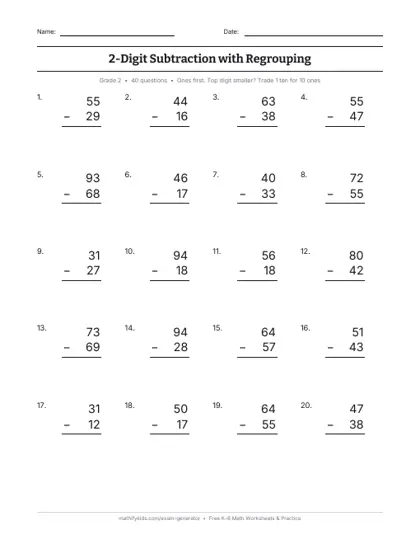
2-digit subtraction with regrouping worksheet: printable PDF with an answer key. · Make a fresh test
Subtraction practice · subtraction speed test · subtraction chart · subtraction for kids
Last reviewed
Questions parents ask
What is subtraction with regrouping?
Subtraction where a top digit is smaller than the digit below it. 1 ten is traded for 10 ones (or 1 hundred for 10 tens) so the subtraction can be done.
Is regrouping the same as borrowing?
Yes. Regrouping is the word most US schools use now and borrowing is the older word; both mean trading 1 from the next place for 10.
How do you explain regrouping in subtraction to a child?
Use base-ten blocks or bundles of 10 sticks. When there are not enough ones, undo a ten to make 10 more ones, then take away.
What grade learns subtraction with regrouping?
Grade 2 regroups within 100 and starts within 1,000 (2.NBT.B.5, 2.NBT.B.7). Grade 3 subtracts within 1,000 fluently (3.NBT.A.2).
How can my child check subtraction with regrouping?
Add the answer to the number that was taken away. If the result is the top number, the subtraction is right.