
Subtracting multiples of 10 and 100
Subtracting tens is like subtracting ones: 7 tens − 3 tens = 4 tens, so 70 − 30 = 40. Here is how to take away 10, 100 and more.
The big idea: count tens like ones
A multiple of 10 is 10, 20, 30, 40 and so on. Each is a number of tens: 70 is 7 tens. So subtracting multiples of 10 uses facts your child already knows.
- 7 − 3 = 4, so 7 tens − 3 tens = 4 tens, and 70 − 30 = 40.
- 12 − 5 = 7, so 12 tens − 5 tens = 7 tens, and 120 − 50 = 70.
- 8 − 3 = 5, so 8 hundreds − 3 hundreds = 5 hundreds, and 800 − 300 = 500.
This is why the facts within 20 matter so much: every subtraction fact is reused for tens and hundreds.
See it: pictures to draw with your child
Copy these onto paper or a whiteboard. A quick sketch makes the idea concrete before any written method.
Ten less and a hundred less
When you take away 10, only the tens digit changes: it goes down by 1. 57 − 10 = 47, and the ones digit (7) stays the same.
When you take away 100, only the hundreds digit goes down by 1. 462 − 100 = 362.
On a hundred chart, taking away 10 moves you straight up one row. Ask your child to put a finger on 83, then move up: 73, 63, 53. “What changes? What stays the same?”
Watch the edge case: 105 − 10 = 95. The tens digit was 0, so one hundred is traded for ten tens first. Children who write 195 need to see this on a number line.
Jump back in tens
Set the start and how much to take away. Blue arcs are jumps of 10, red arcs are ones.
Taking tens from any number
To take a multiple of 10 from a 2-digit number, take away from the tens and leave the ones alone. 74 − 30: 7 tens − 3 tens = 4 tens, and the 4 ones stay. Answer: 44.
On a number line, that is three jumps back of 10: 64, 54, 44.
The same works for hundreds: 645 − 300 = 345. Only the hundreds digit changes.
Using tens to subtract any 2-digit number
Taking away tens is the first half of most mental subtraction. For 74 − 36, take away the tens first: 74 − 30 = 44. Then take away the ones: 44 − 6 = 38. This is the jump strategy, and it depends on taking away tens quickly.
A second trick is taking away 9 or 11. To take away 9, take away 10 and add 1 back: 46 − 9 = 36 + 1 = 37. To take away 11, take away 10 and 1 more: 46 − 11 = 35. The same idea works for 19, 21, 29 and 31.
Patterns to spot
| Ones fact | Tens | Hundreds |
|---|---|---|
| 5 − 2 = 3 | 50 − 20 = 30 | 500 − 200 = 300 |
| 9 − 4 = 5 | 90 − 40 = 50 | 900 − 400 = 500 |
| 13 − 6 = 7 | 130 − 60 = 70 | 1,300 − 600 = 700 |
| 10 − 7 = 3 | 100 − 70 = 30 | 1,000 − 700 = 300 |
Each row uses one fact three times. The last row uses the pairs that make 10, which also give the pairs that make 100 and 1,000.
Quiz: take away tens and hundreds
Use the fact you know, then put the tens or hundreds back.
Where this fits: subtraction step by step
- What is subtraction
- Subtraction within 10
- Counting back
- Subtraction on a number line
- Counting up
- Fact families
- Make 10 subtraction strategy
- Subtraction within 20
- Subtracting tens and hundreds (this page)
- 2-digit subtraction
- Subtraction with regrouping
- 3-digit subtraction
- Subtracting across zeros
- Mental subtraction strategies
- Checking subtraction with addition
- Missing number subtraction
- Estimating differences
- Multi-digit subtraction
- Subtraction word problems
What to say to your child
A short script for teaching it the first time. Pause after each line and let your child do the next step.
- “What is 7 − 3?” (4.) “So what is 7 tens − 3 tens?” (4 tens!)
- “And 4 tens is…?” (40.) “So 70 − 30 = 40.”
- “Now 57 − 10. Only one digit changes. Which one?” (The tens: 47.)
- “Let’s try 74 − 30. Jump back 10 three times.” (64, 54, 44.)
- “And 800 − 300?” (8 − 3 = 5, so 500.)
More worked examples
Example 1: tens: 90 − 60
9 − 6 = 3, so 9 tens − 6 tens = 3 tens = 30.
Example 2: tens from a 2-digit number: 86 − 50
8 tens − 5 tens = 3 tens. The 6 ones stay. Answer: 36.
Example 3: crossing 100: 130 − 50
13 tens − 5 tens = 8 tens = 80.
Example 4: hundreds: 750 − 300
7 hundreds − 3 hundreds = 4 hundreds. The 50 stays. Answer: 450.
Practice questions (answers below)
Ask these out loud or write them down. Check each answer, and ask “how did you get that?” for one or two.
- 80 − 30
- 60 − 60
- 100 − 40
- 67 − 10
- 94 − 30
- 105 − 10
- 900 − 600
- 538 − 100
- Raj had 70 stickers and gave away 20. How many are left?
- Stretch: 640 − 50 − 200
Show the answers
- 50
- 0
- 60
- 57
- 64
- 95
- 300
- 438
- 50 stickers
- 390
Common mistakes
How to teach it at home
Hundred chart climb
Point to a number and move up a row to take away 10.
Coins and notes
Pay with 10-rupee notes or dimes and work out what is left in your head.
Count back by 10s
Count back by 10 from any number: 87, 77, 67… while walking or on the stairs.
By grade
- Grade 1 (1.NBT.C.5, 1.NBT.C.6): find 10 less than a number in your head and subtract multiples of 10 from multiples of 10.
- Grade 2 (2.NBT.B.8): take 10 or 100 from any number from 100 to 900 in your head.
- Grade 3 (3.NBT.A.2): use place value to subtract within 1,000.
- Next: 2-digit subtraction and subtraction with regrouping.
More for each grade: Grade 1 math and the CBSE class 1 maths guide; Grade 2 math and the CBSE class 2 maths guide; Grade 3 math and the CBSE class 3 maths guide.
Worksheets and practice
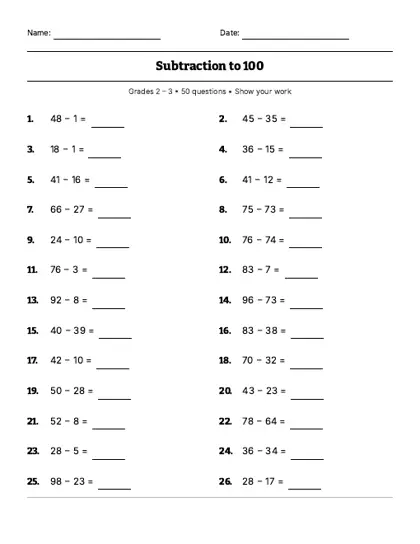
2-digit subtraction worksheet: printable PDF with an answer key. · Make a fresh test
Subtraction practice · subtraction speed test · subtraction chart · subtraction for kids · Multiplication practice trainer · 1-minute speed test
Last reviewed
Questions parents ask
How do you subtract multiples of 10?
Use the ones fact and keep the tens. 70 − 30: 7 − 3 = 4, so 7 tens − 3 tens = 4 tens, which is 40.
What is 10 less than a number?
Take 1 away from the tens digit and keep the ones digit. 10 less than 64 is 54. 10 less than 105 is 95.
How do you subtract 100 from a number?
Take 1 away from the hundreds digit. 462 − 100 = 362. The tens and ones stay the same.
What grade learns subtracting multiples of 10?
Grade 1 subtracts multiples of 10 within 100 (1.NBT.C.6). Grade 2 takes 10 or 100 from 3-digit numbers mentally (2.NBT.B.8).
Why is subtracting tens important?
It is the first step in mental subtraction. To work out 74 − 36 in your head, take 30 first (44) and then 6 (38).