
Missing number subtraction
A missing number can hide anywhere in a subtraction. A bar model or a fact family shows how to find it.
Three places a number can hide
| Missing | Example | How to find it |
|---|---|---|
| The answer | 12 − 5 = ? | Subtract: 7 |
| The number taken away | 12 − ? = 5 | Subtract the answer from the start: 12 − 5 = 7 |
| The starting number | ? − 5 = 7 | Add the two parts: 7 + 5 = 12 |
The last row surprises many children: a subtraction with a missing start is solved by adding. That makes sense once you see that the start is the whole, made of the two parts.
See it: pictures to draw with your child
Copy these onto paper or a whiteboard. A quick sketch makes the idea concrete before any written method.
Use a bar model
Draw a bar for the whole and split it into two parts. In any subtraction, the first number is the whole, and the other two numbers are the parts.
- If you know both parts, add to find the whole.
- If you know the whole and one part, subtract to find the other part.
This one rule solves every missing number problem in addition and subtraction.
Find the missing part
Set the two parts, then choose whether the whole or a part is missing.
Fact families and counting up
For small numbers, a fact family gives the answer straight away. 12 − ? = 5: the family is 5, 7 and 12, so the missing number is 7.
For bigger numbers, count up. 63 − ? = 38: count up from 38 to 63, which is 2 to 40 and 23 more, so 25. Check: 63 − 25 = 38.
Balancing
Some puzzles have numbers on both sides: 15 − 6 = ? − 2. The = sign means both sides are equal. 15 − 6 = 9, so the right side must also be 9: ? − 2 = 9, so the missing number is 11. Puzzles like this build the idea of balance that algebra needs later.
Missing numbers in stories
Word problems often hide the missing number in a different place from the end:
- Start unknown: “Some birds were on a tree. 5 flew away and 8 are left. How many were there at first?” ? − 5 = 8, so 13.
- Change unknown: “There were 15 cakes. Some were eaten and 6 are left. How many were eaten?” 15 − ? = 6, so 9.
- Result unknown: “There were 15 cakes and 9 were eaten. How many are left?” 15 − 9 = ?, so 6.
The start-unknown problems are the hardest for most children, because the story says “flew away” but the answer needs adding. Drawing a bar model first makes it clear that the start is the whole.
Write the missing-number sentence first, with a box or question mark, before solving. It shows exactly what the story says and helps your child choose between adding and subtracting.
Quiz: find the missing number
Decide whether the missing number is the whole or a part.
Where this fits: subtraction step by step
- What is subtraction
- Subtraction within 10
- Counting back
- Subtraction on a number line
- Counting up
- Fact families
- Make 10 subtraction strategy
- Subtraction within 20
- Subtracting tens and hundreds
- 2-digit subtraction
- Subtraction with regrouping
- 3-digit subtraction
- Subtracting across zeros
- Mental subtraction strategies
- Checking subtraction with addition
- Missing number subtraction (this page)
- Estimating differences
- Multi-digit subtraction
- Subtraction word problems
What to say to your child
A short script for teaching it the first time. Pause after each line and let your child do the next step.
- “What number goes in the box: 10 − ? = 6?” (Hmm…)
- “10 is the whole. 6 is one part. What is the other part?” (4!)
- “Check it: 10 − 4?” (6. Yes!)
- “Now ? − 3 = 5. Here the whole is missing. What do we do with the parts?” (Add: 8!)
- “Whole missing: add. Part missing: subtract.”
More worked examples
Example 1: part missing: 15 − ? = 9
15 is the whole and 9 is a part. 15 − 9 = 6, so the missing number is 6. Check: 15 − 6 = 9.
Example 2: whole missing: ? − 8 = 7
8 and 7 are the parts. 8 + 7 = 15, so the missing number is 15. Check: 15 − 8 = 7.
Example 3: bigger numbers: 84 − ? = 47
Count up from 47: 3 to 50 and 34 to 84, total 37. Check: 84 − 37 = 47.
Example 4: balance: 20 − 8 = ? + 5
20 − 8 = 12, so ? + 5 = 12. The missing number is 7.
Practice questions (answers below)
Ask these out loud or write them down. Check each answer, and ask “how did you get that?” for one or two.
- 9 − ? = 4
- ? − 3 = 6
- 14 − ? = 8
- ? − 7 = 7
- 20 − ? = 13
- ? − 25 = 30
- 70 − ? = 45
- Raj had some sweets. He ate 4 and has 9 left. How many did he have?
- Stretch: 18 − 9 = ? − 3
Show the answers
- 5
- 9
- 6
- 14
- 7
- 55
- 25
- 13 sweets
- 12
Common mistakes
How to teach it at home
Hidden objects
Show 10 toys, hide some, and ask how many are hiding from what is left.
Box puzzles
Write puzzles like 15 − ? = 9 on sticky notes around the house.
Mystery number
“I’m thinking of a number. Take away 6 and you get 8. What is it?”
By grade
- Grade 1 (1.OA.B.4, 1.OA.D.8): find the unknown number in addition and subtraction equations within 20.
- Grade 2 (2.OA.A.1): solve word problems with unknowns in all positions within 100.
- Grade 3 (3.OA.A.4): find unknown numbers in equations, a step towards algebra.
- Next: subtraction word problems.
More for each grade: Grade 1 math and the CBSE class 1 maths guide; Grade 2 math and the CBSE class 2 maths guide; Grade 3 math and the CBSE class 3 maths guide.
Worksheets and practice
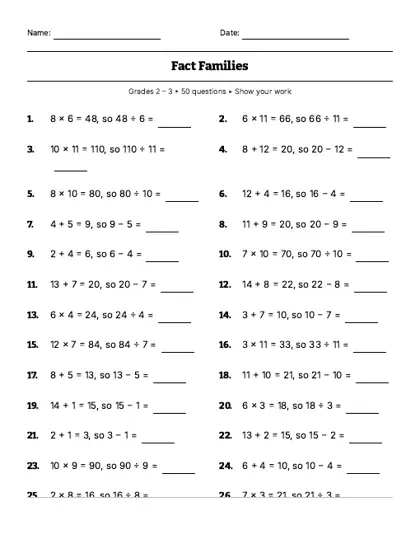
Fact families worksheet: printable PDF with an answer key. · Make a fresh test
Subtraction practice · subtraction speed test · subtraction chart · subtraction for kids
Last reviewed
Questions parents ask
How do you find a missing number in subtraction?
Decide what is missing. If the starting number is missing, add the other two. If the number taken away is missing, subtract the answer from the start.
What is ? − 5 = 7?
12. The start is missing, so add the two parts: 7 + 5 = 12. Check: 12 − 5 = 7.
What is 12 − ? = 5?
7. 12 is the whole and 5 is one part, so the other part is 12 − 5 = 7.
What grade learns missing number subtraction?
Grade 1 within 20 (1.OA.D.8), grade 2 in word problems within 100 (2.OA.A.1), and grade 3 as a step to algebra (3.OA.A.4).
How do bar models help with missing numbers?
They show the whole and the parts. Whole missing: add the parts. Part missing: subtract from the whole.