
Subtraction word problems
Read the story, picture it, then decide what to subtract. A bar model makes any subtraction word problem easy to see.
A 4-step plan for any word problem
- Read it twice. First for the story, then for the numbers and the question.
- Picture it. Draw dots, a number line or a bar model. Say what is happening in your own words.
- Write the number sentence and work it out: 42 − 17 = 25.
- Answer in a sentence with the unit (25 stickers), and check by adding back: 25 + 17 = 42.
See it: pictures to draw with your child
Copy these onto paper or a whiteboard. A quick sketch makes the idea concrete before any written method.
The kinds of subtraction word problems
| Type | Example | Number sentence |
|---|---|---|
| Take away | 12 birds sit on a wire. 5 fly away. How many are left? | 12 − 5 = ? |
| Compare (how many more) | Sam has 15 cards and Ana has 9. How many more does Sam have? | 15 − 9 = ? |
| Compare (how many fewer) | A red tower has 8 blocks; a blue one has 13. How many fewer in the red tower? | 13 − 8 = ? |
| Missing part | 20 children, 11 are girls. How many are boys? | 20 − 11 = ? |
| Missing change | Mia had 7 shells and now has 12. How many did she find? | 12 − 7 = ? |
Take-away problems come first in kindergarten and grade 1. Compare problems are harder because nothing is taken away, so children need to see the two amounts side by side.
Draw it as a bar model
Set the two parts. Choose “A part is unknown” for take-away and compare stories.
A word about key words
Words like left, how many more, fewer, difference and gave away often mean subtract. But key words can mislead.
“Leo has 6 more marbles than Sam. Sam has 9. How many does Leo have?” contains “more” but needs addition: 9 + 6 = 15.
So teach key words as clues, not rules. The real question is: “Do I know the whole and one part?” If so, subtract. If you know both parts and need the whole, add.
Word problems grade by grade
- Grade 1: take away, compare and missing-part stories within 20, with objects and drawings.
- Grade 2: one- and two-step problems within 100 with bar models. “A class had 52 pencils and used 27. How many are left?”
- Grade 3: two-step problems within 1,000, checked with estimates. “A shop had 450 apples, sold 186 and threw away 24. How many are left?”
- Grade 4: multi-step problems with larger numbers and all four operations.
Two-step problems
From grade 2, many stories need two steps. “Ana had 60 rupees. She bought a pen for 18 and a book for 25. How much is left?” Either add the costs first (18 + 25 = 43, then 60 − 43 = 17) or subtract one at a time (60 − 18 = 42, 42 − 25 = 17). Both give 17.
Quiz: solve the word problems
Picture the story, then subtract.
Where this fits: subtraction step by step
- What is subtraction
- Subtraction within 10
- Counting back
- Subtraction on a number line
- Counting up
- Fact families
- Make 10 subtraction strategy
- Subtraction within 20
- Subtracting tens and hundreds
- 2-digit subtraction
- Subtraction with regrouping
- 3-digit subtraction
- Subtracting across zeros
- Mental subtraction strategies
- Checking subtraction with addition
- Missing number subtraction
- Estimating differences
- Multi-digit subtraction
- Subtraction word problems (this page)
What to say to your child
A short script for teaching it the first time. Pause after each line and let your child do the next step.
- “Listen: Sam has 15 cards and Ana has 9. How many more does Sam have? What do we know?” (Both numbers.)
- “Is anything taken away?” (No.) “So let’s draw two bars and compare.”
- “Sam’s bar is longer. How much longer?” (15 − 9 = 6.)
- “Say it as a sentence.” (Sam has 6 more cards.)
- “Check: 9 + 6 = 15. Yes!”
More worked examples
Example 1: grade 1, take away
“There are 11 apples. Tom eats 3. How many are left?” 11 − 3 = 8. There are 8 apples left.
Example 2: grade 2, compare
“A giraffe is 52 dm tall and a camel is 28 dm. How much taller is the giraffe?” 52 − 28 = 24. The giraffe is 24 dm taller.
Example 3: grade 3, two steps
“A shop had 450 apples. It sold 186 and threw away 24. How many are left?” 450 − 186 = 264, then 264 − 24 = 240 apples.
Example 4: grade 4, large numbers
“A stadium holds 8,500 people. 6,738 tickets are sold. How many seats are empty?” 8,500 − 6,738 = 1,762 seats.
Practice questions (answers below)
Ask these out loud or write them down. Check each answer, and ask “how did you get that?” for one or two.
- 9 frogs are on a log. 4 jump off. How many are left?
- Ana has 14 beads and Sam has 8. How many more does Ana have?
- There are 20 children; 12 are boys. How many are girls?
- Mia had 9 stickers and now has 16. How many did she get?
- A ribbon is 75 cm. 38 cm is cut off. How much is left?
- A bus had 46 people. 19 got off. How many are on the bus?
- A school has 412 students; 187 walk to school. How many do not walk?
- Raj had 100 rupees and spent 35 and 28. How much is left?
- Leo has 6 more marbles than Sam. Sam has 9. How many does Leo have?
- Stretch: a tank holds 1,000 litres and has 365 litres. How much more water fits?
Show the answers
- 5 frogs
- 6 more
- 8 girls
- 7 stickers
- 37 cm
- 27 people
- 225 students
- 37 rupees
- 15 marbles (this one is addition!)
- 635 litres
Common mistakes
How to teach it at home
Story time take-away
Make up quick stories with toys: “7 dinosaurs, 2 go home…”
How many more?
Compare heights, ages and scores at home.
Child as author
Let your child invent a subtraction story for you to solve.
By grade
- Grade 1 (1.OA.A.1): take-away, compare and missing-part problems within 20.
- Grade 2 (2.OA.A.1): one- and two-step problems within 100 with unknowns in all positions.
- Grade 3 (3.OA.D.8): two-step problems, checked with estimation.
- Grade 4 (4.OA.A.3): multi-step problems with whole numbers.
- Next: estimating differences to check answers.
More for each grade: Grade 1 math and the CBSE class 1 maths guide; Grade 2 math and the CBSE class 2 maths guide; Grade 3 math and the CBSE class 3 maths guide; Grade 4 math and the CBSE class 4 maths guide.
Worksheets and practice
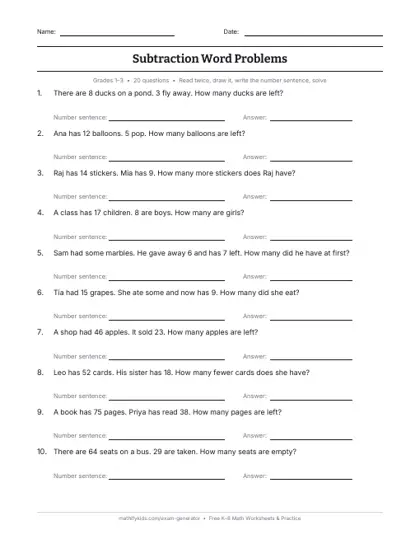
Subtraction word problems worksheet: printable PDF with an answer key. · Make a fresh test
Subtraction practice · subtraction speed test · subtraction chart · subtraction for kids
Last reviewed
Questions parents ask
How do you solve subtraction word problems?
Read twice, draw a bar model, decide whether you know the whole and a part, write the number sentence, and answer in a full sentence.
What are the key words for subtraction?
Left, how many more, fewer, difference, gave away and remain often mean subtract. Treat them as clues, because “more” also appears in addition problems.
What is a compare word problem?
A story that compares two amounts, such as “how many more does Sam have?” Nothing is taken away, but you subtract to find the difference.
How do I help my child with subtraction word problems?
Ask them to retell the story, draw it, and decide whether the whole or a part is missing before doing any maths.
What grade starts subtraction word problems?
Kindergarten solves take-away stories within 10, and grade 1 solves all types within 20 (1.OA.A.1).