
Subtraction on a number line
On a number line you can subtract two ways: hop back from the bigger number, or count up from the smaller one.
Hop back to take away
- Find the first number on the line and put your finger on it.
- Hop back (to the left) one step for each number you take away.
- The number you land on is the answer.
For 12 − 3: start at 12, hop back 3 times (11, 10, 9) and land on 9. So 12 − 3 = 9. Subtracting moves to the left, because the numbers get smaller.
Hopping back is quick when the number taken away is small. For bigger numbers, there is a better way.
See it: pictures to draw with your child
Copy these onto paper or a whiteboard. A quick sketch makes the idea concrete before any written method.
Count up to find the difference
Subtraction also tells you how far apart two numbers are. On a number line you can see that distance by starting at the smaller number and counting up to the bigger one.
For 13 − 9: start at 9 and count the hops to 13: 10, 11, 12, 13. That is 4 hops, so 13 − 9 = 4. Counting back 9 steps from 13 would take much longer and is easy to get wrong.
A good rule: if the number taken away is small, hop back; if the two numbers are close, count up.
Hop back or count up
Set the start and how many to take away. Then switch between hopping back and counting up.
Bigger numbers: jump back in tens, then ones
For 2-digit numbers, split the number taken away into tens and ones. For 64 − 27: jump back 2 tens (54, 44), then hop back 7 ones to 37. So 64 − 27 = 37.
Many schools use an open number line: a blank line where children draw only the jumps they need. The jumps can be any size, such as back 4 to reach 60 and then back 23 more. This is the thinking behind mental subtraction.
Counting up works with big numbers too. For 82 − 76, count up 4 to 80 and 2 more to 82: 6. Shopkeepers give change this way.
Jump back in tens, then ones
Try 2-digit numbers. Blue arcs are tens, red arcs are ones.
When to use a number line
- Grade 1: to understand what taking away does, with hops of 1, and to count up for close numbers.
- Grade 2: for jumps of 10, open number lines and finding differences within 100.
- Later: as a quick sketch for subtracting time (how long from 3:45 to 4:20?), money and temperatures.
Once your child can picture the jumps without drawing them, the number line has done its job and the subtraction has become mental maths.
Quiz: subtract on a number line
Picture the hops: back for small numbers, up for close numbers.
Where this fits: subtraction step by step
- What is subtraction
- Subtraction within 10
- Counting back
- Subtraction on a number line (this page)
- Counting up
- Fact families
- Make 10 subtraction strategy
- Subtraction within 20
- Subtracting tens and hundreds
- 2-digit subtraction
- Subtraction with regrouping
- 3-digit subtraction
- Subtracting across zeros
- Mental subtraction strategies
- Checking subtraction with addition
- Missing number subtraction
- Estimating differences
- Multi-digit subtraction
- Subtraction word problems
What to say to your child
A short script for teaching it the first time. Pause after each line and let your child do the next step.
- “Put your finger on 11.” (Finds 11.)
- “We are taking away 2, so hop back 2.” (10, 9.)
- “Where did you land?” (9.) “So 11 − 2 = 9.”
- “Now 15 − 12. Hopping back 12 is a lot. Start at 12 and count up to 15.” (13, 14, 15.)
- “How many hops?” (3!) “So 15 − 12 = 3.”
More worked examples
Example 1: hop back: 10 − 4
Start at 10. Hop back 4: 9, 8, 7, 6. You land on 6, so 10 − 4 = 6.
Example 2: count up: 21 − 18
Start at 18. Count up to 21: 19, 20, 21. That is 3 hops, so 21 − 18 = 3.
Example 3: tens then ones: 53 − 21
Start at 53. Jump back 2 tens: 43, 33. Hop back 1 one: 32. So 53 − 21 = 32.
Practice questions (answers below)
Ask these out loud or write them down. Check each answer, and ask “how did you get that?” for one or two.
- 9 − 2
- 14 − 3
- 16 − 14
- 20 − 17
- 30 − 10
- 45 − 20
- 52 − 7
- 63 − 58
- A ribbon is 34 cm. Mia cuts off 12 cm. How long is it now?
- Stretch: 81 − 36
Show the answers
- 7
- 11
- 2
- 3
- 20
- 25
- 45
- 5
- 22 cm
- 45
Common mistakes
How to teach it at home
Chalk number line
Draw 0 to 20 on the pavement. Stand on a number and hop back to subtract.
Ruler hops
Use a ruler as a number line: start at 15, slide back 6.
Countdown
Count down from 20 to 0 together, then by 2s and by 10s from 100.
By grade
- Grade 1 (1.OA.C.5): relate counting to subtraction, such as counting back or counting up.
- Grade 2 (2.NBT.B.5, 2.MD.B.6): subtract within 100 using place value and show differences on a number line.
- Next: counting up and subtracting tens.
More for each grade: Grade 1 math and the CBSE class 1 maths guide; Grade 2 math and the CBSE class 2 maths guide.
Worksheets and practice
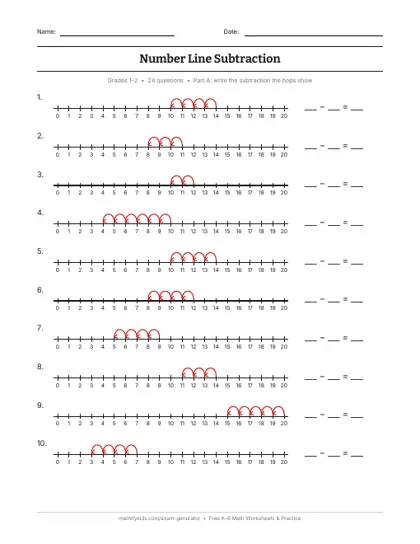
Number line subtraction worksheet: printable PDF with an answer key. · Make a fresh test
Subtraction practice · subtraction speed test · subtraction chart · subtraction for kids
Last reviewed
Questions parents ask
How do you subtract on a number line?
Start at the first number and hop back one step for each number taken away. Where you land is the answer: 12 − 3 lands on 9.
What is counting up on a number line?
Starting at the smaller number and counting the hops to the bigger one. For 13 − 9, there are 4 hops from 9 to 13, so the answer is 4.
When should I hop back and when should I count up?
Hop back when taking away a small number. Count up when the two numbers are close together.
What is an open number line?
A blank line where children draw only the jumps they need, such as tens and then ones. It shows how mental subtraction works.
What grade learns subtraction on a number line?
Grade 1 with hops of 1, and grade 2 with jumps of 10 within 100 (1.OA.C.5, 2.MD.B.6).