
Mental subtraction strategies
Five tricks for subtracting in your head: tens first, count up, round and adjust, same difference and back to ten.
Why learn to subtract in your head?
Column subtraction always works, but it is slow for problems like 62 − 59 or 300 − 198, and it hides how numbers relate. Mental strategies are quicker and build number sense, and they give a fast check on written answers.
The trick is to look at the numbers first and choose. Different numbers suit different strategies, and children who choose well rarely need a pencil for 2-digit subtraction.
See it: pictures to draw with your child
Copy these onto paper or a whiteboard. A quick sketch makes the idea concrete before any written method.
The five strategies
| Strategy | Example | Best when |
|---|---|---|
| Tens first | 74 − 32: 74 − 30 = 44, 44 − 2 = 42 | No regrouping needed, or small ones |
| Count up | 62 − 57: 57 → 60 is 3, 60 → 62 is 2, total 5 | The two numbers are close |
| Round and adjust | 83 − 29: 83 − 30 = 53, add 1 back = 54 | Taking away 9, 19, 29, 98… |
| Same difference | 71 − 38 = 73 − 40 = 33 | Moving both numbers makes it easy |
| Back to ten | 53 − 8: 53 − 3 = 50, 50 − 5 = 45 | Taking a 1-digit number across a ten |
Picture it on a number line
Jump back in tens, then ones. Switch to count up for close numbers.
The same-difference trick
If you add the same amount to both numbers, the difference does not change. Picture two children, aged 7 and 10: in 5 years they will be 12 and 15, still 3 years apart.
So 71 − 38 is the same as 73 − 40 (add 2 to both), and 73 − 40 = 33 is easy. For 300 − 198, add 2 to both: 302 − 200 = 102.
You can also take the same amount from both. 500 − 178 is the same as 499 − 177, which needs no regrouping: 322.
How to choose
- Is the number taken away close to a ten or hundred (19, 29, 98)? Round and adjust.
- Are the two numbers close together? Count up.
- Do the ones subtract easily (74 − 32)? Tens first.
- Is it a 1-digit number crossing a ten (53 − 8)? Back to ten.
- Can both numbers move to make a round number? Same difference.
There is no single right method. Ask your child “how did you do it?” and celebrate different routes to the same answer.
Building the habit
Mental strategies grow from the facts within 20. A child who knows 13 − 8 = 5 instantly can do 63 − 8, 130 − 80 and 1,300 − 800 just as quickly. So keep a few minutes of fact practice going while learning these strategies.
Start with one strategy a week, using numbers that suit it. Then mix problems and ask your child to choose. Writing the jumps on a quick number line is fine at first; the aim is to need the paper less and less.
Quiz: subtract in your head
Pick a strategy for each one. The hint shows a quick way.
Where this fits: subtraction step by step
- What is subtraction
- Subtraction within 10
- Counting back
- Subtraction on a number line
- Counting up
- Fact families
- Make 10 subtraction strategy
- Subtraction within 20
- Subtracting tens and hundreds
- 2-digit subtraction
- Subtraction with regrouping
- 3-digit subtraction
- Subtracting across zeros
- Mental subtraction strategies (this page)
- Checking subtraction with addition
- Missing number subtraction
- Estimating differences
- Multi-digit subtraction
- Subtraction word problems
What to say to your child
A short script for teaching it the first time. Pause after each line and let your child do the next step.
- “What is 62 − 59? Would you use columns?” (Maybe.)
- “Look how close the numbers are. Count up from 59.” (60, 61, 62: three!)
- “Now 83 − 29. 29 is nearly 30. Take 30.” (53.) “We took 1 too many, so add it back.” (54!)
- “And 74 − 32?” (Tens first: 44, then 42.)
- “Which trick did you like best? There is more than one right way.”
More worked examples
Example 1: tens first: 86 − 43
Take the tens: 86 − 40 = 46. Then the ones: 46 − 3 = 43. So 86 − 43 = 43.
Example 2: round and adjust: 152 − 98
98 is nearly 100. 152 − 100 = 52. We took 2 too many, so add 2: 54.
Example 3: same difference: 61 − 27
Add 3 to both: 64 − 30 = 34. So 61 − 27 = 34.
Example 4: back to ten: 42 − 7
42 − 2 = 40, then take the other 5: 35.
Practice questions (answers below)
Ask these out loud or write them down. Check each answer, and ask “how did you get that?” for one or two.
- 55 − 23
- 71 − 68
- 64 − 19
- 90 − 47
- 43 − 8
- 200 − 97
- 81 − 39
- 500 − 248
- A toy costs 79 rupees. You pay with 100. How much change?
- Stretch: 1,000 − 999 and 1,000 − 1
Show the answers
- 32
- 3
- 45
- 43
- 35
- 103
- 42
- 252
- 21 rupees
- 1 and 999
Common mistakes
How to teach it at home
Change at the shop
Ask how much change from 100 for a price like 64: count up.
Ages
Ask how many years between two family members’ ages.
One strategy a week
Pick one trick and use it for every subtraction that week.
By grade
- Grade 2 (2.NBT.B.5, 2.NBT.B.9): subtract within 100 using strategies based on place value, and explain why they work.
- Grade 3 (3.NBT.A.2): subtract within 1,000 fluently using strategies and algorithms.
- Next: checking subtraction with addition and estimating differences.
More for each grade: Grade 2 math and the CBSE class 2 maths guide; Grade 3 math and the CBSE class 3 maths guide; Grade 4 math and the CBSE class 4 maths guide.
Worksheets and practice
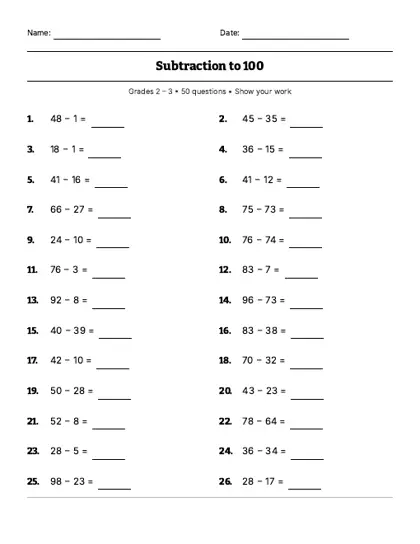
2-digit subtraction worksheet: printable PDF with an answer key. · Make a fresh test
Subtraction practice · subtraction speed test · subtraction chart · subtraction for kids
Last reviewed
Questions parents ask
What are mental subtraction strategies?
Ways to subtract in your head without writing columns: tens first, count up, round and adjust, same difference and back to ten.
What is the easiest way to subtract in your head?
It depends on the numbers. Close numbers: count up. Numbers like 29 or 98: round and adjust. Otherwise take the tens first, then the ones.
What is the same difference strategy?
Adding or taking the same amount from both numbers keeps the difference the same. 71 − 38 = 73 − 40 = 33.
What grade learns mental subtraction?
Grade 2 subtracts within 100 using place-value strategies (2.NBT.B.5), and grade 3 within 1,000 (3.NBT.A.2).
Should my child still learn column subtraction?
Yes. Mental strategies are faster for many problems, and the written method handles any size. Children need both.