
Addition with regrouping
When a column adds up to 10 or more, trade 10 ones for 1 ten (or 10 tens for 1 hundred). That trade is called regrouping or carrying.
What regrouping means
Each place in a number can hold only one digit, from 0 to 9. When the ones add up to 10 or more, there are too many ones for one place.
So we trade 10 ones for 1 ten and move that ten to the tens column. This trade is called regrouping. Many families call it carrying, and both words mean the same thing.
Example: 47 + 28. Ones: 7 + 8 = 15, which is 1 ten and 5 ones.
Write 5 in the ones place and carry the 1 ten. Tens: 4 + 2 + 1 = 7, so the answer is 75.
The small 1 written above the tens column is not “one”. It is one ten, worth 10. Children who understand this rarely forget to carry.
See it: pictures to draw with your child
Copy these onto paper or a whiteboard. A quick sketch makes the idea concrete before any written method.
How to add with regrouping, step by step
- Line up the places. Ones under ones, tens under tens, hundreds under hundreds.
- Add the ones. If the sum is 10 or more, write the ones digit and carry 1 to the tens.
- Add the tens, plus any carried 1. If this is 10 or more, write the ones digit of it and carry 1 to the hundreds.
- Add the hundreds, plus any carried 1.
- Check with an estimate. 47 + 28 is about 50 + 30 = 80, so 75 makes sense.
Watch each column, step by step
Type two numbers and press Next step. The red 1 shows each regroup.
Every kind of regrouping
| Case | Example | What happens |
|---|---|---|
| No regrouping | 34 + 25 = 59 | 4 + 5 = 9 and 3 + 2 = 5. Nothing reaches 10. |
| Regroup ones | 38 + 25 = 63 | 8 + 5 = 13: write 3, carry 1 ten. |
| Regroup tens | 172 + 54 = 226 | 7 + 5 = 12 tens: write 2, carry 1 hundred. |
| Regroup twice | 368 + 257 = 625 | 8 + 7 = 15 (carry), then 6 + 5 + 1 = 12 (carry again). |
| Ones make exactly 10 | 46 + 34 = 80 | 6 + 4 = 10: write 0, carry 1. Do not forget the 0. |
| Chain through a zero | 195 + 7 = 202 | 5 + 7 = 12, then 9 + 1 = 10, then 1 + 1 = 2. |
Why regrouping works
Our numbers use base ten: 10 ones make 1 ten, 10 tens make 1 hundred, and 10 hundreds make 1 thousand. Regrouping does not change the total. It only writes the same amount in the standard way.
15 ones and 6 tens is the same amount as 7 tens and 5 ones. The second way is just how we write it.
Base-ten blocks make this easy to see. Build both numbers, push the ones together, and swap any group of 10 cubes for a rod.
Then push the rods together and swap 10 rods for a flat. The blocks left on the table are the answer, written in the standard way.
Regrouping in subtraction
Subtraction uses the same trade in reverse: when there are not enough ones, 1 ten is broken into 10 ones. Children who understand carrying as a trade usually find subtraction regrouping (borrowing) much easier.
Quiz: add with regrouping
Every question needs at least one regroup.
Where this fits: addition step by step
What to say to your child
A short script for teaching it the first time. Pause after each line and let your child do the next step.
- “Let’s add 47 and 28. Start with the ones. What is 7 + 8?” (15.)
- “Can 15 fit in the ones place?” (No, only one digit fits.) “So 15 is 1 ten and 5 ones.”
- “Write the 5. The ten moves over to the tens. Write a small 1 on top.”
- “Now the tens: 4 + 2 + the 1 we carried.” (7.) “So the answer is 75.”
- “Is that sensible? 47 is about 50, 28 is about 30. 50 + 30 = 80.” (75 is close, so yes!)
More worked examples
Example 1: one regroup: 56 + 27
Ones: 6 + 7 = 13, so write 3 and carry 1. Tens: 5 + 2 + 1 = 8. Answer: 83.
Example 2: regroup the tens: 284 + 153
Ones: 4 + 3 = 7. Tens: 8 + 5 = 13 tens, so write 3 and carry 1 hundred. Hundreds: 2 + 1 + 1 = 4, so 437.
Example 3: two regroups: 479 + 246
Ones: 9 + 6 = 15, write 5 and carry 1. Tens: 7 + 4 + 1 = 12, write 2 and carry 1. Hundreds: 4 + 2 + 1 = 7, so 725.
Example 4: making exactly 10: 65 + 25
Ones: 5 + 5 = 10, so write 0 and carry 1. Tens: 6 + 2 + 1 = 9. Answer: 90.
Practice questions (answers below)
Ask these out loud or write them down. Check each answer, and ask “how did you get that?” for one or two.
- 37 + 45
- 58 + 26
- 69 + 23
- 44 + 36
- 163 + 29
- 245 + 182
- 378 + 145
- 599 + 1
- A shop sold 186 cups on Monday and 147 on Tuesday. How many cups?
- Stretch: 456 + 278 + 66
Show the answers
- 82
- 84
- 92
- 80
- 192
- 427
- 523
- 600
- 333 cups
- 800
Common mistakes
How to teach it at home
Bundle and trade
Use straws or sticks. Each time you reach 10 loose ones, put a rubber band round them to make a ten.
Money swap
Add coins. When you have 10 one-rupee or one-cent coins, swap them for a 10.
Estimate first
Before your child adds, ask “about how much?” and compare the answer with the guess.
By grade
- Grade 2 (2.NBT.B.5, 2.NBT.B.7): add within 100 fluently and within 1,000 using models, regrouping ones and tens.
- Grade 2 (2.NBT.B.9): explain why the strategies work, using place value.
- Grade 3 (3.NBT.A.2): fluently add within 1,000 with the standard method.
- Next: 3-digit addition and estimating sums.
More for each grade: Grade 2 math and the CBSE class 2 maths guide; Grade 3 math and the CBSE class 3 maths guide.
Worksheets and practice
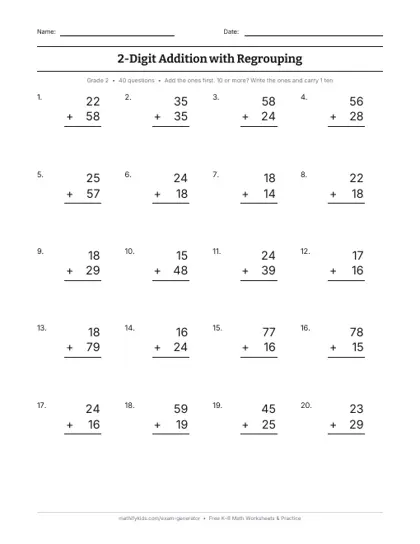
2-digit addition with regrouping worksheet: printable PDF with an answer key. · Make a fresh test
Addition practice · addition speed test · addition chart · addition for kids
Last reviewed
Questions parents ask
What is addition with regrouping?
It is addition where a column adds up to 10 or more. Ten ones are traded for one ten (or ten tens for one hundred) and moved to the next column.
Is regrouping the same as carrying?
Yes. Regrouping is the word most US schools use now and carrying is the older word; both mean moving a group of ten to the next place.
How do you explain regrouping to a child?
Use base-ten blocks or bundles of 10 sticks. When there are 10 or more loose ones, trade 10 of them for a ten. The written 1 is that ten.
What grade learns regrouping in addition?
Grade 2 regroups within 100 and starts within 1,000 (2.NBT.B.5, 2.NBT.B.7). Grade 3 adds within 1,000 fluently (3.NBT.A.2).
Why does my child forget to carry?
Usually because the 1 feels like a small mark, not a real ten. Practice with blocks and ask “where did that ten go?” after each column.