
Estimating sums
To estimate a sum, round each number to the nearest 10 or 100, then add the rounded numbers. You get a quick answer close to the exact one.
What estimating a sum means
An estimate is an answer that is close enough, found quickly. We estimate when an exact answer is not needed, or to check that an exact answer makes sense.
To estimate 47 + 38: round 47 to 50 and 38 to 40. Then 50 + 40 = 90. The exact answer is 85, which is close to 90, so the estimate did its job.
We write “about 90” or use the sign ≈, which means “is about equal to”: 47 + 38 ≈ 90.
See it: pictures to draw with your child
Copy these onto paper or a whiteboard. A quick sketch makes the idea concrete before any written method.
How to round a number
- Find the two tens (or hundreds) the number sits between. 47 is between 40 and 50.
- Look at the digit to the right. For the nearest 10, look at the ones. For the nearest 100, look at the tens.
- 5 or more rounds up; 4 or less rounds down. 47 has 7 ones, so it rounds up to 50.
On a number line, a number rounds to whichever end it is nearer. Numbers exactly halfway, like 45, round up by convention.
Round, then add
Change the numbers and the place. Compare the estimate with the exact answer.
Nearest 10 or nearest 100?
Rounding to a bigger place is quicker but less accurate. For 268 + 341:
- Nearest 100: 300 + 300 = 600 (exact answer 609, off by 9).
- Nearest 10: 270 + 340 = 610 (off by 1).
A good habit is to round to the place that keeps the numbers easy to add in your head. For most 2-digit sums that is the nearest 10. For 3-digit sums, try the nearest 100 first and use tens if you need to be closer.
A neat trick is front-end estimation: keep only the first digit of each number and add. 268 + 341 → 200 + 300 = 500. It is fast but always too low, so it works best as a rough check.
When to estimate
- To check an answer. If 47 + 38 comes out as 715, the estimate of 90 shows straight away that something is wrong.
- When “about” is enough. “Do we have enough money?” and “Will it take more than an hour?” rarely need exact answers.
- Before a word problem. An estimate tells your child roughly what size of answer to expect.
In grade 3, the standards ask children to judge whether answers are reasonable using mental math and estimation (3.OA.D.8). Making “estimate first” a habit is one of the best ways to cut careless mistakes.
Over or under?
When both numbers round up, the estimate is bigger than the exact answer. When both round down, it is smaller. If one rounds up and the other down, the errors partly cancel, and the estimate is usually very close.
Asking “is the real answer bigger or smaller than our estimate?” is a great thinking question for grade 4. It can also settle money questions: if every price was rounded up, the real total will be less than the estimate.
Quiz: estimate the sum
Round each number, then add the rounded numbers.
Where this fits: addition step by step
What to say to your child
A short script for teaching it the first time. Pause after each line and let your child do the next step.
- “We want to know about how much 47 + 38 is. What ten is 47 close to?” (50.)
- “And 38?” (40.)
- “So about how much is the sum?” (50 + 40 = 90.)
- “Now work it out exactly.” (85.) “Is 85 close to 90?” (Yes!)
- “If you had got 115, what would the estimate tell you?” (That it’s wrong.)
More worked examples
Example 1: 2-digit: 63 + 28
63 rounds to 60. 28 rounds to 30. 60 + 30 = 90, so 63 + 28 ≈ 90. (Exact: 91.)
Example 2: 3-digit: 412 + 386
To the nearest 100: 400 + 400 = 800. (Exact: 798.)
Example 3: checking an answer: 259 + 148 = 307?
Estimate: 300 + 100 = 400. 307 is far from 400, so check again. The correct answer is 407.
Example 4: money: ₹48 + ₹29 + ₹12
Round: 50 + 30 + 10 = 90. About ₹90, so a ₹100 note is enough. (Exact: ₹89.)
Practice questions (answers below)
Ask these out loud or write them down. Check each answer, and ask “how did you get that?” for one or two.
- Round 46 to the nearest 10.
- Round 72 to the nearest 10.
- Estimate 34 + 58.
- Estimate 67 + 25.
- Round 351 to the nearest 100.
- Estimate 412 + 279 to the nearest 100.
- Estimate 189 + 207 to the nearest 100.
- Is 58 + 37 = 85 reasonable?
- A book costs $38 and a game $47. Is $80 enough?
- Stretch: estimate 1,248 + 3,675 to the nearest 1,000.
Show the answers
- 50
- 70
- 30 + 60 = 90
- 70 + 30 = 100
- 400
- 400 + 300 = 700
- 200 + 200 = 400
- No: 60 + 40 = 100, and the exact answer is 95
- No: about $40 + $50 = $90 (exact $85)
- 1,000 + 4,000 = 5,000
Common mistakes
How to teach it at home
Shopping total
Round each price to the nearest 10 and keep a running estimate in your head. Compare with the bill.
Guess then check
Before any written sum, ask “about how much?” and write the estimate beside it.
Closest wins
Each player estimates a sum; the closest to the exact answer gets a point.
By grade
- Grade 3 (3.NBT.A.1, 3.OA.D.8): round to the nearest 10 or 100 and use estimates to check if answers are reasonable.
- Grade 4 (4.NBT.A.3, 4.OA.A.3): round multi-digit numbers to any place and judge answers with estimation.
- Next: addition word problems and multi-digit addition.
More for each grade: Grade 3 math and the CBSE class 3 maths guide; Grade 4 math and the CBSE class 4 maths guide.
Worksheets and practice
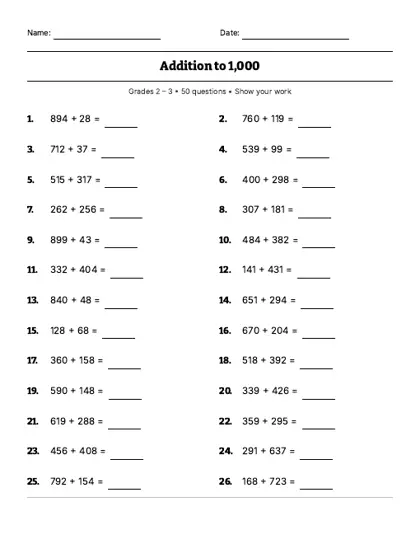
3-digit addition worksheet: printable PDF with an answer key. · Make a fresh test
Addition practice · addition speed test · addition chart · addition for kids
Last reviewed
Questions parents ask
How do you estimate a sum?
Round each number to the nearest 10 or 100, then add the rounded numbers. 47 + 38 is about 50 + 40 = 90.
What is the difference between an estimate and the exact answer?
An estimate is a close answer found quickly with rounded numbers. The exact answer uses the real numbers. 47 + 38 is about 90 but exactly 85.
Should you round to the nearest 10 or 100?
Round to the place that makes the numbers easy to add. Nearest 10 is closer; nearest 100 is quicker for 3-digit numbers.
Why is estimating sums important?
It checks whether an answer makes sense and helps with everyday questions like whether there is enough money.
What grade learns estimating sums?
Grade 3 rounds to 10 or 100 and estimates (3.NBT.A.1, 3.OA.D.8). Grade 4 rounds to any place (4.NBT.A.3).