
Adding multiples of 10 and 100
Adding tens is like adding ones: 3 tens + 4 tens = 7 tens, so 30 + 40 = 70. Learn to add 10, 100 and other multiples in your head.
The big idea: count tens like ones
A multiple of 10 is a number you say when you count in tens: 10, 20, 30, 40 and so on. Each one is a number of tens: 50 is 5 tens. So adding multiples of 10 uses facts your child already knows.
- 3 + 4 = 7, so 3 tens + 4 tens = 7 tens, and 30 + 40 = 70.
- 6 + 8 = 14, so 6 tens + 8 tens = 14 tens, and 60 + 80 = 140.
- 2 + 5 = 7, so 2 hundreds + 5 hundreds = 7 hundreds, and 200 + 500 = 700.
This is why learning facts within 10 and 20 matters so much: every fact is reused for tens and hundreds.
See it: pictures to draw with your child
Copy these onto paper or a whiteboard. A quick sketch makes the idea concrete before any written method.
Adding 10 and adding 100
When you add 10, only the tens digit changes: it goes up by 1. 47 + 10 = 57, and the ones digit (7) stays the same.
When you add 100, only the hundreds digit goes up by 1. 362 + 100 = 462.
A hundred chart shows this beautifully: adding 10 moves you straight down one row. Ask your child to put a finger on 23, then move down: 33, 43, 53. “What changes? What stays the same?”
Watch the edge case: 95 + 10 = 105. The tens digit was 9, so 10 tens become 1 hundred. Children who expect 915 need to see this on a number line.
Jump in tens
Set the start and how much to add. Blue arcs are jumps of 10, green arcs are ones.
Adding tens to any number
To add a multiple of 10 to a 2-digit number, add to the tens and leave the ones alone. 47 + 30: 4 tens + 3 tens = 7 tens, and the 7 ones stay. Answer: 77.
On a number line, that is three jumps of 10: 47, 57, 67, 77.
The same works for hundreds: 245 + 300 = 545. Only the hundreds digit changes.
And for tens in bigger numbers: 245 + 30 = 275, because 4 tens + 3 tens = 7 tens.
Using tens to add any 2-digit number
Adding tens is the first half of most mental addition. For 47 + 36, add the tens first: 47 + 30 = 77. Then add the ones: 77 + 6 = 83. This is the jump strategy, and it relies on adding tens quickly.
A second trick is adding 9 or 11. To add 9, add 10 and take 1 away: 46 + 9 = 56 − 1 = 55. To add 11, add 10 and 1 more: 46 + 11 = 57. The same idea works for 19, 21, 29 and 31.
Patterns to spot
| Ones fact | Tens | Hundreds |
|---|---|---|
| 2 + 3 = 5 | 20 + 30 = 50 | 200 + 300 = 500 |
| 4 + 4 = 8 | 40 + 40 = 80 | 400 + 400 = 800 |
| 7 + 5 = 12 | 70 + 50 = 120 | 700 + 500 = 1,200 |
| 9 + 6 = 15 | 90 + 60 = 150 | 900 + 600 = 1,500 |
Each row uses one fact three times. Count the zeros: tens have one zero, hundreds have two.
Quiz: add tens and hundreds
Use the fact you know, then put the tens or hundreds back.
Where this fits: addition step by step
What to say to your child
A short script for teaching it the first time. Pause after each line and let your child do the next step.
- “What is 3 + 4?” (7.) “So what is 3 tens + 4 tens?” (7 tens!)
- “And 7 tens is…?” (70.) “So 30 + 40 = 70.”
- “Now 47 + 10. Only one digit changes. Which one?” (The tens: 57.)
- “Let’s try 47 + 30. Jump 10 three times.” (57, 67, 77.)
- “And 300 + 400?” (3 + 4 = 7, so 700.)
More worked examples
Example 1: tens: 60 + 70
6 + 7 = 13, so 6 tens + 7 tens = 13 tens = 130.
Example 2: tens to a 2-digit number: 34 + 50
3 tens + 5 tens = 8 tens. The 4 ones stay. Answer: 84.
Example 3: crossing 100: 85 + 30
8 tens + 3 tens = 11 tens = 110, plus the 5 ones: 115.
Example 4: hundreds: 450 + 300
4 hundreds + 3 hundreds = 7 hundreds. The 50 stays. Answer: 750.
Practice questions (answers below)
Ask these out loud or write them down. Check each answer, and ask “how did you get that?” for one or two.
- 20 + 50
- 40 + 40
- 70 + 60
- 36 + 10
- 58 + 30
- 95 + 10
- 300 + 600
- 418 + 100
- Riya has 40 stickers and gets 30 more. How many now?
- Stretch: 260 + 50 + 200
Show the answers
- 70
- 80
- 130
- 46
- 88
- 105
- 900
- 518
- 70 stickers
- 510
Common mistakes
How to teach it at home
Hundred chart walk
Point to a number and move down to add 10 or up to take 10 away.
Coins and notes
Add 10-rupee notes, or dimes, in your head while shopping.
Skip-count jumps
Count by 10s from any number: 7, 17, 27, 37… while walking or on the stairs.
By grade
- Grade 1 (1.NBT.C.4, 1.NBT.C.5): add multiples of 10 and find 10 more than a number in your head.
- Grade 2 (2.NBT.B.8): add 10 or 100 to any number from 100 to 900 in your head.
- Grade 3 (3.NBT.A.2): use place value to add within 1,000.
- Next: 2-digit addition and mental addition.
More for each grade: Grade 1 math and the CBSE class 1 maths guide; Grade 2 math and the CBSE class 2 maths guide; Grade 3 math and the CBSE class 3 maths guide.
Worksheets and practice
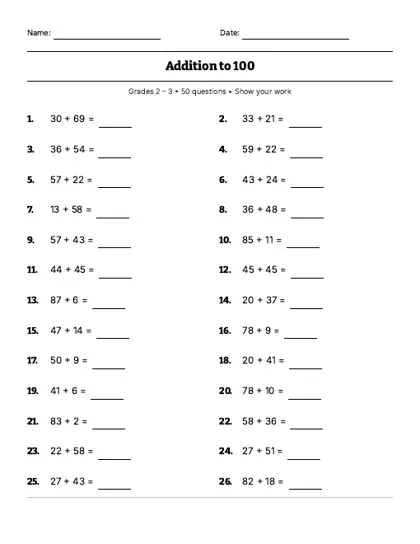
2-digit addition worksheet: printable PDF with an answer key. · Make a fresh test
Addition practice · addition speed test · addition chart · addition for kids · Multiplication practice trainer · 1-minute speed test
Last reviewed
Questions parents ask
How do you add multiples of 10?
Use the ones fact and keep the tens. 30 + 50: 3 + 5 = 8, so 3 tens + 5 tens = 8 tens, which is 80.
What is 10 more than a number?
Add 1 to the tens digit and keep the ones digit. 10 more than 64 is 74. 10 more than 95 is 105.
How do you add 100 to a number?
Add 1 to the hundreds digit. 362 + 100 = 462. The tens and ones stay the same.
What grade learns adding multiples of 10?
Grade 1 adds multiples of 10 within 100 (1.NBT.C.4). Grade 2 adds 10 or 100 to 3-digit numbers mentally (2.NBT.B.8).
Why is adding tens important?
It is the first step in mental addition. To add 47 + 36 in your head, add 30 first (77) and then 6 (83).