
Properties of addition
Three rules make addition easier: order does not matter, grouping does not matter, and adding zero changes nothing.
The three properties of addition
| Property | Kid name | Example |
|---|---|---|
| Commutative property | The turn-around rule | 3 + 5 = 5 + 3 |
| Associative property | The grouping rule | (2 + 6) + 4 = 2 + (6 + 4) |
| Identity property | The zero rule | 7 + 0 = 7 |
Children do not need the long names in grade 1. They need the ideas, because each rule saves work: fewer facts to learn, easier sums to do in their heads.
See it: pictures to draw with your child
Copy these onto paper or a whiteboard. A quick sketch makes the idea concrete before any written method.
The turn-around rule (commutative property)
You can add numbers in any order and get the same sum. 3 + 5 = 8 and 5 + 3 = 8. This halves the number of facts to learn: once your child knows 8 + 5, they also know 5 + 8.
It also makes counting on easier: for 2 + 9, turn it around and start at 9.
Turn it around
Make two groups, then tap Turn it around. Does the total change?
The grouping rule (associative property)
When you add three numbers, you can add any two first. (2 + 6) + 4 and 2 + (6 + 4) both make 12. Brackets show which pair to add first.
Smart grouping makes sums easy. In 7 + 5 + 3, add 7 + 3 first to make 10, then 10 + 5 = 15. See adding three numbers for more.
The zero rule (identity property)
Adding 0 changes nothing: 9 + 0 = 9 and 0 + 9 = 9. Zero means “no more”, so the number stays the same.
Why the properties matter later
The properties are not just rules to memorise. They are the reason mental maths works. When a child adds 38 + 27 by doing 30 + 20 and 8 + 7, they are using the grouping and turn-around rules without saying so.
The same rules come back again and again:
- Multiplication has the same turn-around and grouping rules: 3 × 4 = 4 × 3.
- Bigger sums get easier: 47 + 28 + 53 is 47 + 53 = 100, then 100 + 28 = 128.
- Algebra in middle school uses them to rearrange expressions like x + 5 + 3x.
Using the rules to check answers
A good habit is to add the numbers in a different order to check. If 6 + 9 + 4 gives 19 one way, it must give 19 the other way too. If the two answers differ, one of them has a mistake.
Ask your child to explain which rule they used. Saying “I turned it around” or “I found a 10 first” shows real understanding, not just a remembered answer.
Quiz: which rule is it?
Choose the rule, or fill in the missing number.
Where this fits: addition step by step
What to say to your child
A short script for teaching it the first time. Pause after each line and let your child do the next step.
- “Here are 3 red blocks and 5 blue blocks. How many?” (8.)
- “Now put the blue ones first. How many now?” (Still 8!)
- “That is the turn-around rule. 3 + 5 and 5 + 3 are the same.”
- “What is 6 + 0?” (6.) “Adding zero changes nothing.”
- “7 + 5 + 3. Which two make 10?” (7 and 3!) “So it is 10 + 5.” (15.)
More worked examples
Example 1: using the turn-around rule
2 + 8 looks hard to count on. Turn it around: 8 + 2. Count on 2 from 8: 9, 10. So 2 + 8 = 10.
Example 2: using the grouping rule
4 + 9 + 6. Group the 4 and 6 to make 10. Then 10 + 9 = 19. So 4 + 9 + 6 = 19.
Example 3: using the zero rule
0 + 15 + 0. Adding zero changes nothing, so the answer is 15.
Practice questions (answers below)
Ask these out loud or write them down. Check each answer, and ask “how did you get that?” for one or two.
- 5 + 3 = 3 + ?
- 9 + 0
- 0 + 14
- (4 + 6) + 3
- 2 + (8 + 5)
- 6 + 7 + 4
- Which rule says 6 + 2 = 2 + 6?
- If 9 + 6 = 15, what is 6 + 9?
- Stretch: 25 + 37 + 75 (find the friendly pair)
Show the answers
- 5
- 9
- 14
- 13
- 15
- 17
- The turn-around (commutative) rule
- 15
- 137
Common mistakes
How to teach it at home
Shoe swap
Put 3 shoes on the left and 4 on the right, then swap sides. Is the total the same?
Zero snack
“You have 5 grapes and I give you 0 more. How many?”
Make-10 hunt
Write three numbers on cards. Find two that make 10 and add the third.
By grade
- Grade 1 (1.OA.B.3): use the turn-around and grouping rules as strategies.
- Grade 2 (2.NBT.B.9): explain why addition strategies work using place value and the properties.
- Grade 3 (3.NBT.A.2): add within 1,000 using strategies based on the properties.
More for each grade: Grade 1 math and the CBSE class 1 maths guide; Grade 2 math and the CBSE class 2 maths guide; Grade 3 math and the CBSE class 3 maths guide.
Worksheets and practice
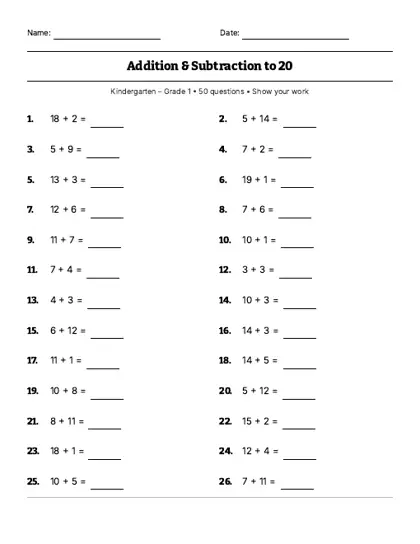
Addition facts worksheet: printable PDF with an answer key. · Make a fresh test
Addition practice · addition speed test · addition chart · addition for kids
Last reviewed
Questions parents ask
What are the properties of addition?
The commutative property (order does not matter), the associative property (grouping does not matter) and the identity property (adding 0 changes nothing).
What is the commutative property of addition?
You can add numbers in any order and get the same sum: 4 + 6 = 6 + 4. Children often call it the turn-around rule.
What is the associative property of addition?
When adding three numbers, you can add any two first: (2 + 3) + 7 = 2 + (3 + 7). It helps you look for pairs that make 10.
What is the identity property of addition?
Adding zero to a number leaves it unchanged: 12 + 0 = 12. Zero is called the identity for addition.
Do the properties of addition work for subtraction?
No. Order matters in subtraction: 9 − 4 is 5, but 4 − 9 is not. The rules work for addition (and multiplication) only.