
What is addition?
Addition means putting groups together to find how many there are altogether. Pictures, words and a quiz for kindergarten and grade 1.
Addition means putting together
When we add, we put two or more groups together and find the total. 3 red apples and 2 green apples make 5 apples altogether. We write this as 3 + 2 = 5.
The sign + is read as “plus” or “add”. The sign = is read as “equals” or “is the same as”. So 3 + 2 = 5 says “3 plus 2 is the same as 5”.
The words to know
| Word | Meaning | In 3 + 2 = 5 |
|---|---|---|
| Addends | The numbers being added | 3 and 2 |
| Sum (or total) | The answer to an addition | 5 |
| Plus (+) | The addition sign | + |
| Equals (=) | Both sides have the same value | = |
See it: pictures to draw with your child
Copy these onto paper or a whiteboard. A quick sketch makes the idea concrete before any written method.
Put groups together
Change the two groups and watch the total change.
Two kinds of adding
Children meet addition in two everyday situations, and it helps to name both:
- Adding to: something grows. “There are 4 birds. 2 more fly in. How many now?” 4 + 2 = 6.
- Putting together: two groups join. “3 cats and 5 dogs. How many pets?” 3 + 5 = 8.
Both are addition, and both answer the question “how many altogether?”. Later, children meet comparing problems such as “Ana has 2 more than Sam”, which are addition too.
From counting all to counting on
Young children add by counting all: they count the first group, count the second group, then count everything again from 1. It works, and it is how every child starts.
The next step is counting on. Your child holds the first number in their head and counts on from there.
For 5 + 3 they say “5… 6, 7, 8” instead of counting to 5 first. It is quicker and leads to knowing facts by heart.
You can nudge this step by hiding the first group under a cup: “There are 5 under here, and here are 3 more. How many altogether?”
Your child cannot count the hidden ones, so they start at 5 and count on. See counting on for more.
What the = sign really means
Many children think = means “write the answer next”. It actually means “is the same as”: both sides must have the same value.
So 5 = 2 + 3 is just as true as 2 + 3 = 5, and so is 2 + 3 = 4 + 1.
Try a balance game: put 2 blocks and 3 blocks on one side of a table and 5 blocks on the other. “Are the two sides the same?” This early idea makes algebra much easier years later.
Quiz: how many altogether?
Count each group, then write the addition.
Addition in real life
- 2 cookies on a plate and 3 more: 2 + 3 = 5 cookies.
- 4 children on the swings and 4 on the slide: 4 + 4 = 8 children.
- 6 spoons in the drawer and 1 on the table: 6 + 1 = 7 spoons.
- Fingers: 5 on one hand and 5 on the other make 10.
Say additions out loud during the day. Children who hear “and 2 more makes…” many times learn what addition means long before they write a sum.
Where this fits: addition step by step
What to say to your child
A short script for teaching it the first time. Pause after each line and let your child do the next step.
- “Here are 3 toy cars. Here are 2 more.” (Points to each group.)
- “Push them together. How many cars now?” (Counts: 5.)
- “When we put groups together, we add. 3 and 2 more make 5.”
- “We can write it as 3 + 2 = 5. The + means add.” (Traces the +.)
- “Now you make a sum with the blocks and tell me.” (2 and 4 more make 6!)
More worked examples
Example 1: 2 + 4 with objects
Put out 2 blocks, then 4 more blocks. Push them together and count all: 1, 2, 3, 4, 5, 6. So 2 + 4 = 6.
Example 2: a story
“There are 5 ducks on the pond. 3 more ducks land.” Draw 5 circles and 3 more circles. Count them: 8. So 5 + 3 = 8 ducks.
Example 3: reading a sum
4 + 1 = 5 is read “4 plus 1 equals 5”. It means 4 and 1 more make 5, the same as counting one more than 4.
Practice questions (answers below)
Ask these out loud or write them down. Check each answer, and ask “how did you get that?” for one or two.
- 2 + 1
- 3 + 3
- 4 + 2
- 5 + 0
- 1 + 4
- What is the sum in 3 + 4 = 7?
- What are the addends in 6 + 2 = 8?
- There are 3 red and 4 blue balloons. How many balloons?
- Stretch: draw a picture for 5 + 4 and find the sum.
Show the answers
- 3
- 6
- 6
- 5
- 5
- 7
- 6 and 2
- 7 balloons
- 9
Common mistakes
How to teach it at home
Snack sums
“You have 2 grapes. I give you 3 more. How many now?” Eat them afterwards.
Toy car parking
Park some cars in two rows and ask how many altogether.
Finger sums
Hold up fingers on two hands and say the addition together.
By grade
- Kindergarten (K.OA.A.1, K.OA.A.2): add with objects, fingers and drawings, and solve story problems within 10.
- Grade 1 (1.OA.A.1): solve word problems within 20 and write the addition sentence.
- Next: counting on and addition within 10.
More for each grade: Kindergarten math; Grade 1 math and the CBSE class 1 maths guide.
Worksheets and practice
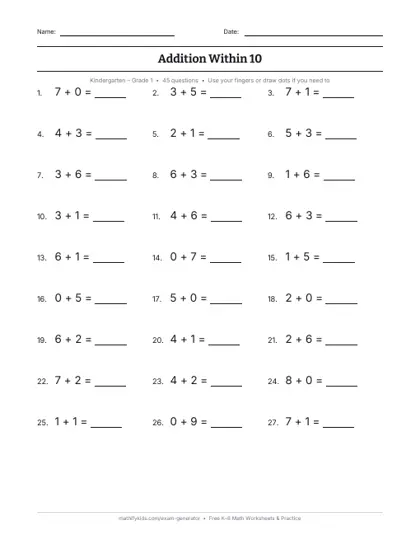
Addition within 10 worksheet: printable PDF with an answer key. · Make a fresh test
Addition practice · addition speed test · addition chart · addition for kids
Last reviewed
Questions parents ask
What is addition in simple words?
Addition is putting groups together to find how many there are altogether. 3 apples and 2 more apples make 5 apples, written 3 + 2 = 5.
What does the + sign mean?
The + sign means plus or add. 4 + 3 is read “4 plus 3” and means 4 and 3 more.
What are addends and the sum?
The numbers you add are addends. The answer is the sum. In 4 + 3 = 7, 4 and 3 are addends and 7 is the sum.
How do you explain addition to a child?
Use real objects. Show two groups, push them together and count them all. Then write the addition sentence that matches.
What grade do kids learn addition?
Kindergarten adds within 10 with objects. Grade 1 adds within 20, and grade 2 knows the facts to 20 from memory.