
Addition word problems
Read the story, picture it, then decide what to add. A bar model makes almost any addition word problem easy to see.
A 4-step plan for any word problem
- Read it twice. First for the story, then for the numbers and the question.
- Picture it. Draw dots, a number line or a bar model. Say what is happening in your own words.
- Write the number sentence and work it out: 24 + 17 = 41.
- Answer the question in words with the unit (41 children), and check it makes sense with an estimate.
See it: pictures to draw with your child
Copy these onto paper or a whiteboard. A quick sketch makes the idea concrete before any written method.
The kinds of addition word problems
| Type | Example | Number sentence |
|---|---|---|
| Add to (result unknown) | 5 birds sit on a wire. 3 more land. How many now? | 5 + 3 = ? |
| Put together (total unknown) | 12 red and 9 blue beads. How many beads? | 12 + 9 = ? |
| Add to (change unknown) | Leo had 8 cards. Now he has 13. How many did he get? | 8 + ? = 13 |
| Start unknown | Some birds flew away: 4 flew off and 6 are left. How many at first? | ? − 4 = 6, so 6 + 4 |
| Compare (more) | Sam has 15 marbles. Ana has 7 more. How many does Ana have? | 15 + 7 = ? |
The first two are the easiest and come first in grade 1. Change-unknown, start-unknown and compare problems are harder, because the story does not match the order of the number sentence. Children need lots of picture work with these.
Draw it as a bar model
Set the two parts. Choose whether the total or a part is the unknown.
A word about key words
Words like in all, altogether, total and more often mean add. But key words can mislead.
“Mia has 12 stickers. That is 5 more than Leo. How many does Leo have?” contains “more” but is a subtraction: 12 − 5 = 7.
So teach key words as clues, not rules. The real question is always: “Do I know the parts and need the whole?” If so, add. If you know the whole and one part, subtract (or count up).
Word problems grade by grade
- Grade 1: stories within 20 with objects and drawings; three numbers that add to 20 or less. “3 apples, 4 pears and 2 bananas. How many fruit?”
- Grade 2: one- and two-step problems within 100 with bar models. “24 boys and 19 girls are on a trip. How many children?”
- Grade 3: two-step problems within 1,000, checked with estimates. “A shop had 245 pens and got 180 more, then sold 100. How many now?”
- Grade 4: multi-step problems with larger numbers and all four operations.
Our addition practice builds the fact speed that makes word problems feel easy.
Two-step problems
From grade 2, problems often need two steps. “A bakery made 36 muffins in the morning and 28 in the afternoon. It sold 50. How many are left?” First add: 36 + 28 = 64. Then subtract: 64 − 50 = 14.
A bar model with three boxes helps children see both steps before they start.
Quiz: solve the word problems
Picture the story, then add.
Where this fits: addition step by step
What to say to your child
A short script for teaching it the first time. Pause after each line and let your child do the next step.
- “Listen: 12 red beads and 9 blue beads. How many beads? What do we know?” (12 red and 9 blue.)
- “What do we need to find?” (All the beads together.)
- “Let’s draw a bar: a part for red, a part for blue, and the whole on top.”
- “Parts known, whole unknown, so we add. 12 + 9?” (21.)
- “Say the answer as a sentence.” (There are 21 beads.)
More worked examples
Example 1: grade 1, put together
“7 dogs and 6 cats are at the vet. How many animals?” 7 + 6 = 13. There are 13 animals.
Example 2: grade 2, change unknown
“Priya had 28 shells. After the beach she had 45. How many did she find?” 28 + ? = 45. Count up: 28 → 30 is 2, 30 → 45 is 15, so 17 shells.
Example 3: grade 3, two steps
“A farm has 126 hens and 87 ducks. It buys 50 more hens. How many birds now?” 126 + 87 = 213, then 213 + 50 = 263 birds.
Example 4: grade 4, large numbers
“A stadium sold 3,456 tickets on Friday and 4,289 on Saturday. How many tickets?” 3,456 + 4,289 = 7,745 tickets.
Practice questions (answers below)
Ask these out loud or write them down. Check each answer, and ask “how did you get that?” for one or two.
- 4 frogs are on a log. 5 more hop on. How many frogs?
- 8 red cars and 7 blue cars. How many cars?
- Tom has 9 stickers. He gets some more and now has 14. How many did he get?
- Anu has 23 crayons. Raj has 8 more than Anu. How many does Raj have?
- 35 children are in the hall and 27 more come in. How many children?
- A train has 148 people. At the station 75 get on. How many now?
- 3 + 6 + 4 pencils in three boxes. How many pencils?
- A library lent 256 books in May and 318 in June. How many books?
- Some birds flew away: 6 flew and 9 stayed. How many were there at first?
- Stretch: a shop had 245 pens, got 180 more and sold 100. How many now?
Show the answers
- 9 frogs
- 15 cars
- 5 stickers
- 31 crayons
- 62 children
- 223 people
- 13 pencils
- 574 books
- 15 birds
- 325 pens
Common mistakes
How to teach it at home
Story time sums
Make up quick stories with your child’s toys: “3 dinosaurs and 4 more come…”
Child as author
Let your child invent a word problem for you, then swap roles.
Real totals
Add things you actually count: shoes at the door, plates for guests, pages read this week.
By grade
- Grade 1 (1.OA.A.1, 1.OA.A.2): add-to, put-together and compare problems within 20, including three numbers.
- Grade 2 (2.OA.A.1): one- and two-step problems within 100 with all unknown positions.
- Grade 3 (3.OA.D.8): two-step problems; check answers with estimation.
- Grade 4 (4.OA.A.3): multi-step problems with whole numbers.
- Next: estimating sums to check answers.
More for each grade: Grade 1 math and the CBSE class 1 maths guide; Grade 2 math and the CBSE class 2 maths guide; Grade 3 math and the CBSE class 3 maths guide; Grade 4 math and the CBSE class 4 maths guide.
Worksheets and practice
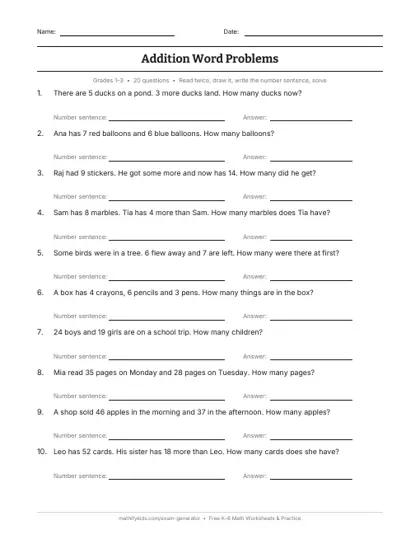
Addition word problems worksheet: printable PDF with an answer key. · Make a fresh test
Addition practice · addition speed test · addition chart · addition for kids
Last reviewed
Questions parents ask
How do you solve addition word problems?
Read the problem twice, draw a picture or bar model, write the number sentence, then answer in a full sentence with the unit.
What are the key words for addition?
In all, altogether, total, sum, both and more often mean add. Treat them as clues, not rules, because “more” can also appear in subtraction problems.
What is a bar model?
A bar model draws the parts as boxes side by side with the whole above. If the parts are known and the whole is not, you add.
How do I help my child with word problems?
Ask them to retell the story in their own words and draw it before doing any maths. Then ask: do we know the parts or the whole?
What grade starts addition word problems?
Kindergarten solves simple stories within 10. Grade 1 solves word problems within 20 (1.OA.A.1), and they grow harder each year.