
Order of operations word problems
In order of operations word problems, write the whole story as one expression, with brackets where needed, then work it out in the right order.
The idea: one story, one expression
Two-step stories can be solved one step at a time. Writing them as one expression is a grade 5 skill that makes the thinking visible, and it prepares children for algebra.
The order of operations then tells everyone how to read the expression. A teacher can see at a glance whether the story was understood.
See it: pictures to draw with your child
Copy these onto paper or a whiteboard. A quick sketch makes the idea concrete before any written method.
A four-step plan
- Read the whole story and find the question.
- Find the steps: what has to be worked out first?
- Write one expression, with brackets around anything + or − that has to happen first.
- Work it out in the right order, then check the answer makes sense.
Common story types
Groups plus extras: 4 packs of 6 pens and 3 loose pens is 4 × 6 + 3 = 27. Total then share: 18 red and 12 blue beads shared by 5 children is (18 + 12) ÷ 5 = 6.
Cost and change: 3 books at $4 paid with $20 gives 20 − 3 × 4 = $8 change. Two kinds of item: 2 adults at $9 and 3 children at $5 cost 2 × 9 + 3 × 5 = $33.
Check your expression
Type the expression you wrote for a story. The steps show whether it does things in the order the story says.
Key words
- Expression: one calculation for the whole story, like (18 + 12) ÷ 5.
- Total: the result of adding all the parts.
- Share equally: divide into equal groups.
- Each: often means multiply: 3 books at $4 each is 3 × 4.
- Change: money given back: paid minus cost.
Does the answer make sense?
Always read the answer back into the story. If 30 beads are shared by 5 children, each getting 6 makes sense, but 32.4 or 150 does not.
A wrong answer usually means the expression did things in the wrong order. Comparing it with the story step by step finds the problem.
Teaching tip: draw it first
A quick drawing often shows the steps. Two kinds of ticket can be two rows of boxes. Sharing a total can be a bar split into equal parts.
Once the drawing is done, the expression usually writes itself. Ask your child to point to each part of the drawing as they write the matching part of the expression.
For stories with money, a simple table works too: one row for each item, with the number and the price. Each row becomes one product in the expression.
Quiz: order of operations word problems
Write one expression, then type the answer.
Where this fits: the order of operations step by step
What to say to your child
A short script for teaching it the first time. Pause after each line and let your child do the next step.
- “What does the story ask?” (How many beads each child gets.)
- “What happens first?” (Add the red and blue.)
- “How do we show that?” (Brackets: (18 + 12).)
- “Then?” (Divide by 5.)
- “Does 6 each make sense?” (Yes: 5 × 6 = 30.)
More worked examples
Example 1: groups plus extras
5 boxes of 8 eggs and 4 more: 5 × 8 + 4 = 44.
Example 2: cost and change
4 pens at $2 from $10: 10 − 4 × 2 = $2.
Example 3: total then share
$15 and $25 shared by 4: (15 + 25) ÷ 4 = $10.
Example 4: two items
3 pizzas at $8 and 2 drinks at $3: 3 × 8 + 2 × 3 = $30.
Practice questions (answers below)
Ask these out loud or write them down. Check each answer, and ask “how did you get that?” for one or two.
- 6 bags of 5 apples and 7 more apples
- 24 stickers and 16 more, shared by 4 friends
- 3 shirts at $12, paid with $50
- 2 adults at $10 and 4 children at $6
- A class of 28 makes 4 equal teams, then 2 leave each team
- 9 rows of 8 chairs, 5 taken away
- $40 saved plus $5 a week for 6 weeks
- Double the sum of 15 and 10
- Each of 3 friends buys a $4 sandwich and a $2 drink
- Stretch: 5 packs of 12 cards shared among 6 children, plus 2 each
Show the answers
- 6 × 5 + 7 = 37
- (24 + 16) ÷ 4 = 10
- 50 − 3 × 12 = $14
- 2 × 10 + 4 × 6 = $44
- 28 ÷ 4 − 2 = 5
- 9 × 8 − 5 = 67
- 40 + 5 × 6 = $70
- 2 × (15 + 10) = 50
- 3 × (4 + 2) = $18
- 5 × 12 ÷ 6 + 2 = 12
Common mistakes
How to teach it at home
Shopping stories
Turn a real shopping trip into one expression and work it out together.
Make a story
Give an expression like (5 + 3) × 4 and ask your child to tell a story that fits it.
Guess the expression
Tell a two-step story and race to write the expression first.
By grade
- Grade 4 (4.OA.A.3): multi-step word problems.
- Grade 5 (5.OA.A.2): write expressions that record calculations.
- Grade 6 (6.EE.A.2): write and evaluate expressions, including formulas.
- In India, word problems with BODMAS are part of classes 6 and 7. Next: equation word problems.
More for each grade: Grade 5 math and the CBSE class 5 maths guide; Grade 6 math and the CBSE class 6 maths guide.
Worksheets and practice
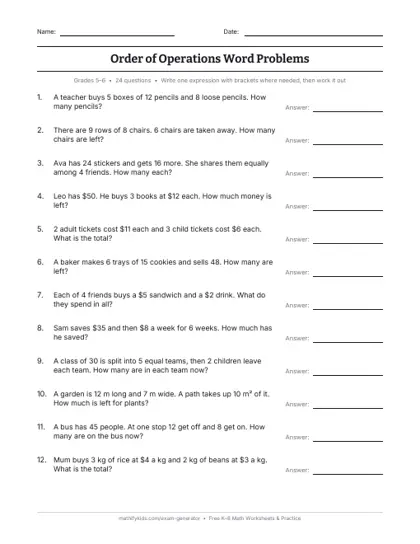
Order of operations word problems worksheet: printable PDF with an answer key. · Make a fresh test
Order of operations practice · order of operations calculator · order of operations for kids · exponents · evaluating expressions
Last reviewed
Questions parents ask
How do you solve order of operations word problems?
Write one expression for the whole story, putting brackets around anything that must happen first, then work it out in order.
When do you need brackets in a word problem?
When the story adds or subtracts before multiplying or dividing, such as finding a total and then sharing it.
Why write one expression instead of two steps?
It shows the whole method at once and prepares children for algebra, where stories become equations.
What does “each” mean in a word problem?
Usually multiply: 3 books at $4 each is 3 × 4.
What grade learns order of operations word problems?
Grades 5 and 6 under Common Core 5.OA.A.2 and 6.EE.A.2.