
Order of operations: left to right
Multiplication and division are partners, so work them from left to right. So are addition and subtraction: 12 ÷ 3 × 2 = 8 and 10 − 4 + 3 = 9.
🧒 Kids: read it like a book!
When two partner signs meet, like ÷ and ×, or − and +, do the one on the left first. Just like reading a book! Then try the quiz.
▶ Quiz 🔢 More practice 🧮 Calculator
💡 Trick: × and ÷ are partners. + and − are partners. When partners meet, the one on the left goes first!
More on the order of operations: PEMDAS · BODMAS and BIDMAS · Left to right · Parentheses and brackets
This part is for grown-ups: the key idea, pictures to draw, what to say, common mistakes, questions with answers and a free worksheet.
The trick: partners go left to right
Multiplication and division have the same rank, and so do addition and subtraction. When two operations have the same rank, work from left to right. M before D in PEMDAS is only the order of the letters, not a rule.
- 12 ÷ 3 × 2: ÷ comes first: 4 × 2 = 8
- 10 − 4 + 3: − comes first: 6 + 3 = 9
- 24 ÷ 4 ÷ 2: left to right: 6 ÷ 2 = 3
- 20 − 6 − 4: left to right: 14 − 4 = 10
Patterns to spot
- With only × and ÷, go straight from left to right.
- With only + and −, go straight from left to right.
- × and ÷ still come before + and −, wherever they are: 10 − 4 × 2 = 2.
- Changing the order of ÷ and × usually changes the answer.
- Two divisions in a row get smaller fast: 48 ÷ 4 ÷ 2 = 6, not 24.
- Brackets let you change the order on purpose: 12 ÷ (3 × 2) = 2.
Key words
- Rank: how early an operation is done. × and ÷ share a rank, and + and − share a lower rank.
- Left to right: do the operation that comes first in the line.
- Partners: two operations of the same rank: × with ÷, and + with −.
- Expression: a calculation with no equals sign, like 12 ÷ 3 × 2.
- Inverse: an operation that undoes another: ÷ undoes ×, and − undoes +.
Why it matters: Left to right is the order of operations rule children get wrong most often, because PEMDAS seems to put M before D and A before S. Fixing it early stops a habit that causes mistakes in algebra, spreadsheets and exams.
See it: pictures to draw with your child
Draw these on paper or a whiteboard. Shading the part being worked out on each line makes the order easy to follow.
What your child already knows
Children already read from left to right, so the rule feels natural once they know which operations are partners. They also know that 2 × 3 and 3 × 2 give the same answer, which is why the order inside a run of × only matters when ÷ is there too.
In real life: Recipes and money both use left to right. “Share 12 cookies among 3 friends, and each friend gets 2 boxes like that” is 12 ÷ 3 × 2. A bus with 10 people where 4 get off and 3 get on carries 10 − 4 + 3 = 9.
Why left to right?
Division is the same as multiplying by a fraction, and subtraction is the same as adding a negative. 12 ÷ 3 × 2 is really 12 × ⅓ × 2, and order doesn’t matter for multiplication. So it is 8 either way.
The trouble only starts if you group the wrong pair: 12 ÷ (3 × 2). Going left to right never groups the wrong pair.
The same works for + and −: 10 − 4 + 3 is 10 + (−4) + 3 = 9.
Worked examples
Example 1: Divide, then multiply
- Work out 36 ÷ 4 × 3.
- Both are partners, so go from the left: 36 ÷ 4 = 9.
- Then 9 × 3 = 27.
Example 2: Subtract, then add
- Work out 15 − 6 + 2.
- Partners again: 15 − 6 = 9.
- Then 9 + 2 = 11.
Example 3: All four operations
- Work out 20 ÷ 5 × 2 + 8 − 3.
- First × and ÷ from the left: 20 ÷ 5 = 4, then 4 × 2 = 8.
- Then + and − from the left: 8 + 8 = 16, then 16 − 3 = 13.
Common mistakes
What to say to your child
A short script for your first session. Pause after each line and let your child answer.
- “Which two signs are partners?” (× and ÷, and + and −.)
- “What do partners do?” (Go from left to right.)
- “What is 12 ÷ 3 × 2?” (8.)
- “What is 10 − 4 + 3?” (9.)
- “And 10 − 4 × 2?” (2. × beats −.)
Questions to try (answers below)
Ask these out loud or write them down. The last one is a stretch.
- 30 ÷ 5 × 2
- 30 ÷ (5 × 2)
- 18 − 7 + 4
- 18 − (7 + 4)
- 40 ÷ 2 ÷ 4
- 9 × 4 ÷ 6
- 50 − 10 − 5 − 5
- 6 + 12 ÷ 3 × 2
- Stretch: 64 ÷ 8 × 2 − 9 + 1
Show the answers
- 12
- 3
- 15
- 7
- 5
- 6
- 30
- 14
- 8
Games to play at home
Arrow game
Write a sum with partner signs. Your child draws numbered arrows over the signs before working it out.
Two answers
Work out 12 ÷ 3 × 2 both ways. Ask which one follows the rule, and why.
Bus stops
Act out a bus journey: people get on and off. Write the sum and work it out left to right.
A 5-day plan for left to right
Ten minutes a day is enough. Short, regular practice works far better than one long session.
- Day 1: Learn it with the pictures above: draw them on paper and talk them through.
- Day 2: Read the script together, then ask the first four questions.
- Day 3: Do the quiz at the top of the page and read the steps for anything missed.
- Day 4: Play one of the games at home for ten minutes.
- Day 5: Ask the rest of the questions, then do a round of the matching practice skill.
By grade
Grade 5 (Common Core 5.OA.A.1) evaluates expressions with brackets, where left to right matters. Grade 6 (6.EE.A.2c) evaluates expressions in the conventional order “when there are no parentheses”. In India, it is part of BODMAS in classes 6 and 7.
More for each grade: Grade 5 math and the CBSE class 5 maths guide; Grade 6 math and the CBSE class 6 maths guide.
What comes next
Next, see parentheses and brackets, or practice with the left to right practice.
Worksheet and more practice
Print a free worksheet with an answer key, or keep practicing online with order of operations practice.
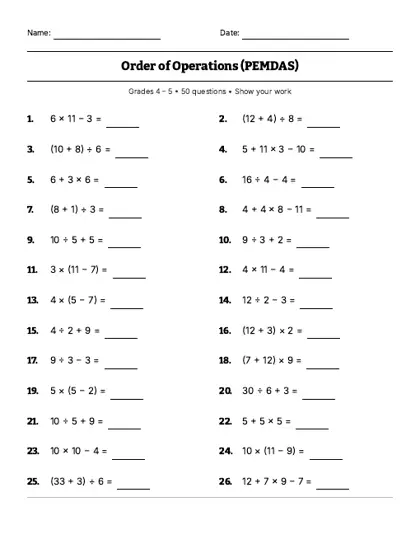 Order of operations
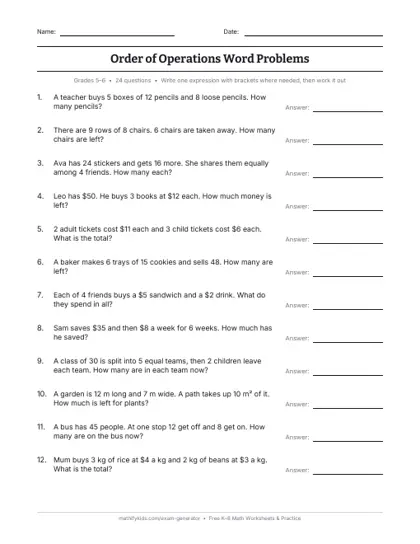 Order of operations word problems
Printable worksheets: order of operations worksheet · BODMAS worksheet · with fractions and decimals · make a fresh order of operations test
More: order of operations for kids · order of operations calculator · practice · with integers · exponents · evaluating expressions
Last reviewed
Questions parents ask
Do you multiply or divide first?
Neither always comes first. Multiplication and division have the same rank, so you do whichever comes first from left to right.
Do you add or subtract first?
Whichever comes first from left to right. Addition and subtraction have the same rank.
What is 12 ÷ 3 × 2?
8. Divide first because it comes first: 12 ÷ 3 = 4, then 4 × 2 = 8.
What is 10 − 4 + 3?
9. Subtract first because it comes first: 10 − 4 = 6, then 6 + 3 = 9.
Why is PEMDAS written with M before D?
Only because the letters have to go in some order. The rule is that M and D share one step, done left to right.