
Order of operations with parentheses
Parentheses mean “do this first”. With brackets inside brackets, start with the innermost pair and work outwards. Quiz for kids, parent help below.
🧒 Kids: inside out!
Brackets are like boxes. Open the smallest box first, then the next box, until everything is done. Then try the quiz!
▶ Quiz 🔢 More practice 🧮 Calculator
💡 Trick: Find the smallest pair of brackets. Work that out first, then move one box out!
More on the order of operations: PEMDAS · BODMAS and BIDMAS · Left to right · Parentheses and brackets
This part is for grown-ups: the key idea, pictures to draw, what to say, common mistakes, questions with answers and a free worksheet.
The trick: start with the innermost brackets
Work out what is inside parentheses before anything else. If brackets are inside other brackets, start with the innermost pair and work outwards. Inside each pair, the usual order still applies: exponents, then × and ÷, then + and −.
- (8 − 3) × 4: brackets first: 5 × 4 = 20
- 8 − 3 × 4: no brackets: 8 − 12 = −4
- 2 × [3 + (8 − 2)]: inside out: 2 × [3 + 6] = 2 × 9 = 18
- (2 + 3 × 4) × 2: inside, × first: (2 + 12) × 2 = 28
Patterns to spot
- Brackets can only change the answer if they change which operation is done first.
- Brackets around a multiplication in a sum with + do nothing: 3 + (4 × 2) = 3 + 4 × 2.
- Round ( ) go inside square [ ], which go inside curly { }.
- A number right before a bracket means multiply: 3(4 + 1) = 3 × 5 = 15.
- Every opening bracket needs a closing one. Count them to check.
- Moving brackets is a quick way to make many different answers from the same numbers.
Key words
- Parentheses: round brackets ( ). In the UK and India they are just called brackets.
- Square brackets: [ ], used around round brackets when one group is inside another.
- Braces: { }, also called curly brackets, used around square brackets.
- Nested brackets: brackets inside brackets, worked from the inside out.
- Grouping symbol: anything that groups numbers to be worked out first, including the fraction bar.
Why it matters: Brackets let a writer say “do this first” without words. Grade 5 students use them to write expressions from stories, and grade 6 students use them in formulas. Reading them correctly is the key to every longer calculation.
See it: pictures to draw with your child
Draw these on paper or a whiteboard. Shading the part being worked out on each line makes the order easy to follow.
What your child already knows
Children already know the four operations and the idea of doing one part of a problem before another. Two-step word problems from grade 3 use the same thinking. Brackets are just a way of writing it down.
In real life: Brackets turn stories into sums. “Add the cost of a $4 sandwich and a $2 drink, then double it for two people” is (4 + 2) × 2 = $12. Without brackets, 4 + 2 × 2 would only be $8.
The fraction bar is a bracket too
A fraction bar groups the top and the bottom. In (8 + 4) ÷ 3, written as a fraction with 8 + 4 on top and 3 underneath, the top is worked out first: 12 ÷ 3 = 4.
When the same sum is typed on one line, the brackets must be written: (8 + 4) ÷ 3. Without them, 8 + 4 ÷ 3 means something different.
This is why calculators and spreadsheets need extra brackets that a written fraction doesn’t.
Worked examples
Example 1: One pair
- Work out 50 − (12 + 8).
- Brackets first: 12 + 8 = 20.
- Then 50 − 20 = 30.
Example 2: Nested brackets
- Work out 3 × [10 − (2 + 5)].
- Innermost first: 2 + 5 = 7.
- Then the square brackets: 10 − 7 = 3.
- Then 3 × 3 = 9.
Example 3: Where do the brackets go?
- Put brackets in 6 + 4 × 5 to make 50.
- Try (6 + 4) × 5 = 10 × 5 = 50.
- That works.
- Without brackets the answer is 26.
Common mistakes
What to say to your child
A short script for your first session. Pause after each line and let your child answer.
- “What do brackets tell you?” (Do this part first.)
- “What is (8 − 3) × 4?” (20.)
- “And 8 − 3 × 4?” (−4. No brackets, so × first.)
- “With brackets inside brackets, which do you open first?” (The innermost.)
- “What is 2 × [3 + (8 − 2)]?” (18.)
Questions to try (answers below)
Ask these out loud or write them down. The last one is a stretch.
- (6 + 4) × 3
- 6 + 4 × 3
- 40 ÷ (2 + 6)
- 5 × [2 + (9 − 4)]
- [(3 + 5) × 2] − 10
- Put brackets in 2 + 3 × 4 to make 20
- 4(5 + 2)
- “Add 9 and 6, then divide by 3”
- Stretch: {2 × [10 − (3 + 4)]} + 6
Show the answers
- 30
- 18
- 5
- 35
- 6
- (2 + 3) × 4
- 28
- (9 + 6) ÷ 3 = 5
- 12
Games to play at home
Bracket target
Give four numbers and the signs. Your child moves brackets to hit as many target numbers as possible.
Nesting cups
Use nesting cups or boxes to show brackets inside brackets. Open the smallest first.
Story to sum
Tell a two-step story and ask your child to write one sum with brackets for it.
A 5-day plan for parentheses and brackets
Ten minutes a day is enough. Short, regular practice works far better than one long session.
- Day 1: Learn it with the pictures above: draw them on paper and talk them through.
- Day 2: Read the script together, then ask the first four questions.
- Day 3: Do the quiz at the top of the page and read the steps for anything missed.
- Day 4: Play one of the games at home for ten minutes.
- Day 5: Ask the rest of the questions, then do a round of the matching practice skill.
By grade
Grade 5 (Common Core 5.OA.A.1) uses parentheses, brackets and braces in expressions. 5.OA.A.2 writes simple expressions with them from words. Grade 6 adds exponents, and in India brackets are part of BODMAS in classes 6 and 7.
More for each grade: Grade 5 math and the CBSE class 5 maths guide.
What comes next
Next, try nested brackets practice and where do the brackets go?, or check a sum with the calculator.
Worksheet and more practice
Print a free worksheet with an answer key, or keep practicing online with order of operations practice.
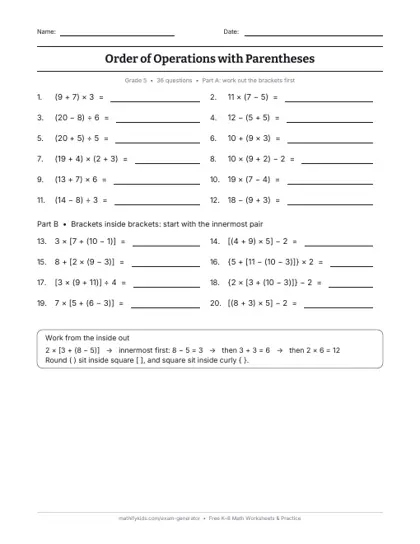 Order of operations with parentheses
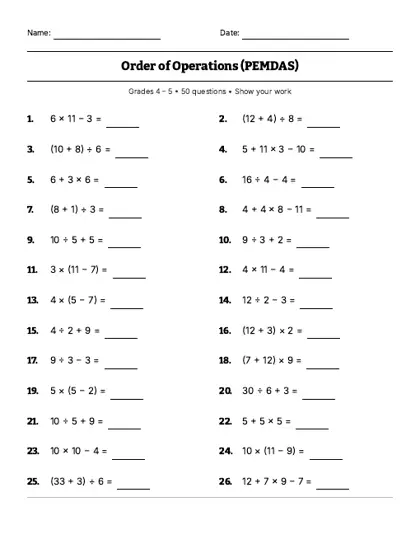 Order of operations
Printable worksheets: order of operations worksheet · BODMAS worksheet · with fractions and decimals · make a fresh order of operations test
More: order of operations for kids · order of operations calculator · practice · with integers · exponents · evaluating expressions
Last reviewed
Questions parents ask
Do you always do parentheses first?
Yes. Whatever is inside parentheses is worked out before anything outside them.
How do you work out brackets inside brackets?
Start with the innermost pair and work outwards. Inside each pair, use the usual order.
What is the difference between ( ), [ ] and { }?
They all mean “do this first”. Using different shapes just makes nested brackets easier to read.
What does a number in front of brackets mean?
Multiply. 3(4 + 1) means 3 × (4 + 1) = 15.
What grade learns parentheses in math?
Grade 5 under Common Core 5.OA.A.1 and 5.OA.A.2, which also use square brackets and braces.