
The BODMAS rule (and BIDMAS)
BODMAS gives the order to work out a sum: Brackets, Orders, Division and Multiplication, then Addition and Subtraction. It is PEMDAS with other names.
🧒 Kids: brackets first!
BODMAS is the order for solving a sum. B for brackets comes first, then powers, then ÷ and ×, then + and −. Try the quiz!
▶ Quiz 🔢 More practice 🧮 Calculator
💡 Trick: Brackets first, then powers, then ÷ and ×, then + and −. Left to right for the partners!
More on the order of operations: PEMDAS · BODMAS and BIDMAS · Left to right · Parentheses and brackets
This part is for grown-ups: the key idea, pictures to draw, what to say, common mistakes, questions with answers and a free worksheet.
The trick: BODMAS and PEMDAS are the same rules
BODMAS and PEMDAS put the steps in the same order. Only the names differ: Brackets for Parentheses, Orders for Exponents. Division is written before Multiplication in BODMAS, but they are still partners, so go left to right.
- 18 − 3 × 4: multiply first: 18 − 12 = 6
- (18 − 3) × 4: brackets first: 15 × 4 = 60
- 40 ÷ 5 × 2: D and M left to right: 8 × 2 = 16
- ½ of 20 + 3: “of” first: 10 + 3 = 13
Patterns to spot
- BODMAS, BIDMAS, BEDMAS and PEMDAS all give the same answer to every sum.
- D comes before M in the word, and M before D in PEMDAS. Neither order matters: go left to right.
- A and S are partners too, so 20 − 5 + 3 = 18, not 12.
- Curly, square and round brackets all mean “do this first”, from the inside out.
- Writing a step under the last one, with the = signs lined up, keeps the working neat.
- The same rules work for decimals, fractions and negative numbers.
Key words
- BODMAS: Brackets, Orders, Division, Multiplication, Addition, Subtraction: the order used in India and the UK.
- BIDMAS: the same rules, with I for Indices in place of O for Orders.
- Orders and indices: powers and roots, like 5² or √9.
- “Of”: in some Indian books the O stands for “of”, as in ½ of 10, which means multiply.
- Brackets: ( ), [ ] and { }. Work from the innermost bracket outwards.
Why it matters: BODMAS is the name most Indian and UK schools use, while US websites and apps say PEMDAS. Knowing both names stops children worrying that they are different rules. The answers are always the same.
See it: pictures to draw with your child
Draw these on paper or a whiteboard. Shading the part being worked out on each line makes the order easy to follow.
What your child already knows
Children already know their four operations and times tables. Many have seen sums like 2 + 3 × 4 in class and argued about the answer. BODMAS settles the argument.
In real life: In shops, BODMAS is everywhere. Two notebooks at ₹45 and a pen at ₹20 cost 2 × 45 + 20 = ₹110. A family of 4 sharing a ₹600 bill plus a ₹40 tip each pays (600 + 40) ÷ 4 = ₹160.
What the O means: orders or “of”?
In the UK the O means orders, which are powers like 3². Many Indian books say the O means “of”, as in “½ of 20”. Both are fine, because “of” means multiply, and it is done before the other × and ÷.
So ½ of 20 ÷ 5 is 10 ÷ 5 = 2. The “of” is worked out first.
When there are no powers and no “of”, BODMAS is simply brackets, then × and ÷ left to right, then + and − left to right.
Worked examples
Example 1: Brackets
- Work out 6 × (7 − 2) + 5.
- Brackets first: 7 − 2 = 5.
- Multiply: 6 × 5 = 30.
- Add: 30 + 5 = 35.
Example 2: Division and multiplication
- Work out 48 ÷ 6 × 2 − 4.
- D and M from the left: 48 ÷ 6 = 8, then 8 × 2 = 16.
- Subtract: 16 − 4 = 12.
Example 3: A money problem
- Riya buys 3 pencils at ₹8 and a ruler for ₹15.
- Write 3 × 8 + 15.
- Multiply first: 24.
- Add: 24 + 15 = ₹39.
Common mistakes
What to say to your child
A short script for your first session. Pause after each line and let your child answer.
- “What does the B in BODMAS stand for?” (Brackets.)
- “What does the O stand for?” (Orders, like 3², or “of”.)
- “What is 18 − 3 × 4?” (6.)
- “And 40 ÷ 5 × 2?” (16, left to right.)
- “Is BODMAS different from PEMDAS?” (No, just different names.)
Questions to try (answers below)
Ask these out loud or write them down. The last one is a stretch.
- 15 + 5 × 2
- (15 + 5) × 2
- 36 ÷ 4 × 3
- 50 − 10 + 5
- 8 + 2²
- 100 − [6 × (4 + 1)]
- ½ of 30 + 4
- 3 notebooks at ₹40 and a bag at ₹150
- Stretch: {60 ÷ [2 × (8 − 5)]} + 1
Show the answers
- 25
- 40
- 27
- 45
- 12
- 70
- 19
- ₹270
- 11
Games to play at home
Price tags
Write a shopping list with prices in ₹. Your child writes one BODMAS sum for the total.
Bracket hunt
Write 4 + 6 × 2 − 1 and challenge your child to add brackets to make 19, 23 and 10.
Teach it back
Ask your child to explain BODMAS to you as if you had never heard of it.
A 5-day plan for BODMAS and BIDMAS
Ten minutes a day is enough. Short, regular practice works far better than one long session.
- Day 1: Learn it with the pictures above: draw them on paper and talk them through.
- Day 2: Read the script together, then ask the first four questions.
- Day 3: Do the quiz at the top of the page and read the steps for anything missed.
- Day 4: Play one of the games at home for ten minutes.
- Day 5: Ask the rest of the questions, then do a round of the matching practice skill.
By grade
In India, BODMAS is taught in class 6 and used in the class 7 chapter “Arithmetic Expressions”. In the US the same rules are called PEMDAS, taught in grade 5 (5.OA.A.1) with exponents added in grade 6 (6.EE.A.1). UK schools say BIDMAS.
More for each grade: Grade 5 math and the CBSE class 5 maths guide; Grade 6 math and the CBSE class 6 maths guide; Grade 7 math and the CBSE class 7 maths guide.
What comes next
Next, see parentheses and brackets and the left to right rule, or check any sum with the BODMAS calculator.
Worksheet and more practice
Print a free worksheet with an answer key, or keep practicing online with order of operations practice.
 BODMAS
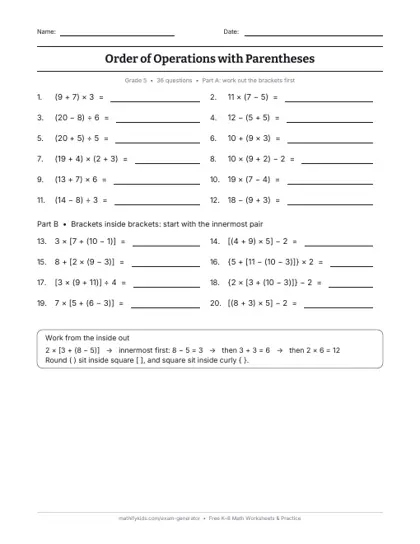 Order of operations with parentheses
Printable worksheets: order of operations worksheet · BODMAS worksheet · with fractions and decimals · make a fresh order of operations test
More: order of operations for kids · order of operations calculator · practice · with integers · exponents · evaluating expressions
Last reviewed
Questions parents ask
What is the BODMAS rule?
The order for working out a sum: Brackets, Orders (powers), Division and Multiplication from left to right, then Addition and Subtraction from left to right.
What is the difference between BODMAS and PEMDAS?
Only the names. Brackets are parentheses and orders are exponents. The order of the steps and the answers are the same.
What does the O in BODMAS stand for?
Orders, which means powers and roots. Many Indian books say “of”, as in ½ of 10. Both are done before × and ÷.
Is division always done before multiplication in BODMAS?
No. Division and multiplication have the same rank, so you work from left to right.
What class learns BODMAS?
In India, BODMAS is taught in classes 6 and 7. The US calls it PEMDAS and teaches it in grades 5 and 6.