
Writing numerical expressions
Writing numerical expressions turns words into a calculation: “add 8 and 7, then multiply by 2” is 2 × (8 + 7). Brackets show what happens first.
The idea: words in, expression out
A numerical expression is a calculation written with numbers and signs, like 2 × (8 + 7). Writing one means reading the words and deciding what happens first.
Whatever happens first goes in brackets, unless the order of operations already puts it first. “Multiply 4 by 5, then add 3” needs no brackets: 4 × 5 + 3.
See it: pictures to draw with your child
Copy these onto paper or a whiteboard. A quick sketch makes the idea concrete before any written method.
Key phrases to watch for
- “then”: the first part happens first. “Add 8 and 7, then multiply by 2” is (8 + 7) × 2.
- “the sum of”, “the difference between”: these usually need brackets. “3 times the sum of 4 and 5” is 3 × (4 + 5).
- “the product of”, “the quotient of”: × and ÷ go first anyway, so brackets are optional. “Add 2 to the product of 3 and 4” is 2 + 3 × 4.
- “twice”, “half”, “triple”: × 2, ÷ 2 and × 3.
Reading an expression without working it out
Grade 5 also asks children to read an expression and describe it. For example, 3 × (18,932 + 921) is three times as large as 18,932 + 921, without calculating anything.
Questions like “which is bigger: 5 × (12 + 8) or 4 × (12 + 8)?” can be answered just by reading. Five lots of the same sum must be bigger than four lots.
Check your expression
Write the expression from the words, then type it here to see each step and the value.
Next step: expressions with letters
In grade 6, the same skill uses letters for unknown numbers. “5 less than twice a number” becomes 2n − 5.
The writing algebraic expressions lesson takes it from here. A child who can write numerical expressions finds algebraic ones much easier.
Key words
- Numerical expression: a calculation with numbers and signs but no equals sign, like 4 × (6 + 2).
- Sum: the result of adding.
- Difference: the result of subtracting.
- Product: the result of multiplying.
- Quotient: the result of dividing.
Teaching tip: act it out
Give your child some counters and read an instruction like “add 3 and 2, then multiply by 4”. They make 3 + 2 = 5 counters, then make four groups of 5.
Now ask them to write what they did. Because the adding really happened first, the brackets make sense: (3 + 2) × 4.
After a few goes, try it the other way round. Write 3 + 2 × 4 and ask your child to act it out. They will see it is a different calculation.
Finish by mixing the two: read an instruction, write the expression, then swap papers and act out each other’s expressions to check them. If the counters don’t match the words, look at where the brackets went.
Quiz: words and expressions
Choose the expression that matches the words.
Where this fits: the order of operations step by step
What to say to your child
A short script for teaching it the first time. Pause after each line and let your child do the next step.
- “What does ‘then’ tell you?” (The first part happens first.)
- “Write ‘add 8 and 7, then multiply by 2’.” ((8 + 7) × 2.)
- “Why the brackets?” (So the adding happens first.)
- “Write ‘3 times the sum of 4 and 5’.” (3 × (4 + 5).)
- “Which is bigger, 5 × (12 + 8) or 4 × (12 + 8)?” (5 ×, without calculating.)
More worked examples
Example 1: then
“Subtract 3 from 10, then multiply by 4” is (10 − 3) × 4 = 28.
Example 2: sum of
“Half the sum of 9 and 11” is (9 + 11) ÷ 2 = 10.
Example 3: product of
“Add 6 to the product of 5 and 3” is 6 + 5 × 3 = 21.
Example 4: reading
(250 + 75) × 2 is double 250 + 75.
Practice questions (answers below)
Ask these out loud or write them down. Check each answer, and ask “how did you get that?” for one or two.
- Add 4 and 6, then multiply by 3
- Multiply 4 by 6, then add 3
- Twice the sum of 7 and 5
- Subtract 2 from the product of 9 and 3
- Divide 24 by the difference between 10 and 4
- Half of 18, plus 1
- Describe 4 × (35 + 15)
- Is 7 × (9 + 3) bigger than 6 × (9 + 3)?
- Write 2 × (10 − 3) in words
- Stretch: triple the sum of 4 and 2, then subtract 5
Show the answers
- (4 + 6) × 3
- 4 × 6 + 3
- 2 × (7 + 5)
- 9 × 3 − 2
- 24 ÷ (10 − 4)
- 18 ÷ 2 + 1
- four times 35 + 15
- Yes
- e.g. subtract 3 from 10, then double
- 3 × (4 + 2) − 5
Common mistakes
How to teach it at home
Say it, write it
You say a two-step instruction; your child writes the expression.
Write it, say it
Your child writes an expression; you say it in words. Swap roles.
Bigger or smaller
Compare pairs like 6 × (20 + 5) and 5 × (20 + 5) without working them out.
By grade
- Grade 5 (5.OA.A.2): write simple expressions that record calculations, and interpret them without evaluating.
- Grade 5 (5.OA.A.1): use brackets in expressions.
- Grade 6 (6.EE.A.2a): write expressions with letters.
- In India, this is part of the class 7 chapter “Arithmetic Expressions”. Next: word problems.
More for each grade: Grade 5 math and the CBSE class 5 maths guide.
Worksheets and practice
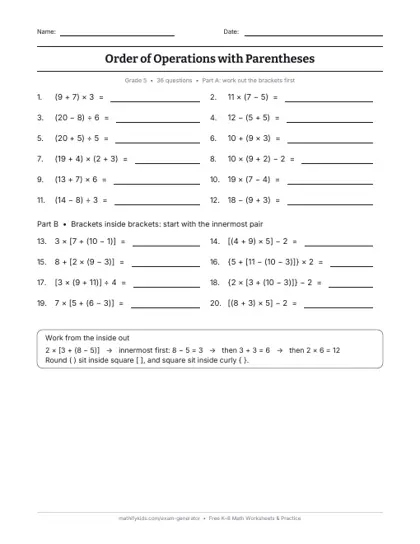
Order of operations with parentheses worksheet: printable PDF with an answer key. · Make a fresh test
Order of operations practice · order of operations calculator · order of operations for kids · exponents · evaluating expressions
Last reviewed
Questions parents ask
What is a numerical expression?
A calculation written with numbers and operation signs but no equals sign, like 2 × (8 + 7).
How do you write a numerical expression from words?
Decide what happens first and put it in brackets if needed, then write the rest of the calculation around it.
When do you need brackets?
When the words say to do + or − before × or ÷, as in “add 8 and 7, then multiply by 2”.
What does it mean to interpret an expression?
To describe it without calculating, such as “3 × (18,932 + 921) is three times as large as 18,932 + 921”.
What grade learns writing numerical expressions?
Grade 5 under Common Core 5.OA.A.2. Grade 6 then writes expressions with letters.