
Multiplication flash cards
Free multiplication flash cards to use online or print. Pick the times tables, flip each card, and the cards you miss come back until you know them.
🧒 Kids: pick your tables and tap Start the cards. Say the answer out loud, then flip the card to check! 🃏
Ready-made decks
- 2, 5 and 10 tables · the first tables, grade 2 and early grade 3
- 3, 4, 9 and 11 tables · doubling and the 10-minus trick
- 6, 7 and 8 tables · the hard facts
- All tables 2 to 12 · a full review for grade 4
- 13 to 20 tables · a challenge for grades 5 and 6
One table at a time: 2 · 3 · 4 · 5 · 6 · 7 · 8 · 9 · 10 · 11 · 12
Printable multiplication flash cards
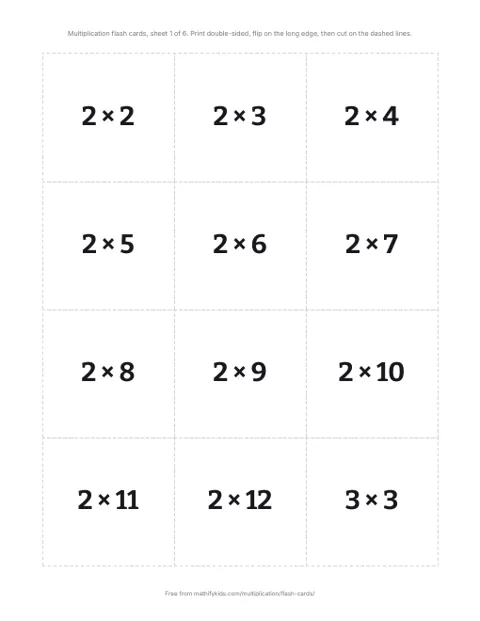
Download the multiplication flash cards (PDF): 66 cards for the 2 to 12 times tables, 12 cards to a sheet.
Print double-sided and choose “flip on long edge”, so each answer lands behind its question. Then cut along the dashed lines. Each answer side also shows the turn-around, so one card covers both 7 × 8 and 8 × 7.
Card stock lasts longest. A rubber band per table keeps the deck in order.
How to use flash cards so the facts stick
Flash cards work when they are short, frequent and focused on the facts your child does not know yet. Going through all 144 cards every night does the opposite.
- Start small. Pick 10 to 20 cards: one table plus a few older facts.
- Say it, then flip. Your child says the answer before turning the card. A guess after flipping does not count.
- Two piles. “Knew it quickly” and “not yet”. A fact counts as known when the answer comes in about 3 seconds.
- Go again. Run through the “not yet” pile once more. The online cards do this for you: a missed card comes back a few cards later.
- Stop at five minutes. End while it is still going well. Do it again tomorrow.
The three-box method
Teachers often use three boxes or envelopes to spread practice out over the week:
- Box 1, every day: new and missed cards.
- Box 2, every other day: cards your child knew once.
- Box 3, once a week: cards known three times in a row.
A missed card always goes back to box 1. Over a few weeks most cards drift into box 3, and the daily practice shrinks to the handful of facts that are genuinely hard. This spacing is the reason flash cards work better over a month than in one long evening.
Pair each card with a strategy
Flash cards train quick recall, but a child who only memorizes has nothing to fall back on when a fact goes missing. Before a card goes into the deck, make sure your child can work it out. For 7 × 8, that might be 7 × 7 = 49 plus one more 7. See multiplication strategies for a way to reach every fact.
Once the cards are going well, test the speed with the 1-minute speed test. Use the practice trainer for typed answers and a fact map.
Flash card games
- Beat the pile: time how long the deck takes, then try to beat it tomorrow.
- Multiplication war: each player flips a card and says the answer. The bigger product wins both cards.
- Answer first: show the answer side and ask for the fact. 56 is 7 × 8. This builds division facts too.
- Teacher swap: your child holds the cards and tests you. Make a few deliberate mistakes for them to catch.
For screen games, try the multiplication games.
Which cards for which grade?
- Grade 2 (class 2): the 2, 5 and 10 tables, after lots of work with equal groups.
- Grade 3 (class 3): all tables to 10 × 10. Common Core expects them from memory by the end of the year (3.OA.C.7).
- Grade 4 (class 4): the 11 and 12 tables, and any slow facts from grade 3.
- Grades 5 and 6: a small deck of the facts that still slow down long division and fractions.
For teachers: flash cards in the classroom
- Partner practice: pairs take turns as quizzer and answerer, five minutes each, using the printed cards.
- One link per group: copy a ready-made deck link above so each group practices its own tables on tablets.
- Exit ticket: each child writes the three cards they missed on a sticky note. Those cards start tomorrow’s practice.
- Turn-around talk: ask why one card can cover both 6 × 9 and 9 × 6. It is a quick way into the properties of multiplication.
More times tables help
- How to learn the times tables: the best order and a trick for every table.
- Multiplication chart: print the 1 to 12 or 1 to 20 chart, or a blank one to fill in.
- Mixed times tables worksheets for written practice.
Back to multiplication for kids · 3rd grade math
Last reviewed
Questions parents ask
How do you use multiplication flash cards?
Say the fact, flip the card and check. Put cards you knew quickly in one pile and the rest in another, then go through the “not yet” pile again. Five minutes a day works better than one long session.
How many multiplication flash cards are there?
For the 2 to 12 tables there are 66 different facts once turn-arounds are counted only once (7 × 8 and 8 × 7 share a card). The printable set on this page has those 66 cards; the online cards show every fact from × 1 to × 12.
Are flash cards good for learning times tables?
Yes, once your child understands what multiplication means. Flash cards build quick recall. Pair them with a strategy for each fact, so a forgotten fact can be worked out instead of guessed.
What order should kids learn multiplication flash cards?
Start with the 2, 5 and 10 tables, then 3, 4, 9 and 11, then 6, 7, 8 and 12. Keep a small deck of 10 to 20 cards and add new ones as old ones become easy.
How do I print the flash cards double-sided?
Choose two-sided printing and “flip on long edge”. The answers are already laid out to land behind the right questions. Cut along the dashed lines. Card stock makes them last longer.
What age are multiplication flash cards for?
Most children use them in grade 3 (about age 8), after equal groups and arrays in grade 2. They are also useful in grades 4 and 5 for any facts that are still slow.