
13 times table
The 13 times table (table of 13) from 13 × 1 to 13 × 12, with a trick, practice and a 1-minute challenge. Parent help is below.
🧒 Kids: learn the 13 times table!
Read the table out loud. Then tap Practice and answer the questions!
▶ Practice the 13 table ⏱️ 1-minute challenge
- 13 × 1 = 13
- 13 × 2 = 26
- 13 × 3 = 39
- 13 × 4 = 52
- 13 × 5 = 65
- 13 × 6 = 78
- 13 × 7 = 91
- 13 × 8 = 104
- 13 × 9 = 117
- 13 × 10 = 130
- 13 × 11 = 143
- 13 × 12 = 156
Bigger: 13 × 13 to 13 × 20
- 13 × 13 = 169
- 13 × 14 = 182
- 13 × 15 = 195
- 13 × 16 = 208
- 13 × 17 = 221
- 13 × 18 = 234
- 13 × 19 = 247
- 13 × 20 = 260
💡 Trick: 10 times plus 3 times. 13 × 7 → 10 × 7 = 70, 3 × 7 = 21, total 91
⏱️ 1-minute challenge 🃏 13 times table flash cards 🎮 Play a times table game
More tables: 2× · 3× · 4× · 5× · 6× · 7× · 8× · 9× · 10× · 11× · 12× · 13× · 14× · 15× · 16× · 17× · 18× · 19× · 20×
This part is for grown-ups. It has the patterns that make the 13 times table easy, pictures to draw, what to say, common mistakes, questions with answers and a free worksheet.
The trick for the 13 times table: 10 times plus 3 times
Split 13 into 10 and 3. Do both facts and add.
- 13 × 7: 10 × 7 = 70, 3 × 7 = 21, total 91
- 13 × 12: 10 × 12 = 120, 3 × 12 = 36, total 156
Patterns in the 13 times table
- The ones digits go 3, 6, 9, 2, 5, 8, 1, 4, 7, 0, the same as the 3 times table.
- Each answer is the 10 times answer plus the 3 times answer.
- 13 × 8 = 104 is the first answer over 100.
- The answers go odd, even, odd, even.
Saying the table out loud helps too: thirteen times one is 13, thirteen times two is 26…
- Thirteen times one is 13.
- Thirteen times two is 26.
- Thirteen times three is 39.
- Thirteen times four is 52.
- Thirteen times five is 65.
See the 13 times table
Draw these with your child. Each one shows that multiplying by 13 means counting equal groups of 13.
Facts you already know
Learn it after the 1 to 12 tables. You do not need new facts: every fact splits into a 10 times fact and a fact you already know.
For example, 13 × 6 = 10 × 6 + 3 × 6 = 60 + 18 = 78. Children who know the 1 to 12 tables can work out every 13 times fact this way, and with practice the answers become memorised.
The table also works backwards as division: 39 ÷ 13 = 3 · 91 ÷ 13 = 7 · 156 ÷ 13 = 12.
In real life: A baker’s dozen is 13: bakers used to add one extra to every 12. How many buns in 3 baker’s dozens? 3 × 13 = 39.
Common mistakes with the 13 times table
What to say to your child
A short script for your first 13 times table session. Pause after each line and let your child answer.
- “13 is 10 and 3. What is 10 × 6?” (60.) “And 3 × 6?” (18.) “Add them.” (78.)
- “Try it another way: 10 times plus 3 times.”
- “What is 13 × 10?” (130.) “So 13 × 9 is one 13 less.” (117.)
- “Where would you use the 13 times table?” (A baker’s dozen is 13: bakers used to add one extra to every 12.)
13 times table questions (answers below)
- 13 × 7
- 13 × 8
- 13 × 9
- 13 × 4
- 13 × 9
- 13 × ? = 78
- ? × 13 = 143
- 104 ÷ 13
- How many buns in 7 baker’s dozens?
- 65 buns are shared equally into groups of 13. How many groups?
Show the answers
- 91
- 104
- 117
- 52
- 117
- 6
- 11
- 8
- 91 buns
- 5
The 13 times table as division facts
Every multiplication fact has a division fact hiding inside it. If 13 × 6 = 78, then 78 shared into groups of 13 makes 6 groups. Here are the division facts for the table of 13:
- 13 ÷ 13 = 1
- 26 ÷ 13 = 2
- 39 ÷ 13 = 3
- 52 ÷ 13 = 4
- 65 ÷ 13 = 5
- 78 ÷ 13 = 6
- 91 ÷ 13 = 7
- 104 ÷ 13 = 8
- 117 ÷ 13 = 9
- 130 ÷ 13 = 10
- 143 ÷ 13 = 11
- 156 ÷ 13 = 12
Four facts with the same three numbers make a fact family.
13 × 7 = 91 · 7 × 13 = 91 · 91 ÷ 13 = 7 · 91 ÷ 7 = 13
Learning the table this way means your child learns division at the same time. To check a division answer, multiply back (see check division with multiplication).
Multiples of 13
The answers in the 13 times table are the multiples of 13. They go on forever: 13, 26, 39, 52, 65, 78, 91, 104… Every multiple of 13 can be split into equal groups of 13 with nothing left over.
Is it a multiple of 13? 13 is prime and has no quick digit test, so divide by 13 and check for a remainder. Try it on 182: it is 13 × 14. Older children use these tests to find factors and multiples and to simplify fractions.
13 times table word problems
Word problems show your child when to use the table. Read each one aloud, ask “how many groups, and how many in each group?”, then multiply.
- Groups to total. How many buns in 6 baker’s dozens? There are 6 groups of 13, so 6 × 13 = 78 buns.
- Total to groups. 117 buns are put into groups of 13. How many groups? Ask “13 times what is 117?” The answer is 9.
- Two steps. Count the buns in 4 baker’s dozens, then in 3 more. That is 52 + 39 = 91. Quicker: 4 + 3 = 7 groups, and 7 × 13 = 91.
For more practice, see multiplication word problems.
A 5-day plan for the 13 times table
- Day 1: learn the trick (10 times plus 3 times) and say the table forwards.
- Day 2: say it backwards, then answer the practice questions in order.
- Day 3: mixed order, with extra time on 13 × 7 and 13 × 8.
- Day 4: missing numbers and division: 13 × ? = 104 and 104 ÷ 13.
- Day 5: the 1-minute challenge, then the worksheet.
Five minutes a day is enough. A fact is learned when the answer comes in about 3 seconds without counting. Come back to the table once a week after that, so it stays fresh.
13 to 20 times tables worksheet
Print the free 13 to 20 times tables worksheet: 50 questions, including missing factors, with an answer key.
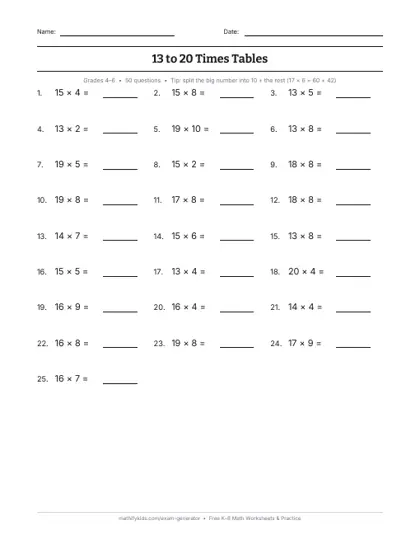 13 to 20 times tables
You can also print this page, cover the answers in the 13 times table above, and say each one. For mixed written practice, use the mixed times tables worksheets or make a custom test with the 13 times table practice.
More: how to learn the times tables · multiplication chart · multiplication flash cards · Times Table Blaster game · multiplication for kids
Last reviewed
Questions parents ask
What is the 13 times table?
The 13 times table is the list of answers when you multiply by 13: 13, 26, 39, 52, 65, 78, 91, 104, 117, 130, 143, 156. These are also the first twelve multiples of 13.
What is the trick for the 13 times table?
10 times plus 3 times. Split 13 into 10 and 3. Do both facts and add. For example, 13 × 7: 10 × 7 = 70, 3 × 7 = 21, total 91.
How do you learn the 13 times table fast?
Learn it after the 1 to 12 tables. You do not need new facts: every fact splits into a 10 times fact and a fact you already know. Learn the trick and say the table forwards and backwards. Then practice mixed-up facts for 5 minutes a day, until each answer comes in about 3 seconds.
What are the hardest facts in the 13 times table?
For most children: 13 × 7 = 91, 13 × 8 = 104, 13 × 9 = 117, 13 × 12 = 156. Practice those first with the trainer on this page.
What is 13 × 12?
13 × 12 = 156. And 13 × 11 = 143.