
Cross-sections of 3D shapes
A cross-section is the flat shape you see when you slice through a solid. Slice a cylinder across: a circle. Slice it straight down: a rectangle.
Not sure this is the right level? Take the free grade 7 check-up and get a daily practice plan.
What a cross-section is
Cut a loaf of bread and look at the cut face: that face is a cross-section. Mathematicians imagine slicing a solid with a flat plane and ask what 2D shape the cut makes. Common Core standard 7.G.A.3 asks grade 7 students to describe the 2D figures that come from slicing 3D figures, as in plane sections of right rectangular prisms and right rectangular pyramids.
The answer depends on two things: the solid, and the direction of the slice. Grade 7 focuses on two directions:
- Parallel to the base: a horizontal slice, like cutting a carrot into coins.
- Perpendicular to the base: a vertical slice, straight down, like cutting a cake.
See it: pictures to draw with your child
Copy these onto paper or a whiteboard. A quick sketch makes the idea concrete before any written method.
The common cross-sections
| Solid | Slice parallel to the base | Slice straight down through the middle |
|---|---|---|
| Rectangular prism | Rectangle | Rectangle |
| Cube | Square | Square |
| Cylinder | Circle | Rectangle |
| Cone | Circle | Triangle (through the tip) |
| Square pyramid | Square | Triangle (through the tip) |
| Sphere | Circle | Circle |
A slice parallel to the base of a prism or cylinder is always a copy of the base. For a pyramid or cone, it is a smaller copy of the base, shrinking as the slice moves toward the tip. A slice straight down through a prism or cylinder is a rectangle, because the sides run straight up and down. Through the tip of a pyramid or cone, it is a triangle.
Tilted slices
Slices at an angle make more surprising shapes. A tilted slice through a cylinder makes an oval (an ellipse). A slice that cuts off one corner of a cube makes a triangle, and a slice through the middle of a cube at just the right tilt makes a hexagon. These are good puzzles with modeling clay and dental floss, but the grade 7 standard mainly asks about slices parallel and perpendicular to the base.
A full example, start to finish
A square pyramid has a base 6 cm on each side. What do you get when you slice it parallel to the base, halfway up? And straight down through the tip?
- Parallel slice: it is a copy of the base, so a square. Halfway up, every side is half as long: a 3 cm square.
- Vertical slice through the tip: the cut goes from the tip down to a line across the base, so it is a triangle. Its base is 6 cm, the width of the pyramid.
- Vertical slice not through the tip: it cuts the two slanted faces below the tip, making a trapezoid.
Cross-sections practice
Name the shape of each slice through prisms, cubes, cylinders, cones, pyramids and spheres. New slices every time.
Go further
Learn the solids themselves in faces, edges and vertices. Cross-sections explain the volume formulas too: a prism or cylinder has the same cross-section all the way up, so its volume is base area × height. See volume and volume of cylinders, cones and spheres.
What to say to your child
A short script for teaching it the first time. Pause after each line and let your child do the next step.
- “If I cut this cucumber across, what shape is the cut face?” (A circle.)
- “And if I cut it the long way, straight down the middle?” (A rectangle.)
- “That cut face is called a cross-section.”
- “What about an ice cream cone cut straight down through the tip?”
- “Use clay and floss to test your guess.”
More worked examples
Example 1: Cylinder, parallel to base
Circle, the same size as the base.
Example 2: Cone, through the tip
Triangle.
Example 3: Cube, parallel to a face
Square.
Practice questions (answers below)
Ask these out loud or write them down. Check each answer, and ask “how did you get that?” for one or two.
- Sphere, any flat slice
- Rectangular prism, parallel to base
- Square pyramid, parallel to base
- Cylinder, straight down through the middle
- Cone, parallel to base
- Triangular prism, parallel to base
- Cube, cutting off one corner
- Cylinder, at a tilt
Show the answers
- Circle
- Rectangle
- A smaller square
- Rectangle
- A smaller circle
- Triangle
- Triangle
- Oval (ellipse)
Common mistakes
How to teach it at home
Fruit and vegetable slices
Cut a carrot, a banana or an orange two ways and name each cross-section.
Clay shapes
Make a cube and a pyramid from clay and slice them with dental floss.
Cake cut
Before cutting a cake or a sandwich, guess the shape of the cut face.
By grade
- Grade 1 (1.G.A.2): build and name 3D shapes.
- Grade 7 (7.G.A.3): describe cross-sections of prisms and pyramids.
- High school (G-GMD.B.4): cross-sections and rotating 2D shapes to make solids.
More for each grade: Grade 7 math and the CBSE class 7 maths guide.
Worksheets and practice
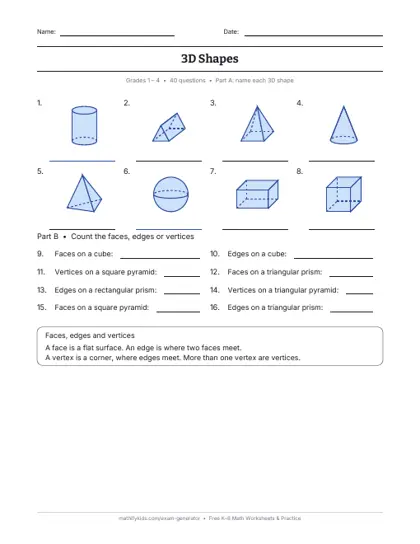
3D shapes worksheet: printable PDF with an answer key.
Last reviewed
Questions parents ask
What is a cross-section?
The 2D shape of the cut face when you slice straight through a 3D solid.
What is the cross-section of a cylinder?
A circle if you slice parallel to the base, and a rectangle if you slice straight down through the middle.
What is the cross-section of a cone?
A circle parallel to the base, and a triangle for a vertical slice through the tip.
Is every cross-section of a sphere a circle?
Yes. Every flat slice of a sphere is a circle, biggest through the center.
What grade learns cross-sections?
Grade 7, in Common Core standard 7.G.A.3.