
Congruent figures and rigid transformations
Two figures are congruent when a sequence of rigid motions (reflections, rotations and translations) moves one exactly onto the other.
Not sure this is the right level? Take the free grade 8 check-up and get a daily practice plan.
What congruent means in grade 8
Congruent figures have the same size and the same shape. Grade 8 gives that idea a precise meaning. Standard 8.G.A.2 says a figure is congruent to another if the second can be obtained from the first by a sequence of rotations, reflections and translations.
These three moves are called rigid motions, because they never stretch or shrink anything:
- Translation: slide every point the same distance in the same direction.
- Reflection: flip across a line, like a mirror image.
- Rotation: turn around a fixed point by an angle such as 90° or 180°.
Rigid motions keep every length and every angle the same (standard 8.G.A.1). So if one figure can be moved onto another using only these, every side and angle must match: the figures are congruent. A dilation changes the size, so it does not make congruent figures; it makes similar ones.
See it: pictures to draw with your child
Copy these onto paper or a whiteboard. A quick sketch makes the idea concrete before any written method.
The moves on a coordinate grid
| Move | What happens to (x, y) |
|---|---|
| Translate a right, b up | (x + a, y + b) |
| Reflect across the x-axis | (x, −y) |
| Reflect across the y-axis | (−x, y) |
| Rotate 180° about the origin | (−x, −y) |
| Rotate 90° clockwise about the origin | (y, −x) |
| Rotate 90° counterclockwise about the origin | (−y, x) |
Apply the rule to each vertex, then join the new vertices. Leave the original shape on the grid so you can compare.
How to find a sequence that maps one figure onto another
- Check orientation. Is the new figure facing the other way, like a mirror image? Then you need a reflection. Is it turned? A rotation.
- Fix the shape first. Do the reflection or rotation, and draw the result.
- Then slide. Compare one vertex of your result with the matching vertex of the target and translate by the difference.
- Check every vertex. All three corners must land exactly on the target.
There is often more than one correct sequence. A rotation of 180° gives the same result as a reflection across the x-axis followed by a reflection across the y-axis.
A full example, start to finish
Triangle P has vertices (1, 1), (4, 1) and (1, 3). Triangle Q has vertices (−1, −3), (−4, −3) and (−1, −1). Show they are congruent.
- Orientation: Q points left while P points right, so try a reflection across the y-axis: (1, 1) → (−1, 1), (4, 1) → (−4, 1), (1, 3) → (−1, 3).
- Compare with Q: each point is 4 above its match in Q.
- Translate down 4: (−1, 1) → (−1, −3), (−4, 1) → (−4, −3), (−1, 3) → (−1, −1). That is exactly Q.
- Conclude: a reflection across the y-axis followed by a translation 4 units down maps P onto Q, so the triangles are congruent.
Congruence practice
Find the sequence of moves that maps one triangle onto another, and decide if two figures are congruent. New triangles every time.
Go further
For the moves themselves, see transformations. Add a dilation and you get similar figures (8.G.A.4): same shape, possibly a different size. Congruent triangles also explain angle relationships with parallel lines.
What to say to your child
A short script for teaching it the first time. Pause after each line and let your child do the next step.
- “Trace this triangle on paper and cut it out.”
- “Can you slide, flip or turn it so it sits exactly on this other triangle?”
- “Which moves did you use? In what order?”
- “Did the cutout ever stretch? That’s why these shapes are congruent.”
- “Now try this bigger triangle. Can you make it fit?”
More worked examples
Example 1: A square slid 3 units right
Congruent: a translation keeps size and shape.
Example 2: A triangle and its mirror image
Congruent: a reflection is a rigid motion.
Example 3: A triangle and a copy twice as big
Not congruent: a dilation changes the size. They are similar.
Practice questions (answers below)
Ask these out loud or write them down. Check each answer, and ask “how did you get that?” for one or two.
- Reflect (2, 5) across the x-axis
- Rotate (3, 1) 180° about the origin
- Translate (−2, 4) 5 right and 3 down
- Rotate (4, 2) 90° clockwise about the origin
- Does a reflection change side lengths?
- Is a dilation by 3 a rigid motion?
- Name the three rigid motions
- Two triangles have the same angles but different sizes. Congruent?
Show the answers
- (2, −5)
- (−3, −1)
- (3, 1)
- (2, −4)
- No
- No
- Translation, reflection, rotation
- No, similar
Common mistakes
How to teach it at home
Paper cutouts
Cut out a shape and move it onto a traced copy using slides, flips and turns.
Floor tiles
Look for tile patterns that repeat by sliding, flipping or turning.
Mirror check
Hold a small mirror on a line in a drawing: the reflection is congruent to the original.
By grade
- Grade 4 (4.G.A.3): lines of symmetry.
- Grade 8 (8.G.A.1, 8.G.A.2): rigid motions keep lengths and angles; congruence by a sequence of rigid motions.
- Grade 8 (8.G.A.3, 8.G.A.4): dilations and similarity.
More for each grade: Grade 8 math and the CBSE class 8 maths guide.
Worksheets and practice
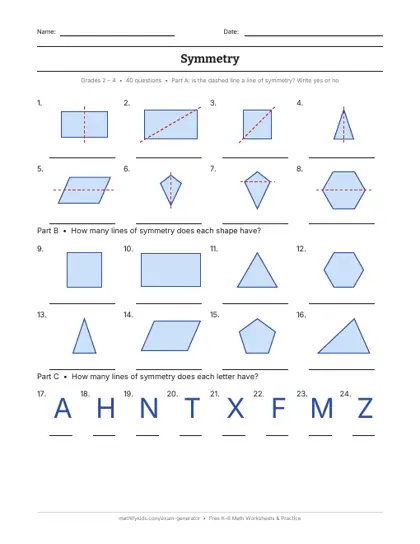
Symmetry worksheet: printable PDF with an answer key.
Last reviewed
Questions parents ask
What does congruent mean in math?
Two figures are congruent when they have exactly the same size and shape, so a sequence of rigid motions can move one onto the other.
What are rigid motions?
Translations, reflections and rotations. They move a figure without changing any lengths or angles.
Is a dilation a rigid motion?
No. A dilation changes the size, so it makes similar figures, not congruent ones.
How do you show two figures are congruent?
Find a sequence of translations, reflections and rotations that maps every vertex of one figure onto the other.
What grade learns congruence and transformations?
Grade 8, in Common Core standards 8.G.A.1 and 8.G.A.2.