
Linear functions: rate of change and initial value
A linear function changes by the same amount each step. Its rate of change is m and its initial value, the start, is b: y = mx + b.
Not sure this is the right level? Take the free grade 8 check-up and get a daily practice plan.
The two numbers that describe a linear function
A taxi charges $3 to start and $2 for every mile. The cost goes up by the same $2 each mile, so it is a linear function. Two numbers describe it completely:
- The rate of change, $2 per mile. This is the slope, m.
- The initial value, $3. This is the value when x = 0, the y-intercept, b.
So the cost y for x miles is y = 2x + 3. A 10-mile ride costs 2 × 10 + 3 = $23.
Common Core standard 8.F.B.4 asks grade 8 students to build a linear function from a description, two points, a table or a graph, and to explain what the rate of change and initial value mean in the situation.
See it: pictures to draw with your child
Copy these onto paper or a whiteboard. A quick sketch makes the idea concrete before any written method.
Spotting m and b in a word problem
- Rate of change: words like per, each, every, an hour, a month. “$12 per month” means m = 12.
- Initial value: a one-time amount at the start: a joining fee, a call-out charge, money already saved, the height before anything happens.
- Decreasing: if something goes down each step, like a candle burning or a tank draining, the rate is negative. A 24 cm candle that burns 3 cm an hour is y = −3x + 24.
Building the function from two points
Sometimes you get two snapshots instead of the rule: “After 2 hours the plumber has charged $110; after 5 hours, $215.”
- Rate of change: (215 − 110) ÷ (5 − 2) = 105 ÷ 3 = $35 per hour.
- Initial value: go back 2 hours from $110: 110 − 2 × 35 = $40. That is the call-out fee.
- Function: y = 35x + 40.
- Check: at x = 5, 35 × 5 + 40 = 215. Correct.
A full example, start to finish
A phone battery is at 100% and drops 15% for each hour of video.
- Rate of change: it goes down 15 each hour, so m = −15.
- Initial value: 100.
- Function: y = −15x + 100.
- Use it: after 4 hours, y = −60 + 100 = 40%. The battery runs out when −15x + 100 = 0, at x = 6 2/3 hours, about 6 hours 40 minutes.
A table shows the same pattern:
| Hours | 0 | 1 | 2 | 3 | 4 |
|---|---|---|---|---|---|
| Battery % | 100 | 85 | 70 | 55 | 40 |
Linear functions practice
Find the rate of change and initial value from stories, tables and two points, and predict values. New problems every time.
What comes next
Two linear functions can be compared by their rates and starting values in comparing functions. When two of them are equal, you are solving a system of equations: which phone plan is cheaper after how many months?
What to say to your child
A short script for teaching it the first time. Pause after each line and let your child do the next step.
- “A taxi costs $3 to get in and $2 a mile. What does a 1-mile ride cost? 2 miles? 0 miles?”
- “What goes up each mile?” (The rate of change.)
- “What is the cost before you go anywhere?” (The initial value.)
- “So the rule is cost = 2 × miles + 3. Let’s graph it.”
- “Can you find a bill at home that works the same way?”
More worked examples
Example 1: A gym costs $20 to join and $15 a month.
m = 15, b = 20: y = 15x + 20. After 6 months: $110.
Example 2: A pool holds 600 gallons and drains 25 gallons a minute.
m = −25, b = 600: y = −25x + 600. Empty after 24 minutes.
Example 3: After 1 week Maya has $35; after 4 weeks, $80.
m = 45 ÷ 3 = 15 per week, b = 35 − 15 = 20: y = 15x + 20.
Practice questions (answers below)
Ask these out loud or write them down. Check each answer, and ask “how did you get that?” for one or two.
- $5 plus $3 per mile: rate of change?
- $5 plus $3 per mile: initial value?
- Equation for $5 plus $3 per mile
- A 30 cm candle burns 2 cm an hour: equation?
- y = 12x + 40: cost after 5 months?
- After 2 hours: $70. After 4 hours: $110. Rate?
- Same problem: initial value?
- Which number is the slope in y = 9x + 25?
Show the answers
- 3
- 5
- y = 3x + 5
- y = −2x + 30
- $100
- $20 per hour
- $30
- 9
Common mistakes
How to teach it at home
Taxi and phone plans
Any bill with a starting fee and a cost per unit is a linear function. Ask: what is the rate of change, and what is the initial value?
Graph a walk
Walk away from a wall, stop, then walk back, while someone times it. Sketch distance against time together.
Input–output game
One person thinks of a rule like “double it and add 1”. The other gives inputs and guesses the rule from the outputs.
By grade
- Grade 8 (8.F.B.4): build linear functions and interpret the rate of change and initial value.
- Grade 8 (8.EE.C.8): systems of two linear equations.
- Algebra 1: linear models, arithmetic sequences and linear regression.
More for each grade: Grade 8 math and the CBSE class 8 maths guide.
Worksheets and practice
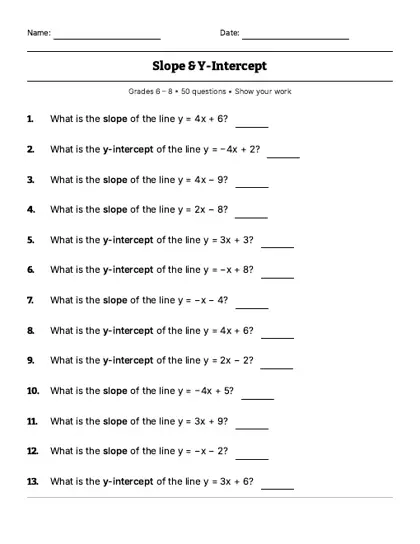
Slope and y-intercept worksheet: printable PDF with an answer key.
Last reviewed
Questions parents ask
What is the rate of change of a linear function?
The amount y changes for each 1 step in x. It is the slope, m, in y = mx + b.
What is the initial value?
The value of y when x = 0: the starting amount. It is the y-intercept, b.
How do you write a linear function from a word problem?
Find the amount that changes each step (m) and the starting amount (b), and write y = mx + b.
How do you find a linear function from two points?
Divide the change in y by the change in x to get m, then work back to x = 0 to get b.
What grade learns linear functions?
Grade 8, in Common Core standard 8.F.B.4.