
Learn slope and functions step by step
Learn functions and slope in 8 levels, from variables and tables to y = mx + b and describing graphs, with a 5-question test for each level.
🧒 Kids: tap Start level ▶ and get 4 of 5 right to pass. Can you reach level 8? 🏆
Which level for which grade?
There are 8 levels. Each has a lesson link and a 5-question test; get 4 right to pass. Progress is saved on this device.
| Level | Skill | Grade |
|---|---|---|
| 1 | Variables and tables | 6 |
| 2 | What is a function | 8 |
| 3 | Proportional graphs | 7–8 |
| 4 | Slope | 8 |
| 5 | y = mx + b | 8 |
| 6 | Linear models | 8 |
| 7 | Comparing functions | 8 |
| 8 | Describing graphs | 8 |
How to use the levels
- Find the starting level. Take the tests from level 1 until your child scores under 4.
- Learn, then test. Open the lesson link for that level, work through the examples, then retake the test.
- Two passes. Pass each level on two different days before moving on.
- Keep graph paper handy. Sketching a slope triangle makes most questions easier.
Why the levels are in this order
Functions start in grade 6 with two variables that change together. Proportional graphs add the idea of a rate. A function makes the rule precise: one output for each input. Slope measures the rate on any straight line, and y = mx + b adds a starting value. With those, real situations become linear models, two functions can be compared, and any graph can be read as a story.
More functions and slope help
- Functions and slope: the topic guide, with every lesson in order.
- Functions practice: new graphs and tables every time, 10 skills.
- Functions levels: 8 short tests from variables to describing graphs.
- Slope worksheet and slope and y-intercept worksheet: printable PDFs with answer keys.
For teachers
The levels work on a projector for a whole-class warm-up. Progress is saved only in each device’s browser, so no login or student data is needed. Link straight to a skill with the practice page, for example /functions/practice/?skill=ymxb.
Practice questions (answers below)
Ask these out loud or write them down. Check each answer, and ask “how did you get that?” for one or two.
- Level 1: c = 8t when t = 3
- Level 2: is {(1, 2), (1, 3)} a function?
- Level 3: line through (0, 0) and (2, 7). Unit rate?
- Level 4: slope through (1, 1) and (3, 7)
- Level 5: y-intercept of y = 4x − 9
- Level 6: $10 plus $4 a visit. Equation?
- Level 7: is y = x² linear?
- Level 8: a flat part on a distance graph means…
Show the answers
- 24
- No
- 3.5
- 3
- −9
- y = 4x + 10
- No
- Stopped
Common mistakes
How to teach it at home
Taxi and phone plans
Any bill with a starting fee and a cost per unit is a linear function. Ask: what is the rate of change, and what is the initial value?
Graph a walk
Walk away from a wall, stop, then walk back, while someone times it. Sketch distance against time together.
Input–output game
One person thinks of a rule like “double it and add 1”. The other gives inputs and guesses the rule from the outputs.
By grade
Check every topic at once
The free math check-up tests every topic of one grade in 10 to 20 minutes. It shows which topics are solid and where to start practicing. Levels you pass here also appear on your progress page.
More for each grade: Grade 6 math and the CBSE class 6 maths guide; Grade 7 math and the CBSE class 7 maths guide; Grade 8 math and the CBSE class 8 maths guide.
Worksheets and practice
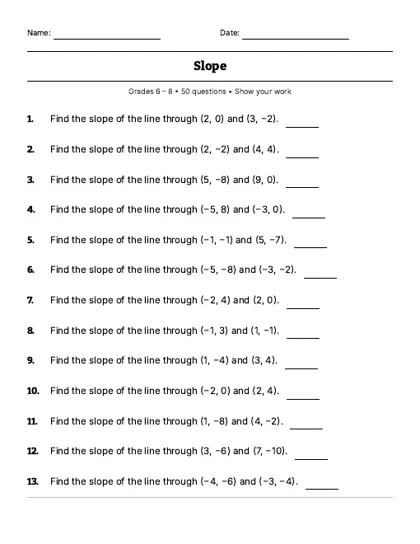
Slope worksheet: printable PDF with an answer key.
Last reviewed
Questions parents ask
How do kids learn functions step by step?
Variables and tables first, then proportional graphs, what a function is, slope, y = mx + b, linear models and finally comparing and describing graphs.
What is the hardest part of functions?
Usually slope with negative numbers, and finding the y-intercept from a table that does not start at x = 0.
Is progress saved?
Yes, passed levels are saved in this browser on this device. Nothing is sent to us.
Which level should an 8th grader start at?
Take the level 3 and 4 tests. If both are easy, go on to level 5, y = mx + b.
How long does each level take?
A test is 5 questions, about 4 minutes. Learning a level usually takes two or three short sessions.