
Probability: how likely is it?
Probability is a number from 0 to 1 that says how likely an event is: 0 is impossible, 1 is certain, and 1/2 is as likely as not.
Not sure this is the right level? Take the free grade 7 check-up and get a daily practice plan.
The probability scale
Standard 7.SP.C.5 puts every probability on a scale from 0 to 1. Probabilities can be written as fractions, decimals or percents: 1/4 = 0.25 = 25%.
- 0, impossible: rolling a 7 on a number cube labeled 1 to 6.
- Less than 1/2, unlikely: picking the one blue marble from 9 red and 1 blue.
- 1/2, equally likely: a coin landing on heads.
- More than 1/2, likely: picking a red marble from that same bag.
- 1, certain: rolling a number less than 7.
See it: pictures to draw with your child
Copy these onto paper or a whiteboard. A quick sketch makes the idea concrete before any written method.
Simple (theoretical) probability
When all outcomes are equally likely, count:
P(event) = number of favorable outcomes ÷ number of possible outcomes
- A bag has 3 red, 5 blue and 2 green marbles. P(blue) = 5/10 = 1/2.
- A number cube: P(even) = 3/6 = 1/2, because 2, 4 and 6 are even.
- A spinner with 8 equal parts, 3 of them red: P(red) = 3/8.
This is a uniform probability model (7.SP.C.7a): every outcome has the same chance. A spinner with unequal parts, or a bent coin, is not uniform; for those you estimate the probabilities from data (7.SP.C.7b).
Experimental probability
Experimental probability comes from actually trying it:
experimental P = times it happened ÷ number of trials
Toss a paper cup 50 times; it lands on its side 31 times. The experimental probability of landing on its side is 31/50. With no way to work out the theoretical probability for a cup, experiments are the only way.
Standard 7.SP.C.6 also goes the other way: use a probability to predict. Roll a number cube 300 times and expect about 1/6 × 300 = 50 fours. The real count might be 46 or 55; the more trials, the closer experimental probability gets to theoretical probability.
A full example: theory and experiment
A spinner has 4 equal parts: red, blue, green and yellow. The theoretical probability of red is 1/4. Jay spins it 20 times and gets red 7 times, an experimental probability of 7/20 = 35%. Is the spinner unfair? Not necessarily: with only 20 spins, results like 3, 5 or 7 reds all happen often. The class combines everyone’s spins: 240 spins with 62 reds, which is about 26%, very close to 25%. That is the point of 7.SP.C.6 and 7.SP.C.7: the more trials, the closer experimental probability gets to the theoretical one, and a large gap after many trials is a sign the model is wrong.
Fractions, decimals and percents
The same probability can be written three ways, and students should move between them easily. A probability of 3/4 is 0.75 and 75%. A weather forecast of a 30% chance of rain means a probability of 0.3, or 3/10: unlikely, but far from impossible. When comparing two probabilities, change them to the same form first: is 5/8 more likely than 0.6? 5/8 = 0.625, so yes, just. In a probability model (7.SP.C.7), all the probabilities of the outcomes must add up to 1: a spinner that is 1/2 red, 1/4 blue and 1/4 green adds to 1, but a model that says 40% red, 40% blue and 30% green cannot be right.
Probability practice
Likelihood words, bags of marbles, spinners, number cubes and experiments. New questions every time.
Go further
Two things at once, like a coin and a number cube, are compound events. The probability worksheet has 50 printable questions with answers.
What to say to your child
A short script for teaching it the first time. Pause after each line and let your child do the next step.
- “If I flip this coin, how likely is heads?” (half the time)
- “Where would that go on a line from impossible to certain?”
- “This bag has 3 red and 5 blue marbles. How many marbles altogether?” (8)
- “So the probability of blue is 5 out of 8.”
- “Let’s roll this cube 30 times and count the 4s. How many do we expect?” (about 5)
- “Were we close? What if we rolled 300 times?”
More worked examples
Example 1: Marbles
4 red, 6 blue: P(red) = 4/10 = 2/5.
Example 2: Number cube
P(greater than 4) = 2/6 = 1/3 (5 and 6).
Example 3: Experiment
A thumbtack lands point up 18 times in 40 tosses: experimental P = 18/40 = 9/20.
Example 4: Prediction
P(red) on a spinner is 1/4. In 200 spins, expect about 50 reds.
Practice questions (answers below)
Ask these out loud or write them down. Check each answer, and ask “how did you get that?” for one or two.
- P(heads) on a fair coin?
- Bag of 2 red, 3 blue. P(red)?
- Number cube: P(a 6)?
- Number cube: P(odd)?
- Probability 0.9: likely or unlikely?
- Probability 0: what does it mean?
- Heads 27 times in 50 flips. Experimental P(heads)?
- Roll a cube 120 times. About how many 3s?
Show the answers
- 1/2
- 2/5
- 1/6
- 1/2
- Likely
- Impossible
- 27/50
- 20
Common mistakes
How to teach it at home
Coin flips
Flip a coin 20 times and tally heads. Compare with 1/2, then combine with a sibling’s 20 flips.
Board games
Before rolling, ask how likely the number you need is.
Weather words
A 30% chance of rain: is that likely or unlikely?
By grade
- Grade 7 (7.SP.C.5, 7.SP.C.6, 7.SP.C.7): probability from 0 to 1, theoretical and experimental probability, and probability models.
- Grade 7 (7.SP.C.8): compound events.
More for each grade: Grade 7 math and the CBSE class 7 maths guide.
Worksheets and practice
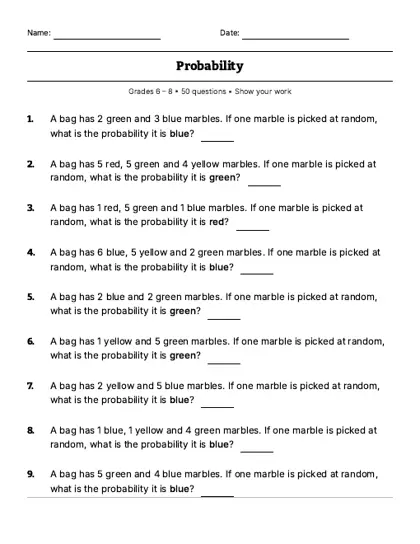
Probability worksheet: printable PDF with an answer key.
Statistics practice · Statistics levels · Mean, median, mode and range
Last reviewed
Questions parents ask
What is probability?
A number from 0 to 1 that tells how likely an event is. 0 is impossible, 1 is certain.
How do you find a simple probability?
Divide the number of favorable outcomes by the number of equally likely outcomes. P(even) on a number cube is 3/6 = 1/2.
What is experimental probability?
The fraction of trials in which the event actually happened, such as 27 heads in 50 flips, which is 27/50.
What is the difference between theoretical and experimental probability?
Theoretical probability is worked out from equally likely outcomes; experimental probability comes from doing trials. With many trials they get close.
What grade learns probability?
Grade 7, in Common Core standards 7.SP.C.5 to 7.SP.C.8.