
Learn the order of operations step by step
Learn the order of operations in 8 levels, from two operations to brackets, exponents, decimals and negatives, with a 5-question test for each.
🧒 Kids: tap Start level ▶ and get 4 of 5 right to pass. Can you reach level 8? 🏆
Which level for which grade?
There are 8 levels, from two operations to decimals and negative numbers. Each level has short lessons and a 5-question test; get 4 right to pass. Progress is saved on this device, so your child can come back and carry on.
| Level | Skill | Grade |
|---|---|---|
| 1 | Two operations | 5 |
| 2 | Left to right | 5 |
| 3 | Parentheses | 5 |
| 4 | Nested brackets | 5 |
| 5 | Words and stories | 5–6 |
| 6 | Exponents | 6 |
| 7 | Three or more steps | 6 |
| 8 | Decimals and negatives | 6–7 |
How to use the levels
- Find the starting level. Take the tests from level 1 until your child scores under 4. That is the level to work on.
- Learn it. Open the Learn links for that level: each lesson has pictures, a parent script and practice.
- Practice for a few days. Use the quizzes on the lesson pages and the order of operations practice tool.
- Retake the test. 4 out of 5 passes the level. Move on to the next one.
Level 2, left to right, is the one to take slowly. It is the rule children forget most often, and every later level depends on it.
Why the levels are in this order
Each level uses the one before it. Levels 1 and 2 set the basic order: × and ÷ before + and −, and partners from left to right.
Levels 3 and 4 add brackets, and level 5 uses them to write expressions from words and stories. Level 6 adds exponents, the grade 6 step.
The last two levels put everything together, then use harder numbers: decimals and negatives. A child stuck at a high level usually has a gap lower down, very often level 2.
Tools that help with every level
The order of operations calculator shows every step of any expression, with the part being worked out highlighted. It helps with every level, especially when your child wants to check homework.
Confident times tables matter too, because most steps are multiplication facts. Keep the multiplication practice going alongside the levels.
More order of operations practice
For teachers
The levels work on a projector for a whole-class warm-up. Progress is saved only in each device’s browser, so no login or student data is needed. On shared computers, use Reset my progress at the end of the lesson.
Practice questions (answers below)
Ask these out loud or write them down. Check each answer, and ask “how did you get that?” for one or two.
- Level 1: 5 + 3 × 4
- Level 2: 20 ÷ 4 × 2
- Level 3: (5 + 3) × 4
- Level 4: 2 × [1 + (6 − 3)]
- Level 5: “Add 6 and 4, then halve it”
- Level 6: 1 + 2³
- Level 7: (8 − 5)² + 12 ÷ 4
- Level 8: −2 + 3 × 4
- Level 8: 0.5 × 6 + 1.5
- Stretch: (2 + 3)² − 4 × 5
Show the answers
- 17
- 10
- 32
- 8
- (6 + 4) ÷ 2 = 5
- 9
- 12
- 10
- 4.5
- 5
Common mistakes
How to teach it at home
Level chart
Print a chart of 8 boxes and colour one each time a level is passed.
Celebrate
A small reward at levels 4 and 8.
Make a target
“Use 2, 3 and 4 to make 14” is a great warm-up for any level.
By grade
Check every topic at once
The free math check-up tests every topic of one grade in 10 to 20 minutes. It shows which topics are solid and where to start practicing. Levels you pass here also appear on your progress page.
More for each grade: Grade 5 math and the CBSE class 5 maths guide; Grade 6 math and the CBSE class 6 maths guide; Grade 7 math and the CBSE class 7 maths guide.
Worksheets and practice
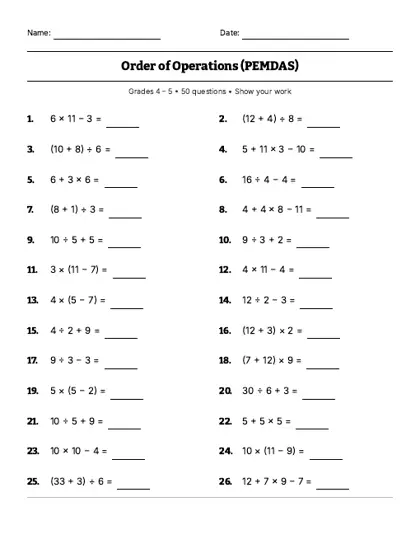
Order of operations worksheet: printable PDF with an answer key. · Make a fresh test
Last reviewed
Questions parents ask
How do you learn the order of operations step by step?
Start with two operations, then left to right, then brackets and nested brackets. Next come writing expressions, exponents, longer expressions, and finally decimals and negatives.
What is the hardest part of the order of operations?
Usually the left to right rule for × and ÷ and for + and −. Level 2 focuses on it.
How long does it take to learn the order of operations?
It is spread over grades 5 and 6, with negatives in grade 7. Most children move through two or three levels a term with short daily practice.
Is progress saved?
Yes, passed levels are saved in this browser on this device. Nothing is sent to us.
Should my child know times tables first?
Yes. Most order of operations steps are multiplication or division facts.