
Position words for kindergarten: above, below, beside
Position words tell us where something is: the cup is on the table, the cat is under it. Children learn them by moving things and saying where.
Not sure this is the right level? Take the free kindergarten check-up and get a daily practice plan.
What position words are
Position words describe where one thing is compared with another. They always need two things: the thing you are talking about and the thing you compare it with. “The bird is above” means nothing until you say above what: the bird is above the tree.
In the Common Core, this is standard K.G.A.1: children describe objects in the world using the names of shapes, and describe their relative positions with words such as above, below, beside, in front of, behind and next to. These words come up again in grade 5 on the coordinate plane (across and up) and in every geometry lesson after that, so it pays to make them secure now.
The seven words to learn first
- Above / on: higher than something. On means touching the top.
- Below / under: lower than something.
- Beside / next to: at the side, close by. These two mean the same thing.
- In front of: nearer to you than the other thing.
- Behind: further away, partly hidden by the other thing.
- Inside / in: within something, with walls around it.
- Between: with one thing on each side.
See it: pictures to draw with your child
Copy these onto paper or a whiteboard. A quick sketch makes the idea concrete before any written method.
Teach them in opposite pairs
Children remember position words better in pairs: above and below, in front of and behind, inside and outside. Put a toy above a box, then below it, and say both sentences. The contrast makes each word sharper than either word alone.
One pair needs extra care: in front of and behind depend on where you stand. If your child walks round to the other side of the table, the toy that was in front of the box is now behind it. That surprises most five-year-olds, and it is worth showing on purpose: it is their first look at the idea that position is relative.
Left and right are harder still, because they also depend on which way you face. Most children are not secure with left and right until age 6 or 7, so in kindergarten use beside and next to instead, and save left and right for grade 1.
Where is it? Position words practice
Look at the picture and pick the position word. New pictures every time.
Go further with shapes and position
Position words pair naturally with shape names: “the circle is above the square” uses both. When your child is ready, the shapes lesson teaches flat and solid shapes with pictures and a sorting quiz. Later, the coordinate plane turns “across and up” into numbers.
What to say to your child
A short script for teaching it the first time. Pause after each line and let your child do the next step.
- “I am putting the teddy on the box. Where is the teddy?” (On the box.)
- “Now I put it under the box. Your turn: say where it is.”
- “Can you put the teddy next to the box? Good, it is beside the box.”
- “Now hide the teddy behind the box. Can I still see it?”
- “Walk round to my side. Is the teddy still behind the box, or is it in front now?”
- “You give me an instruction: tell me where to put the teddy.”
More worked examples
Example 1: the cup and the table
The cup is on the table. The table is under the cup. Both sentences describe the same picture, from the other object’s side.
Example 2: three toys in a row
A car, a ball and a doll sit in a line. The ball is between the car and the doll. The car is next to the ball, but not next to the doll.
Example 3: in front of from two sides
You see a dog in front of a kennel. Your friend stands behind the kennel. For your friend, the kennel is in front of the dog. In front of and behind depend on where you stand.
Practice questions (answers below)
Ask these out loud or write them down. Check each answer, and ask “how did you get that?” for one or two.
- Put a spoon under a cup. Where is the cup?
- What is above you right now?
- Name something inside the fridge.
- Stand behind a chair. What is in front of you?
- Put a book between two toys.
- Is the floor above or below the table?
- Say a sentence with next to about your shoes.
- The cat is on the bed. Where is the bed?
Show the answers
- On (above) the spoon.
- Any answer higher than the child: the ceiling, a light, the sky.
- Any food or drink inside it.
- The chair.
- One toy on each side of the book.
- Below.
- For example: my shoes are next to the door.
- Under (below) the cat.
Common mistakes
How to teach it at home
Simon says positions
“Simon says put your hands above your head… below your knees… behind your back.” Children learn these words fastest with their whole body.
Hide the toy
Hide a small toy and give clues using only position words: it is under something soft, next to the sofa.
Tidy-up talk
When putting things away, say where they go: the books go on the shelf, the shoes go under the bed.
Picture book hunt
On each page of a picture book, ask where one thing is: the owl is in the tree, the fox is behind the rock.
By grade
- Kindergarten (K.G.A.1): describe where objects are using above, below, beside, in front of, behind and next to.
- Grade 1: left and right, and following directions with more than one step.
- Grade 5 (5.G.A.1): the coordinate plane, where position is given with two numbers.
More for each grade: Kindergarten math.
Worksheets and practice
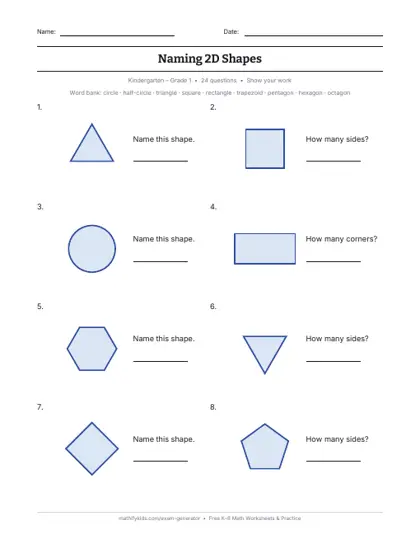
Naming 2D shapes worksheet: printable PDF with an answer key.
Last reviewed
Questions parents ask
What are position words in math?
Words that tell where something is compared with something else: above, below, beside, next to, in front of, behind, inside and between.
What grade learns position words?
Kindergarten, in Common Core standard K.G.A.1.
Do beside and next to mean the same thing?
Yes. Both mean at the side of something and close to it.
Why does my child mix up in front of and behind?
Because these words depend on where you stand. Walk round the object together and say it again from the other side.
When should children learn left and right?
Most children are ready at about 6 or 7, so it usually comes in grade 1.